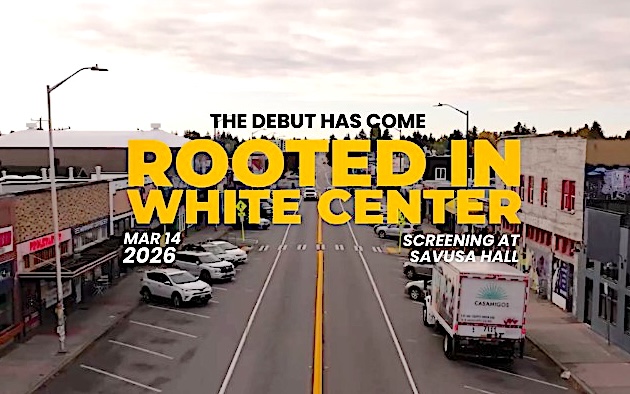
Director, Actor, Writer, Producer Moses Olson and Cinematographer Jonathan Houser teamed up with the help of Post Production Supervisor Ali Mohsenian, and 2nd Unit Camera Allan Jr Estebes to create the documentary series Rooted in White Center for the White Center Community Development Association.The series will debut at the White Center Hub March 14.
On March 14, the community of White Center will gather at the White Center Hub (10829 8th Ave SW, Seattle) at 6:45 PM to witness the documentary series "Rooted in White Center" in its entirety. Produced by the White Center Community Development Association, directed by Moses Olson, and captured by cinematographer Jonathan Houser, the series is more than just a collection of interviews; it is a deep dive into the "rich beauty and the wonder" of a neighborhood often misunderstood by those outside its borders.
A Partnership Built on Heart
The collaboration between Olson and Houser began with a simple "ping" on a Facebook community for Seattle filmmakers. Olson, who had been developing the project for two years, was looking for a Director of Photography (DP) he could trust to go "into the trenches" with him. Among over 60 submissions, Houser’s stood out because of his intent.
"He said something that I will always remember... he said, 'if there’s any way that I can help,'" Olson recalled, noting that Houser wasn't just looking to build a professional reel. "What Jonathan was already doing before he even said yes to this project, he was already meeting with local... shops and doing something out of the goodness of his own heart because he cared".
For Houser, a White Center resident of six years, the project was a "delight beyond delights". "There was a selfishness for me because... the idea of being able to get a look behind and a deeper dive look at how did White Center become the beautiful, diverse, rich place that it is today," Houser shared.
Capturing the "Village" Spirit
The filmmakers approached the project with a specific aesthetic: handheld, intimate, and sincere. Olson avoided "locked off" shots, preferring to get "up close and intimate" to encourage the audience to "lean in". Houser supplemented this vision with a mastery of natural lighting, ensuring the visuals never felt "insincere".
Their primary goal was to "create space" for a community that often feels it has a "chip on its shoulder" due to media portrayals focused on crime. "My intent was to just get out of the way, to let them share what was on their heart," Olson explained.
He described White Center as a "village" where neighbors truly care for one another, noting that "when I hear someone in White Center say we, us, them, they deeply, genuinely believe it".
Mutual Pride and Professional Respect
Throughout the production, a deep professional bond formed between the two creators. Houser expressed immense pride in Olson’s ability to connect with subjects who were initially terrified of the camera. "I’ve never seen a director direct so subtly and accurately as I have Moses," Houser said. "He has a kindness and a gentleness that comes through on screen... to be able to witness that firsthand was such a gift".
Olson was equally effusive regarding Houser’s contribution, crediting the film's stunning look entirely to the cinematographer. "I find this amazing, not just diamond in the rough, just the best person that you could jump into something like this with," Olson said.
He also highlighted the work of post-production supervisor Ali Mohsenian and assistant Allan Jr Estebes, stating, "None of this work I could do without Ali " and "it is all Jonathan and it is all the team... I could not have done it without them".
The External Reputation: A "Chip on the Shoulder"
White Center has long grappled with a reputation shaped largely by media portrayals that emphasize crime, a lack of personal safety, and rowdiness. This external narrative has created what many residents and the filmmakers describe as a "chip on the shoulder," where the community feels constantly defensive against negative stereotypes.
Director Olson noted that this sentiment was a "continual thing" mentioned unprompted by almost every person they interviewed. Because of this, many potential subjects were initially hesitant or even "terrified" to be on camera, requiring the filmmakers to spend days building enough trust to "create space" for their stories to be told.
The Internal Reality: The "Village" Spirit
Contrasting the negative reputation is a community characterized by intense interdependence and grit. Olson and Houser found that White Center operates with a "village culture" that is increasingly rare in modern urban settings.
- Neighborly Care: Houser observed a community of "densely packed individuals" who rely on each other. He described a neighborhood where adults feel a collective responsibility for children, watching over them until they pass from one yard to the next.
- A "Punchy" Identity: Olson described the community as "punchy," composed of mom-and-pop shops that have spent decades fighting against the encroachment of big businesses and corporations to protect their neighbors.
- Deep Belonging: The filmmakers were struck by how residents spoke about the area. Olson noted that when people in White Center use terms like "we," "us," or "them," they "deeply, genuinely believe it," expressing a level of love for their neighborhood that Olson compared to the fervor of sports fans.
A Microcosm of America
The filmmakers view White Center as a microcosm of the broader American experience, representing a collection of beautiful cultures, including strong Cambodian, Vietnamese, and LGBTQ+ communities all packed into a small 16-by-30-block section.
- Diversity as Strength: The area's diversity is seen not just as a statistic, but as an active strength that fosters an "accepting and embracing" atmosphere.
- The Battle Against Displacement: While the community faces the "real threat" of gentrification and displacement, Houser noted a specific distinction: while improved infrastructure from gentrification can benefit everyone, the displacement of long-term residents and immigrant families is the true concern.
The Resolve of the Underdog
Ultimately, the filmmakers found that White Center possesses a unique "resolve and a grit" that surfaces whenever the community is tested. Whether it is the history of youth programs designed to support underserved kids or the current fight to maintain the neighborhood's historical topography, there is a "spirit" of White Center that the filmmakers believe is rooted in empathy and mutual protection. As Houser noted, if one is "blessed to be able to live in this community," there is an inherent responsibility to give back and learn the history of the people who made it beautiful.
Looking Toward the Future
As White Center faces the dual pressures of gentrification and displacement, the filmmakers hope the series provokes "conversation and listening and empathy". Houser believes the documentary serves as a reminder of the responsibility residents have to their community.
"The more we talk about the beauty of White Center the more people when they come to White Center to visit or hang out, they can actually see and appreciate that in a deeper way," Houser said.
The upcoming screening offers the public a chance to see that vision fulfilled, a cinematic tribute to a diverse community that Olson and Houser both hope will foster more conversation and connection.
You can learn more about Moses Olson HERE.
You can learn more about Jonathan Houser HERE.


