
PAUL DORPAT, 1938-2026
PAUL DORPAT, 1938-2026
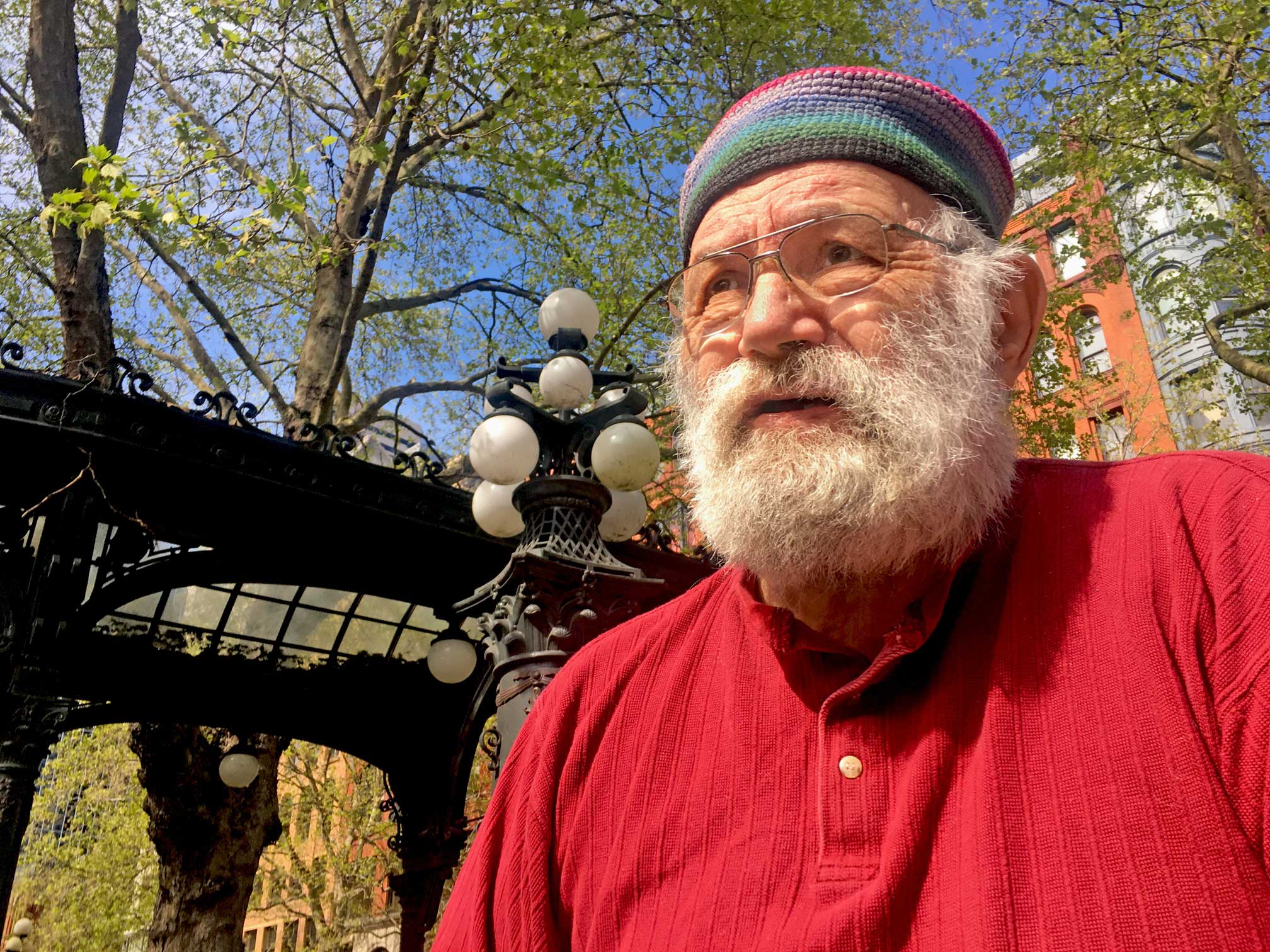
Paul Dorpat in Pioneer Square.
Photo by Clay Eals
Thu, 05/28/2026
By Jean Sherrard and Clay Eals
Seattle’s leading public historian has officially joined his city’s past.
Reproduced with permission from Seattle Now and Then. See more photos and comments there.
Paul Dorpat, who helped shape Seattle’s countercultural moment in the 1960s before spending four decades excavating its history for anyone willing to look, died in his sleep Wednesday (May 27). He was 87.
His route to establishing himself as the city’s reliable weekly photo-historian in the “Now & Then” column in the Sunday magazine of The Seattle Times meandered first through alternative media and theatrics.
Born Oct. 28, 1938, in Grand Forks, N.D., Dorpat came west as a child when his father, the Rev. Theodore Erdman Dorpat, accepted the pastorate of Spokane’s First Lutheran Church. He came of age in that city before enrolling at Whitworth College, where his intellectual restlessness found early footing — and where his resonant basso voice earned him a choir scholarship.
Graduate school took him first to Claremont College in California, “the Oxford of the West,” where he pursued philosophy until illness intervened. He recovered, regrouped and continued his studies at the University of Washington — though he would never complete his doctorate. He didn’t need it.
He moved to Seattle to become an artist but became something larger.
In Seattle, Dorpat fell in with the ferment of the University District, teaching at the Free University and absorbing the energies of a city in the middle of remaking itself.
In 1967, he co-founded The Helix, Seattle’s landmark underground newspaper. The first 1,500 copies rolled off the press on March 23 of that year, selling for 15 cents. The paper billed itself as “a community newspaper in the human sense.”
With Dorpat as its self-described “benevolent sheriff,” The Helix survived war protests, police crackdowns and wiretaps before publishing its final issue on June 11, 1970, with this valediction: “It is time. We are tired. Three years is a long time for an experiment to last.”
The late Tom Robbins, Northwest novelist who ran in the same circles, observed that Dorpat was never quite like the others around him.
“Even in the ’60s, Paul may have had the point of view of a sociologist or historian,” Robbins said. “He was most interested in observing and reporting the phenomenon. He participated, but more at a planning level, bringing people together to make things happen.”
He was, Robbins noted, neither a doper nor a drinker — and consequently less obtuse. His Helix co-founder Walt Crowley observed that Paul preferred writing love poems to Tina Turner over slugging out essays condemning the Vietnam War.
Along the way, Dorpat produced one of the era’s more memorable acts of civic theater: the Piano Drop, a fundraiser for The Helix and KRAB radio in which a piano was released from a helicopter over a field outside Duvall. The piano missed its target — a woodpile — and landed in the soft grass just beyond the crowd. “A piano flop,” Dorpat called it.
Among those who donated their services to the drop was the rock band Country Joe and the Fish, fronted by Country Joe McDonald — who became one of Dorpat’s closest friends from early days, and who died just two-and-a-half months before him.
The same spirit animated the Sky River Rock Festival and Lighter Than Air Fair, which he helped produce in rural Sultan in 1968 — a year before Woodstock and in many ways its spiritual precursor: a multi-day gathering on a farm, drawing many of the same artists, and the same restless crowds and conviction that music could be a form of community.
But his most enduring act was more extended.
It started with a detailed examination of the early 20th-century Denny Hill Regrade for the weekly Seattle Sun in 1978, followed by his popular sepia-toned “294 Glimpses” booklet for the Mayor’s Small Business Task Force in 1981.
“Each of these images is in some way quite precious,” Dorpat said at the time. “Sometimes you see values that have been lost. But, happily, you see examples of things improved. It makes you respect the human effort that went into this city.”
Priced at $2.94 (“a penny per glimpse”), the publication eventually sold 40,000 copies, leading directly to the brand for which he is best known.
On Jan. 17, 1982, Dorpat launched the “Now & Then” column in The Seattle Times, a feature that ran under his stewardship for 37 years — concluding in 2019, after more than 1,800 installments — and reframed how this city understood itself.
“Without story,” he once said, “history is a recluse refusing to invite you in.”
The column’s method was elegant in its simplicity: pair a historical photograph with a contemporary one taken from the same vantage, and let the comparison do the talking. Change, loss and survival, visible all at once.
“It’s like hide and seek,” he said. “That’s a really deep motive in all of us, to figure out how things are hidden, where things have changed, what things are revealed.”
He also was the author or co-author of a shelf’s worth of Seattle books, among them the three-volume “Seattle Now & Then” series, “Building Washington” — co-written with his wife, historian Genevieve McCoy (who survives him), and recipient of the 1999 Washington State Book Award — and “Washington Then & Now.”
He received the Lifetime Achievement Award from the Pacific Northwest Historians Guild in 2001 and the Golden Umbrella Award at Bumbershoot that same year.
Dorpat also was one of three co-founders of HistoryLink, the online encyclopedia of Washington state history — alongside Marie McCaffrey and the late Walt Crowley — a fitting institutional expression of his belief that history belonged to everyone, not just to scholars behind closed doors.
McCaffrey once observed of her co-founder: “Paul floats in and out of time, past and present. When he is around, his presence actively slows one’s metabolism. He imparts a calmness, a sense of serenity.”
That belief was itself a kind of mentorship.
Dorpat had been shaped by the great Murray Morgan — historian, storyteller, and the writer who gave “Skid Road” and a dozen other Seattle books their lasting voice — and he passed that formation on generously.
In his later years, with the passing of Morgan and Times columnist Emmett Watson, Dorpat had graduated to elder among Seattle historians. When a colleague suggested the role carried new responsibilities — that he was no longer the hippie — he was characteristically undeterred.
“Responsibility is more the language of obligation,” he said. “I think we’re more enthusiasts. The language of joy is more appropriate to what we do.”
Pre-COVID, Dorpat donated his formidable collection of more than 309,000 historical photos, negatives, videos and other items to Seattle Public Library, whose free public access, he noted, emulates his vision of “vox populi” (the voice of the people).
Knute Berger, Feliks Banel, David Williams and a long roster of other historians, journalists and curious citizens found in Dorpat an ally who took their questions seriously, offered what he knew and pushed them to go further.
He was, his colleagues said, constitutionally allergic to a certain word. Paul Dorpat bridled at “iconic” — a term he watched inflate and hollow out over the decades until it meant almost nothing, applied equally to sandwiches and symphonies, storefronts and statesmen. If something had to be called iconic, he reasoned, it probably wasn’t. The word had been cheapened beyond rescue.
Yet, if the word is to be reserved for lives of uncommon breadth, curiosity and consequence, then Dorpat is the human for whom it was made — even though he would have sloughed it off to focus on the substance of his quest.
“History is delightful,” he said. “It’s understanding. It’s actually the truth if you do it right, and the truth is progressive. It always is.”
More demurely, he often intoned, “I am like an enchanted tourist in my own city.”
Jean Sherrard and Clay Eals are contributing writers for the “Now & Then” column of Pacific NW magazine of the Seattle Times.
THINGS TO COME
A memorial gathering to celebrate Paul’s life and legacy is being planned. Details will be announced as arrangements take shape.
