
Sound Transit Board approves updated ST3 plan, prioritizing West Seattle while Ballard faces funding gap
Sound Transit Board approves updated ST3 plan, prioritizing West Seattle while Ballard faces funding gap
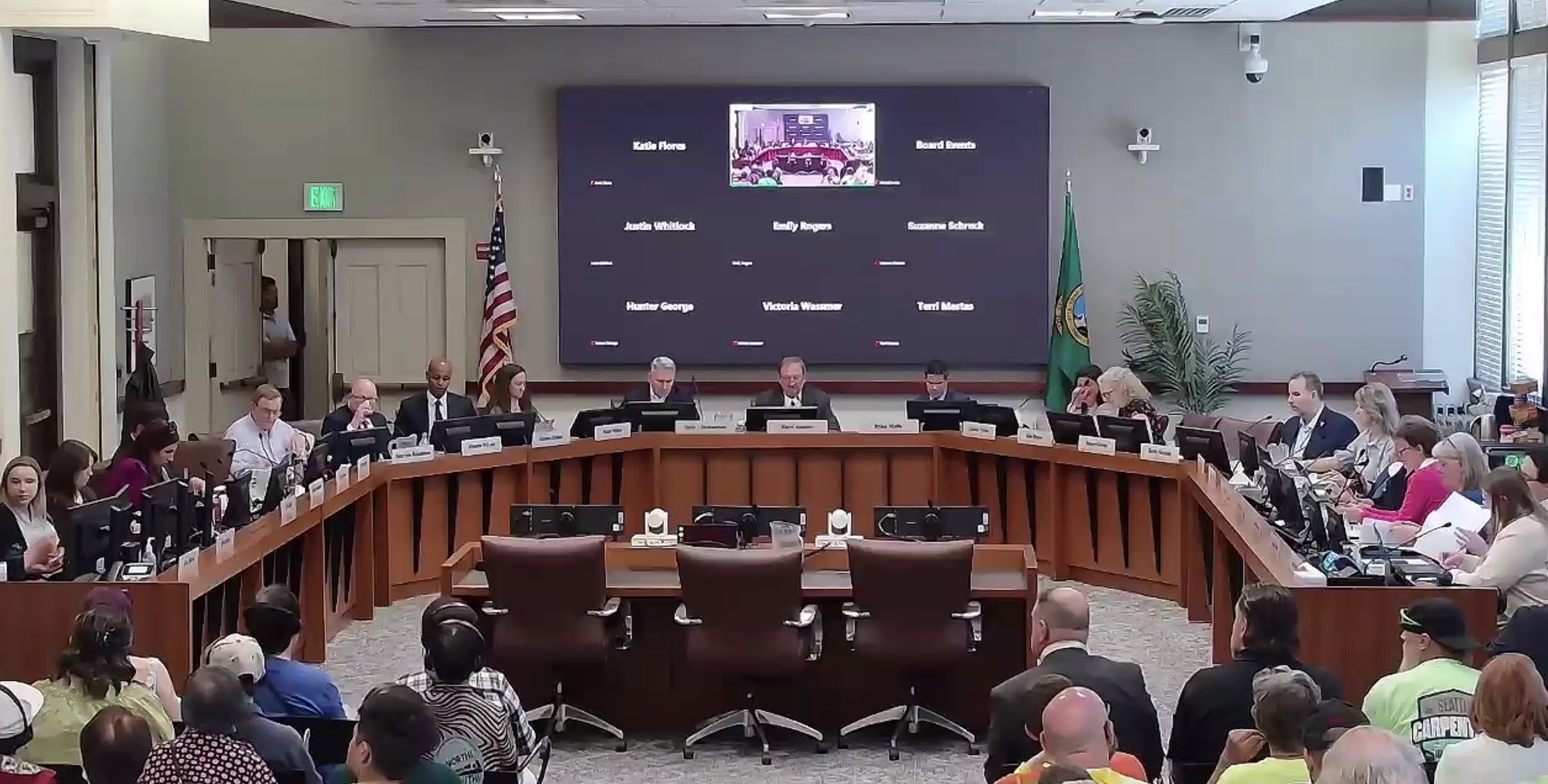
The Ruth Fisher Boardroom was packed with Sound Transit Board members, staff and people anxious to share their opinions about the fate of light rail in Seattle. Ultimately the Board voted to approve a restructured Sound Transit 3 (ST3) system plan.
Thu, 05/28/2026
Facing a massive $34.5 billion long-term funding gap, the Sound Transit Board of Directors voted in a marathon six hour meeting on May 28, 2026, to adopt a restructured Sound Transit 3 (ST3) system plan.
The meeting, characterized by impassioned debate and dozens of public testimonies, centered on how to maintain regional connectivity while grappling with a "hard truth": the original ST3 delivery schedule is no longer affordable due to inflation, rising construction costs, and higher borrowing rates.
The Board's decision creates a tiered project list that greenlights the West Seattle Link Extension for immediate progress while leaving the construction of the full Ballard Link Extension currently unfunded, though design work for Ballard will continue.
Resolution R2026-11: Redefining the ST3 System Plan.
The centerpiece of the meeting was Resolution R2026-11, which establishes an "adaptive program management framework" to monitor and adjust the ST3 program as financial conditions change. The resolution categorizes projects into those that are "fully or partially funded" and those that are "unfunded" or "deferred" until new resources are identified.
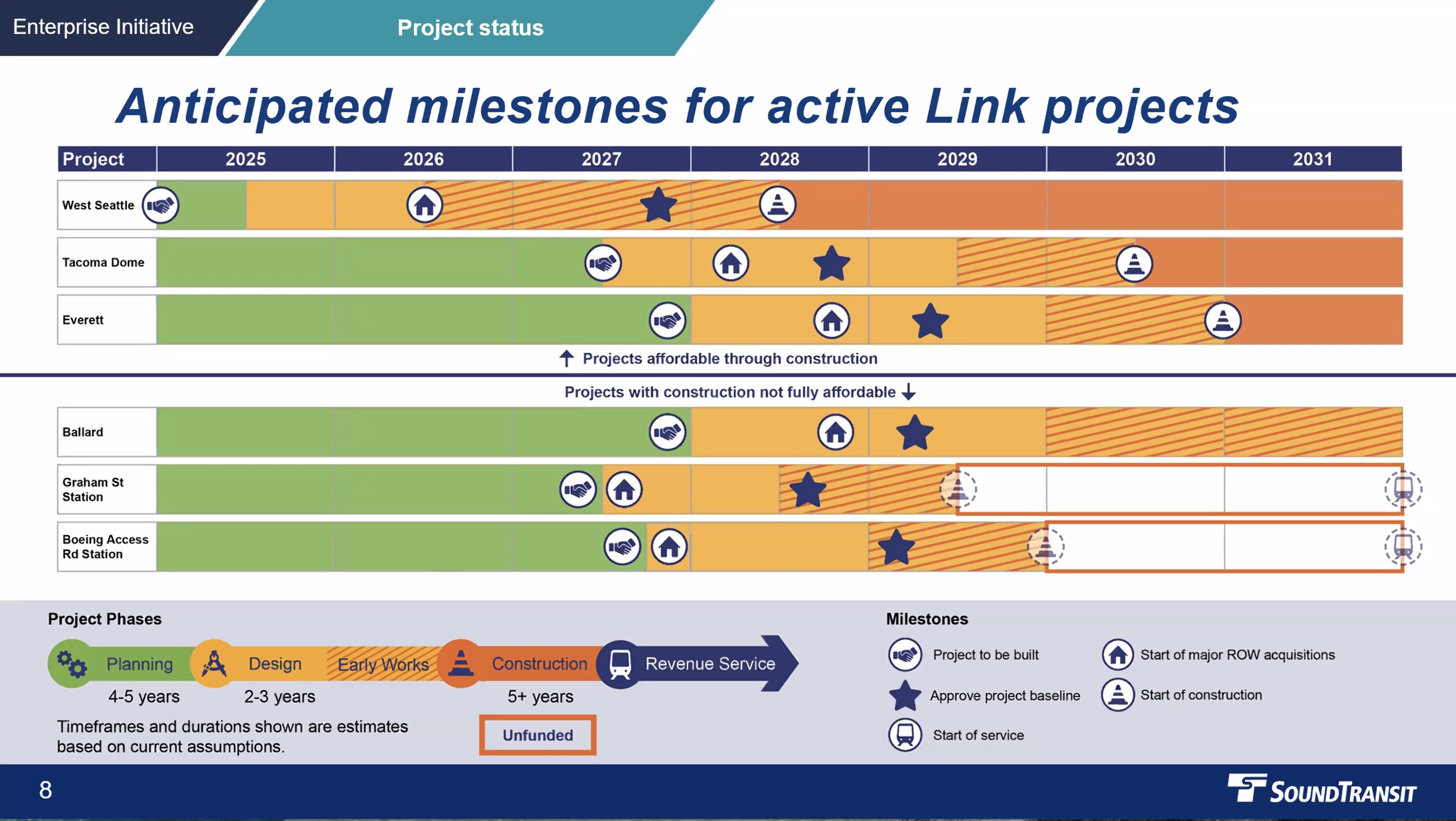
The following projects are fully funded and will be completed through construction:
• Tacoma Dome Access Improvements
• West Seattle Link Extension, no Avalon Station
• Renton Transit Center Parking Garage
• Tacoma Dome Link Extension
• Everett Link Extension, phase 1
• Everett Link Extension, phase 2
• Ballard Link Extension, initial segment to Seattle Center
• TCC Tacoma Link Extension (now 2043)
• South Kirkland – Issaquah Link (now 2050)
• Link Operations and Maintenance Facility South
• Link Operations and Maintenance Facility North
• Graham Street Station
• Sounder Maintenance Base
The following projects are partially funded and will be completed through planning and design:
• Ballard Link Extension, final design phase
• Boeing Access Road Station, final design phase
• Sounder South additional trips (partially funded)
• DuPont Sounder Extension, planning phase
• Regional Parking Fund
• ST Express Bus Base (partially funded)
• High-capacity transit corridor studies/ST4 planning (partially funded).
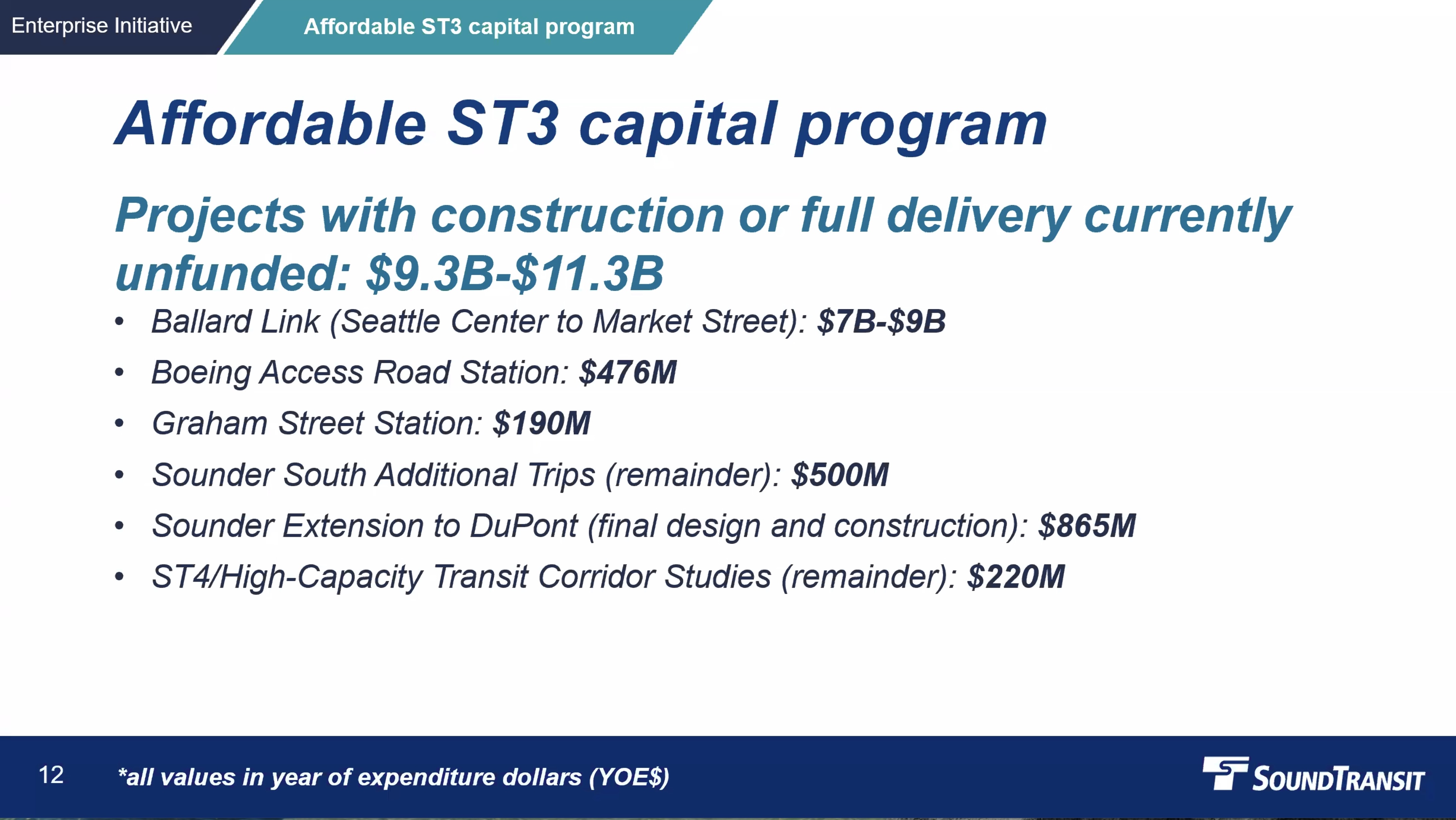
Projects not currently affordable within existing resources
The agency will continue to pursue additional funding for the following projects:
• Ballard Link Extension, Seattle Center to Market Street
• Boeing Access Road infill station
• Sounder additional trips
• DuPont Sounder Extension, final design and construction
• High-capacity transit corridor studies/ST4 planning
Projects deferred until resources are identified
• Tacoma Dome Link Extension Parking
• Everett Link Extension Parking
• Stride Bus Rapid Transit Parking
• North Sammamish Park-and-Ride
• Edmonds and Mukilteo Parking and Access Improvements
• Bus on Shoulder project
• SR 162 Corridor Improvements
• Sounder South Platform Extensions
• Sounder South Station Access Improvements
• ST Express Bus Base, remainder
The Board directed agency staff to develop and implement an adaptive program management plan and a project delivery framework by the end of 2026.
This encompasses transparent program management at an enterprise scale to build in a disciplined accountability approach. The goal of program management will be to identify and incorporate cost savings in capital projects, keep the Board informed about project risks, schedule risk and oversight of project contingencies. It formalizes specific activities to enable cost savings, accelerate project delivery, and develop additional financial resources to deliver the full ST3 program.
The project delivery framework will work to ensure that each project remains affordable and that the Board retains clear visibility and decision-making authority at key project milestones.
Details of the system plan, as well as the adaptive program management plan and project delivery framework, are included in R2026-11
Impact on West Seattle
The West Seattle Link Extension emerged as the project in the "forefront," remaining on its current schedule with a projected opening in 2032. The Board’s action allows the agency to move into final design and property acquisition for the project.
Impact on Ballard
While the segment from downtown to Seattle Center is considered funded, the construction of the Ballard Link Extension from Seattle Center to Market Street remains in the "unfunded" category. However, the Board adopted Amendment 11, which commits the agency to pursuing 100% design for the full Ballard line and exploring "extraordinary innovations" to close the funding gap. In a significant victory for transparency advocates, the Board also passed Amendment 12, requiring the agency to provide a projected opening date or date range for Ballard by August 2026.
Key Outcomes for South Seattle and Tukwila
Through successful amendments, the Board voted to bring the Graham Street Infill Station back into the "affordable" column, fulfilling a long-standing promise to the Rainier Valley. Additionally, the Boeing Access Road Station was granted $10 million for interim transit mitigation while staff develops a plan for its eventual construction.
Resolution R2026-12: New Revenue Through Rental Car Taxes
The Board also passed Resolution R2026-12, authorizing the remaining available rental car sales and use tax authority. This measure increases the tax rate to 2.172% beginning in 2027, which is expected to generate approximately $300 million over the life of the financial plan. Nearly 70% of this new revenue is slated to benefit the South King subarea.
Voices from the Board
The meeting featured intense deliberations among regional leaders. Board Chair Dave Somers opened the session by acknowledging the difficult trade-offs required. "I’ve said before that how we grow as a region matters... The original delivery schedule is no longer affordable. That's a hard truth we've been facing," Somers stated. He later added, "Nothing in this proposal represents a decision to permanently eliminate the voter approved vision. Nothing. The proposal does not cancel ST3. It preserves it".
Board Member and Seattle City Council member Dan Strauss, a tireless advocate for the Ballard extension, expressed frustration over the lack of service to his district. "Ballard deserves a date... Transparency builds trust no matter how bad the news is," Strauss argued during the debate over Amendment 12. He noted the urgency of the situation, observing that during the long meeting, "the last direct bus for the day that goes to Ballard from downtown... left five minutes ago".
Board Member and King County Council member Teresa Mosqueda celebrated the progress for West Seattle and South Seattle. "The West Seattle Link Extension is the furthest along in design and ready to build. We cannot afford to add more delays and this proposal greenlights it for construction," she said. She also emphasized the importance of equity, stating, "I’m very thankful that we are delivering on a promise that was made to the Rainier Valley community members through [the Graham Street] amendment".
Board Member and Seattle Mayor Katie Wilson echoed the need for momentum. "Passing this project now again is not the end, it is the beginning and it allows us to actually move forward with the real work of building out our light rail system," Wilson said. However, she remained firm on prioritizing rail over other infrastructure, noting, "we are Sound Transit not sound parking," while opposing a parking garage in Renton.
Public Comment: "Build the Damn Trains"
The Board heard from dozens of residents, many of whom wore colorful shirts and carried signs demanding that the agency fulfill its promises.
• Jorge Baron, King County Councilmember: "When voters... overwhelmingly supported ST3, they were supporting the promise that high-capacity transit would connect Ballard and Interbay with the region... Failing to deliver this connection will hurt the whole network".
• Violet Lavatai, Graham Street advocate: "Our communities, it's the most diverse community in our city and we rely on transit... All of our city depends on this".
• Kirk Hovven Cottter, Transportation Choices Coalition: "The work isn't finished until every light rail project is built... Together we will build the damn trains".
• Ratta, Chinatown International District organizer: "The neighborhood aunties would like to see Graham Street and South Dearborn Street dig ready in their lifetime".
• Tim Eyman, activist: "The problem with Sound Transit is you've now run out of our money. And now the lies have caught up with you... instead of listening to the people, you turned around and sued the voters".
The final vote for the updated system plan (Resolution R2026-11) passed 16-2, with Board Members Dan Strauss and Claudia Balducci voting no. Resolution R2026-12 passed with 17 affirmative votes.
