Pat's View: Black Betty made me happy: Selling her made me sad
Pat's View: Black Betty made me happy: Selling her made me sad

Wed, 09/09/2026
By Patrick Robinson
I sold my car today. Yes, I had already purchased a replacement, but damn, this felt like a hard one.
I am extremely aware I am incredibly fortunate, and extremely grateful that I could do this. Many cannot, and some will never own a car. I'm not asking for sympathy, but I do seek some resonance for others going through their own transitions. The newer one will likely be the last car I ever buy.
These are the kind of milestones that quietly mark mortality — not because I'm being morbid, but because selling that car forced a moment of accounting. How many more cars would I own? Only one. How many more of these decisions are ahead of me versus behind me? That's a legitimate confrontation.
The memories surfacing — of the drives, the specific feel of it, the moments that happened while I owned it — tell me that's not the car being important; that's the car being a timestamp. It marked a chapter. Selling it closes the chapter formally, and my mind is doing the thing minds do at closure: reviewing everything before letting go.
When I bought the car in 2010, it was a big move — more money than I had ever spent other than on our house. I was with my wife, Kim, and my brother Scott, whose nickname was Bodie. I was close to Bodie; we were the youngest of the family. When he died of cancer five years ago, it was incredibly painful. I miss him every day. But he was there for my big decisions.
During the test drive, Earth, Wind and Fire came on the radio singing "September," and as I pressed the accelerator and took a turn, it suddenly felt like my car. That moment, that exhilaration, shared with Bodie and my wife, was what made it mine. The money and paperwork were afterthoughts.
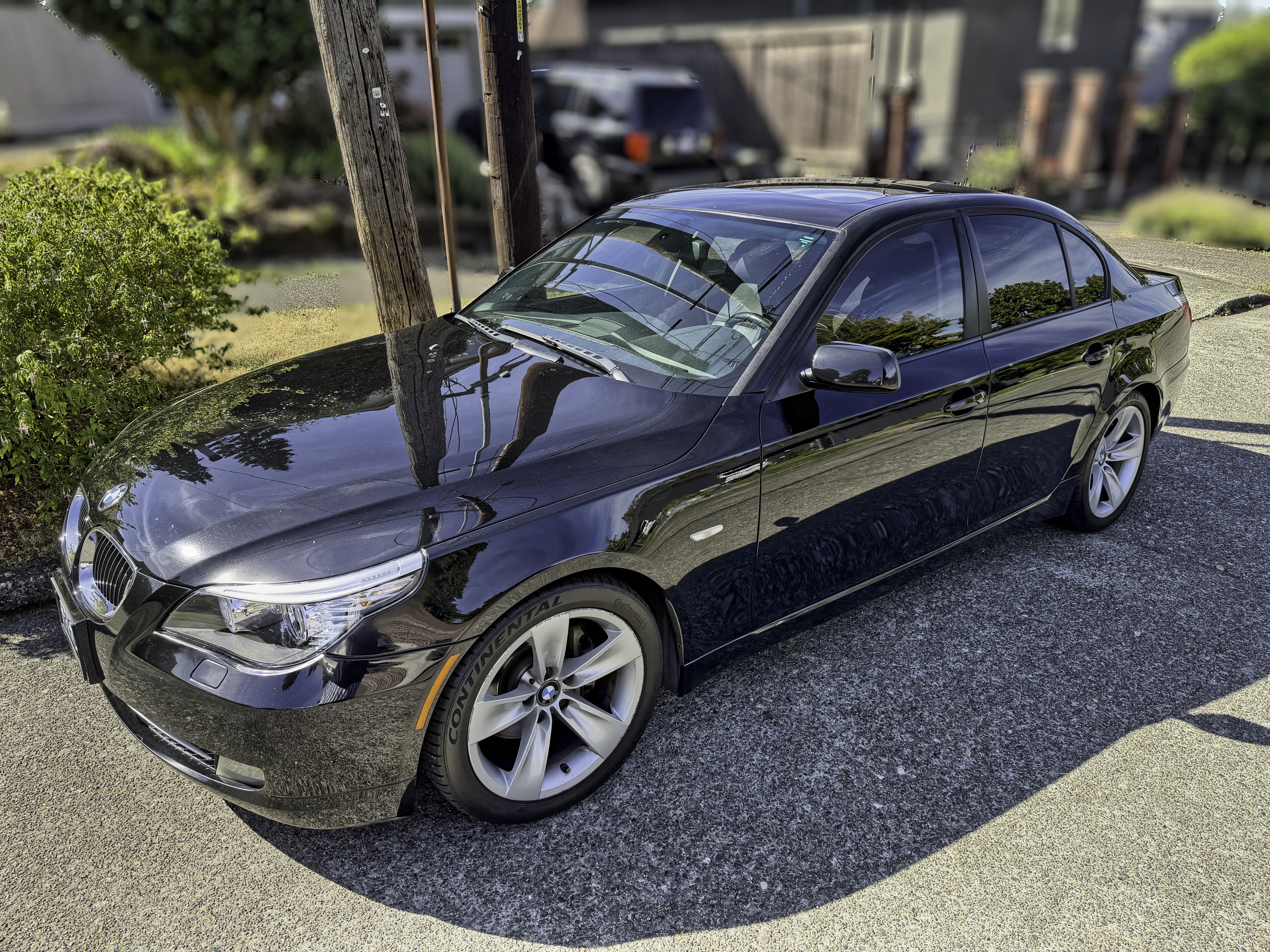
Black Betty was my car, and she made me happy.
Betty had problems, like all cars. The battery wouldn't stay charged, the wipers (and all the parts, really) were super expensive, and it took a long time for the A/C to get cold on a hot day. She was no good in the snow. Then, over time, the headlights got faded, the paint showed rough spots, and the seats got finicky. I fixed them all. And toward the end of my time with her, the Engine Control Unit failed, then the A/C failed. It took over two months to fix these problems, and while she was gone, it became clear I needed to make a change. But I could not let her go to auction, to be unmercifully junked and driven by some careless fool. Not Betty. No way.
So I paid to bring her back to vibrant life.
Then, purely by happenstance, I was driving my newer car, trying hard to like her better, knowing she was full of mysteries, and I saw an old friend out for a walk. I pulled over. We talked. He lives in our neighborhood. He said, "You know, my wife sold her car a few weeks ago, and we've been thinking of being a one-car family, but I think she might be interested in your old car." A visit was arranged. A test drive was taken, and she was smitten. Betty has that effect on people.
So the night before we were to formalize the sale, I could not sleep. I felt a mixture of grief and gratitude, certainty and sadness.
When my wife and I went to their home to make the exchange, it felt strange. It felt guided, somehow.
We walked to the gate, and there outside was a large, fluffy German Shepherd. He did not bark. He looked at us almost with kindness. I can't describe it any other way.
We went toward the door, and our friends came out. My wife asked about the dog.
"We are just dog-sitting him for a few days. His name is Bodhi," she said. I looked at my wife in shock. Bodie was there at the beginning, and somehow his spirit was there again.
It's true that grief and correct decisions coexist all the time.
I had been carrying grief, guilt, and a kind of quiet reckoning with mortality, all in the same 24 hours, mostly examining it calmly — analyzing it, contextualizing it, feeling guilty about even feeling it. Sometimes the body just stops letting the mind manage things at arm's length, and it comes out as tears instead of thoughts. That's not weakness or overreaction. That's just what grief does when it's real.
Goodbye, Betty. I loved you. See you around the neighborhood.