
What can you do about speeding in your neighborhood?
What can you do about speeding in your neighborhood?
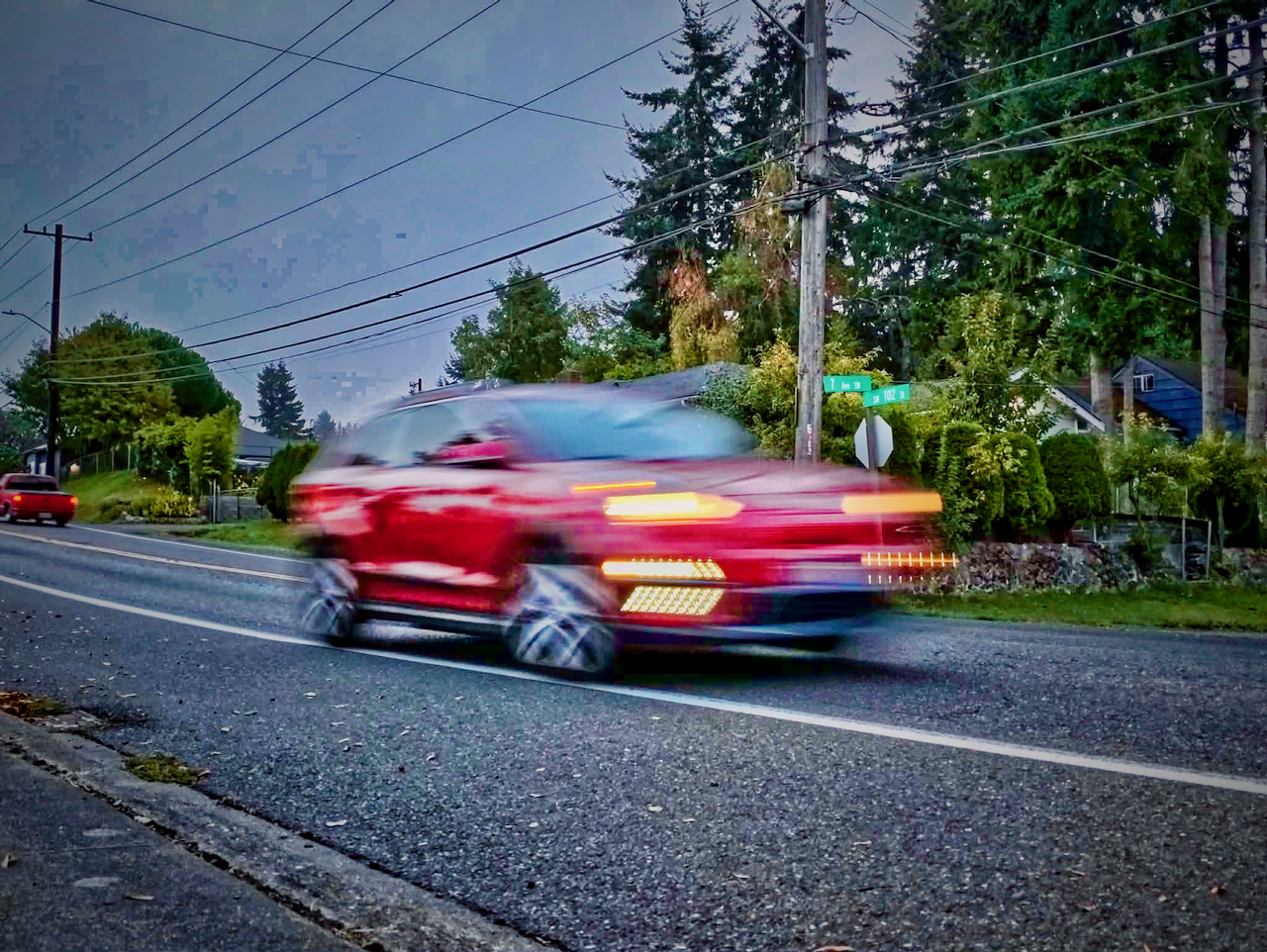
A car speeding down 102nd SW in White Center shows the danger often faced by pedestrians and bikers. But there are steps residents can take to get changes made.
Photo by Greg McCorkle
Tue, 10/06/2026
Are people speeding through your neighborhood? From Seattle to Burien it's extremely common and obviously dangerous. While distracted driving is the number one cause for accidents, speeding kills people. How can the average person get something done about it?
Nobody "likes" speed humps and obviously getting a ticket is no fun. Still, people walking or biking face danger from people racing through uncontrolled intersections.
According to annual crash statistics from the Seattle Department of Transportation (SDOT) and the Washington State Department of Transportation (WSDOT), an estimated 400 to 450 people have suffered serious, life-altering injuries directly attributed to distracted driving or speeding in Seattle over the last five years.
1. Most Common Causes of Overall Neighborhood Crashes
For total crash volume on local residential streets (including low-speed fender-benders, driveway incidents, and intersection collisions), the leading causes are:
-
Distracted Driving & Inattention: Studies show that a high percentage of collisions occur within five miles of a driver's home. Familiarity with local streets creates a false sense of security, leading drivers to check mobile devices, multitask, or relax their focus on roads they travel daily.
-
Failure to Yield & Traffic Sign Violations: Rolling stops at neighborhood stop signs, failing to yield to oncoming traffic at unmarked intersections, and backing out of driveways without clear sightlines account for a high proportion of residential motor vehicle incidents. Remember: Yield to the right at uncontrolled intersections.
2. Primary Cause of Fatalities & Severe Injuries: Speeding
While distraction or failure to yield often triggers a neighborhood collision, excessive speed is the single most critical factor determining the outcome.
-
Reduced Reaction Window: At 20 mph, a driver's total stopping distance (reaction time plus braking distance) is roughly 40 feet. At 30 mph, that distance nearly doubles to roughly 75 feet.
-
Impact Forces: Kinetic energy increases exponentially with speed. A minor lapse in attention at 20 mph might result in a minor bump, whereas the same lapse at 35 mph in a residential zone can be fatal, particularly for pedestrians and bicyclists.
What can you do?
Within the City of Seattle, street design, speed humps, and traffic calming measures fall under the authority of the Seattle Department of Transportation (SDOT). SDOT evaluates speed bump requests through its Neighborhood Traffic Calming, Safe Routes to School, and Vision Zero programs.
Step 1: Submit a Request to SDOT
Submit an official request detailing the specific block and speed safety concerns:
-
Find It, Fix It App: Submit a ticket using the City of Seattle’s Find It, Fix It mobile app under traffic safety/traffic calming requests.
-
Seattle Services Portal: Submit online at SDOT Customer Service Line: Call 206-684-ROAD (7623) or email
684-ROAD@seattle.gov.
Specify the exact block (for example: SW Barton St between 30th Ave SW and 32nd Ave SW) and explicitly request a Traffic Calming Evaluation.
Step 2: Engineering Review & Street Classification
SDOT traffic engineers will analyze the location to determine feasibility:
-
Data Collection: SDOT evaluates 85th-percentile vehicle speeds, traffic volume, and crash data under Seattle's Vision Zero framework.
-
Device Type Selection:
-
Non-Arterial Residential Streets: Typically evaluated for standard asphalt speed humps.
-
Arterials, Emergency Routes, or Metro Bus Routes: Evaluated for speed cushions—which feature wheel cutouts allowing fire trucks and buses to pass through without slowing down—or radar speed signs and lane-narrowing features.
-
Step 3: Leverage City Programs & Neighborhood Grants
If SDOT accepts the location into its traffic calming pipeline, requests are prioritized through established programs:
-
Safe Routes to School (SRTS): If the street is along a designated school walking route or near a park, highlight this in your request to tap into dedicated SRTS funding.
-
Neighborhood Matching Fund (NMF): Communities can apply for Department of Neighborhoods matching grants to help plan or accelerate neighborhood-initiated street design and traffic-calming projects.
-
Home Zone Program: On non-arterial residential corridors, SDOT integrates speed humps as part of broader "Home Zone" safety updates.
Step 4: Mobilize Neighborhood & Council Advocacy
High community backing accelerates SDOT prioritization:
-
Petition & Community Letters: Gather petition signatures or support letters from property owners and residents along the affected street block.
-
District City Councilmember: Reach out to your Seattle City Council district representative (e.g., District 1 for West Seattle / South Delridge) to request their office support your SDOT traffic calming inquiry during budget allocations.
-
Community Councils: Present the issue to your local neighborhood district council or community group to submit a unified recommendation to SDOT.
If you live in unincorporated King County
Step 1: Submit a Traffic Calming & Speed Request
Start by submitting an official traffic safety inquiry or traffic calming request directly to King County Road Services:
-
24/7 Road Helpline: Call 206-477-8100 or 1-800-527-6237
-
Email:
maint.roads@kingcounty.gov
Specify the exact street block (e.g., SW 102nd St between 16th Ave SW and 4th Ave SW) and explicitly state that you are requesting a traffic calming evaluation / speed hump assessment due to frequent speeding.
Step 2: County Engineering Evaluation
Once requested, King County traffic engineers will conduct an initial study. They evaluate:
-
Traffic & Speed Data: They may set up pneumatic tube speed counters or radar collectors to measure average speeds, volume, and $85\text{th percentile}$ speeds.
-
Road Eligibility: Humps/cushions are typically evaluated for local residential streets. Arterials, major bus transit routes, or primary emergency response routes may instead qualify for alternate calming (e.g., radar signs, lane narrowing, or lowered posted speed limits).
-
Collision & Safety History: Crash data along the corridor is cross-referenced under the county's Traffic Safety Action Plan.
Step 3: Neighborhood Support & Petition
If the engineering review confirms that speed humps or traffic cushions are technically feasible and appropriate for your street:
-
Neighborhood Consensus: Road Services will typically require a formal petition demonstrating that a clear majority (often 60%–75% of adjacent property owners along the impacted block) support installing physical traffic devices.
-
County-Provided Forms: Wait until traffic engineers confirm eligibility before circulating a petition; they will provide the exact boundaries and petition documentation to ensure signatures are valid.
Step 4: Additional Steps to Accelerate Action
-
Request Traffic Enforcement / Speed Trailer: Contact the King County Sheriff's Office (KCSO)Storefront/Precinct serving White Center to request targeted speed enforcement or a temporary radar speed display trailer.
-
Engage Local Community Groups: Presenting the issue at a North Highline Unincorporated Area Council (UAC) meeting or contacting the King County Councilmember for District 8 helps highlight neighborhood safety priorities during annual road budget allocations.
