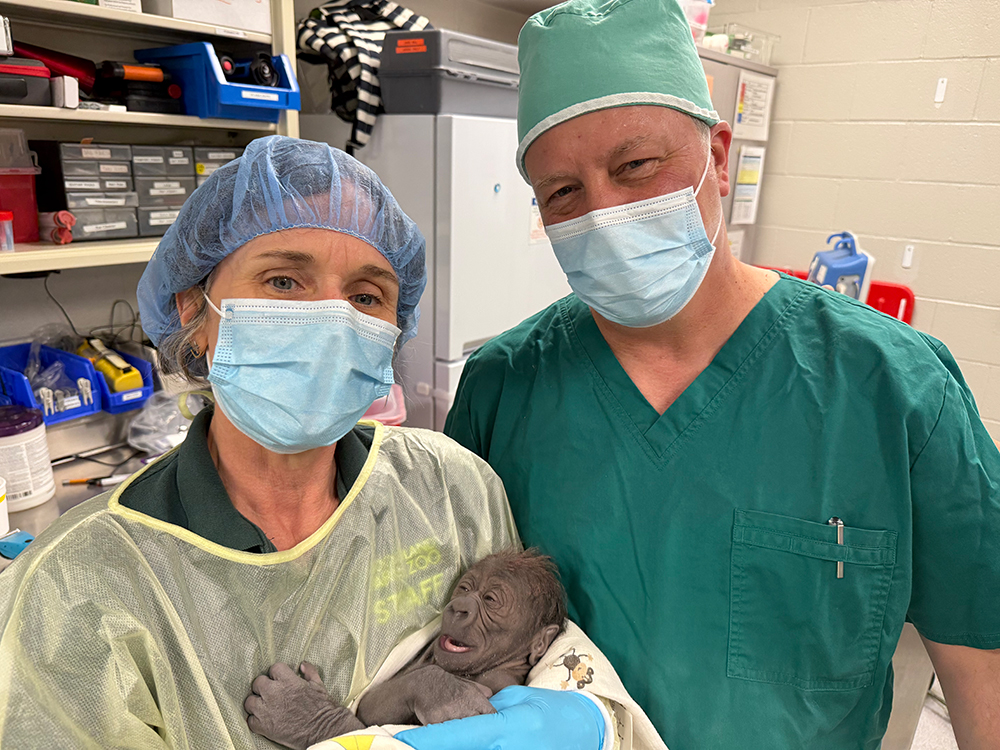
Obstetrical team performs rare C-section on gorilla Olympia to deliver baby
Obstetrical team performs rare C-section on gorilla Olympia to deliver baby
New gorilla mom Jamani steps in to help care for Olympia’s baby
Neonatologist Dr. Andrew Beckstrom (left) and sonographer Dr. Sachita Shah (right) examine the newborn baby boy of western lowland gorilla Olympia at Woodland Park Zoo.
(Nichole Hamilton/MFM Sonographer)
Tue, 05/26/2026
Information from Woodland Park Zoo
Woodland Park Zoo’s pregnant gorilla Olympia, five days past her due date, gave birth to a 5.4-pound boy on Sunday, May 24, at 1:44 p.m. (PDT) by emergency C-section performed by a local medical team who typically works on humans.
This is the second baby for the western lowland gorilla; the gestation period for gorillas is eight and a half months. On average, full-term infant gorillas weigh 4 pounds.
“Thanks to the teamwork of the human doctors, veterinarians, and gorilla care team, Olympia and her baby are in good health and doing well. Given the positive indicators so far, we remain optimistic but are also cautious because the situation is very fluid and fragile,” said Martin Ramirez, Curator of Mammalogy at Woodland Park Zoo.
Last week, Woodland Park Zoo heralded the birth of another gorilla, newly confirmed as a boy, born May 18 to Jamani (jah-MAW-nee). Nadaya (nuh-DIE-yuh) is the first-time dad of both newborns. Like Jamani, the newborn represents the second baby for Olympia. The two moms each gave birth to a son weeks apart in 2012 when they lived together at North Carolina Zoo and successfully raised them together.
Of the 17 gorilla births at Woodland Park Zoo, this is the first gorilla born via C-section in its 126-year history. C-sections on gorillas are extremely rare, with under a dozen performed globally.
An ultrasound performed on Olympia over the weekend indicated complications. “Due to this, we made the critical decision to put Olympia under anesthesia and call in a team of medical consultants to assess the fetus and determine the best intervention,” explained veterinarian Dr. Tim Storms, Director of Animal Health at Woodland Park Zoo.
After Olympia was anesthetized and transported by zoo ambulance to the zoo’s veterinary hospital, the obstetrical team performed an examination. Together with Dr. Sachita Shah, a sonographer with Butterfly Network, they performed an ultrasound and determined that there was decreased amniotic fluid combined with an incompletely dilated cervix, which indicated a non-productive labor. “This meant that Olympia would not be able to deliver her baby without our help, so we made a critical decision to deliver the baby via cesarean section. We had a highly skilled and compassionate volunteer obstetrical team that joined our veterinary team to perform the surgery and deliver a healthy baby boy,” said Storms.
The surgical team from Swedish Medical Center included Dr. Emily Norland, Chief of OBGYN; Dr, Suzanne Peterson, Program Director of OBGYN Residency Program; and Lily Pang, RN. Once delivered, the baby was examined and stabilized by Dr. Andrew Beckstrom, neonatologist and Medical Director of Swedish Medical Center NICU, Dr. Shah and the zoo’s veterinary team with support from King County Medic One.
"Having the ultrasound information from the Butterfly to follow the changes in amniotic fluid, positioning and fetal heart rate that indicated the need for a critical intervention allowed us to share information and mobilize quickly,” said Dr. Sachita Shah, Butterfly and UW Emergency Medicine. “When the baby was born, we used the probe to guide neonatal critical care and resuscitation. It was amazingly well coordinated to have everyone seeing the same information on the screen to guide shared decision making with Woodland Park Zoo’s animal health and gorilla care teams.”
Drs. Norland, Peterson, and Shah, with Nichole Hamilton, Sonographer at MFM Specialists of Puget Sound, had monitored the baby’s development throughout the pregnancy, including ultrasound exams every two weeks, which was instrumental in being able to note the adverse changes and quickly respond. “We’re extremely grateful that this medical team provided their expertise for Olympia and her baby and performed this rare surgical procedure,” added Storms. “I also feel very fortunate to work with our dedicated and talented gorilla caretakers who skillfully trained Olympia to voluntarily participate in these ultrasound exams. None of this advanced care would be possible without them.”
“Working with the team at Woodland Park Zoo to care for Olympia and Jamani is a true privilege and honor. Obstetrics is a team endeavor. The collaboration with the gorilla keeper and veterinary staff enabled this optimal coordinated response to a critical situation,” said Dr. Emily Norland, Chief of OBGYN at Swedish Medical Center. “I’m so grateful for the generosity of my colleagues on the medical team who immediately responded, bringing their clinical expertise, skills, and heart for Olympia and her baby.”
For the baby’s first night, a gorilla keeper and veterinary technician provided round-the-clock care in the off-view gorilla den next to Olympia as she recovered from anesthesia. “Keeping the baby in close proximity to Olympia allowed her to see, hear and smell her baby the entire time. Because Olympia had just undergone a major surgical procedure, we wanted to let her rest the first night without the need to care for her baby,” said Ramirez. “We’ll continue to monitor Olympia for any complications and overall health and well-being as she recovers over the next several weeks.”
The day after the birth, Olympia was reunited with her troop and a couple hours later the baby was introduced to the troop. While Olympia showed interest in her baby, Jamani picked up the baby instead and carried him along with her own baby while allowing Olympia to be nearby. Throughout the day Jamani on cue brought both babies to the mesh for the gorilla care staff to do bottle feeding training sessions. As part of maternal skills training, both moms had been trained to pick up a baby doll and bring it to the gorilla keepers in case there was a need for supplemental feedings of human infant formula through the mesh.
“We weren’t surprised and knew there was a possibility that Jamani would pick up Olympia’s baby,” said Arden Robert, Animal Care Manager of Primates at Woodland Park Zoo. “Last night Jamani nursed Olympia's baby several times. While Olympia is staying very close, she has not yet attempted to take either baby. The gorilla keepers will continue to closely monitor the new moms and babies 24/7 to ensure healthy nursing for both infants.”
The first 72 hours of life are the most critical for a newborn gorilla. “So far Olympia’s baby is doing well and maintaining a healthy body temperature. While Olympia recovers from the C-section, our plan is to allow Jamani to continue caring for Olympia’s son while also caring for her own son as long as both infants remain healthy, which is our priority. Once Olympia shows signs of being ready for her baby, we’ll move forward with plans to reunite them,” said Ramirez.
The new moms will have the option to go into the outdoor habitat later this week, but it may be closed to visitors in the coming days.
With the addition of the two newborns, Woodland Park Zoo currently cares for 13 western lowland gorillas living in two separate family groups. Stay tuned to Woodland Park Zoo’s social media and/or zoo.org/animals/zoobabies for viewing and other updates.
Summer hours: 9:30 a.m.–6:00 p.m. daily. To learn more about Woodland Park Zoo or to become a zoo member, visit www.zoo.org and follow the zoo on Facebook, Instagram, Bluesky and TikTok.
Shown left to right is Traci Colwell, a Lead Animal Keeper, and Dr. Tim Storms, Director of Animal Health, of Woodland Park Zoo with Olympia's baby western lowland gorilla delivered via C-section. (Nichole Hamilton/MFM Sonographer)