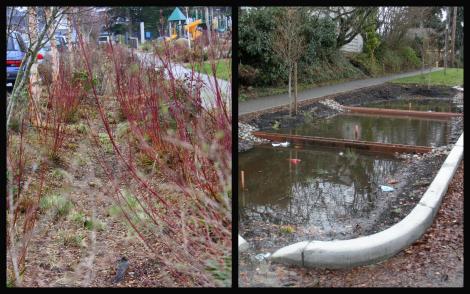
Photo, right, courtesy of ballardraingardengue.wordpress.com as printed in the Ballard News-Tribune
On March 20, several Westwood and Sunrise Heights neighbors sent a letter to King County Executive Dow Constantine pleading with him to halt a rain garden project in their neighborhoods. On April 4, the Sightline Institute, focused on "researching the best practices in public policy for a sustainable northwest," issued a rebuttal to that letter in defense of the Barton CSO Project.
Sightline Daily reporter Lisa Stiffler takes on each point of the letter to Constantine (the letter is found below), and states, "Fears about West Seattle rain gardens appear overblown" and " ... after looking through the concerns about the project, it seems most of the worries are largely unfounded, and many are echoes of fears raised in Ballard that never came to pass. Let’s take a look, point by point."
The article in its entirety can be found here.
31 streets have been chosen in those neighborhoods for rain garden installation. King County's goal is to lead surface rainwater into the groundwater table as opposed to letting it flow into the combined sewer system. The purpose: to avoid combined sewer overflows at the Barton CSO Station on Fauntleroy. On average there are four overflows a year that dump directly into Puget Sound. By installing rain gardens in Westwood and Sunrise Heights, King County hopes to reduce overflows to once a year.
Here is the letter from West Seattle residents to Executive Constantine:
Dear Executive Constantine:
We are writing as very concerned citizens of West Seattle in one of the neighborhoods that would be impacted by the proposed Barton Combined Sewer Overflow (CSO) project. We are requesting that this project be stopped immediately for many reasons, but primarily due to life safety and liability risks.
You have always been a strong advocate for protecting the environment and we stand with you in that effort. We understand that sewer overflows caused by large storm events must be stopped, but urge you to resolve the problem by other means that do not create a life safety hazard in residential neighborhoods.
In short, the Barton CSO project is unsafe, unfair and untested. We have researched this issue and have written and met with County staff working on this project. Based on what we have learned, we are deeply troubled. We summarized our concerns below and trust that you will consider this information carefully:
Unsafe
Managers of the project cannot guarantee that water won’t pool in the “bioswales” during continuous days of rain. Standing water is a drowning hazard for the many children who live in and walk to and from schools throughout our neighborhood.
Standing water creates breeding grounds for mosquitoes, which could lead to cases of West Nile Virus.
Building “bioswales” with steep grades in planting strips creates a hazard on both the street side and sidewalk side—creating access, usability and safety risks for everyone, especially young, elderly and disabled residents.
Standing water will attract nuisance pests including rats.
The design calls for removing established trees; this negates the neighborhood and city efforts to increase the urban tree canopy. New trees will be planted at the sidewalk edges of the bioswales; this could lead to pedestrian traffic infringement, tree roots lifting or cracking sidewalks—and more life safety hazards.
Street parking will be lost on several blocks. This will force cars into denser parking on unaffected streets, disturb traffic flow, and put cars further from their owners—making them more susceptible to car prowl and break ins.
Unfair
If any citizens are hurt due to the life safety hazards described above, homeowners would be sued—along with the City of Seattle and King County—although we are not responsible for this project.
The project design is unattractive; it will ruin the beauty and quality of life in our neighborhood with curb “bump outs” or “bulbs” that include bright white “curb cuts” and tall metal posts with orange and black striped signs on top of them.
The installation of this unattractive hardscape in front of residential homes will reduce property values as it did after the failed “rain gardens” project in Ballard. Managers of the project have done no due diligence regarding this—with the exception of a lone research article that doesn’t cite a single real estate agent and is not independently sourced.
This type of project is only being proposed in certain neighborhoods—ones where citizens have less political and/or financial clout. This type of project would never be proposed in neighborhoods such as Admiral, Laurelhurst or Madison Park. All citizens deserve a positive quality of life. If you would not have this specific project in front of your own home, then it is inappropriate for any neighborhood.
This project was forced to our neighborhood after a safer and more efficient option was recommended—but met opposition from business owners. The financial concerns of business owners cannot be held above the critical life safety concerns of communities.
Untested
Managers for the project found the same impervious soils in West Seattle as in Ballard’s failed rain gardens. They plan to address this with under drains and deep wells—but have no proof that doing so will work—and that it won’t create new issues underground. Our city streets already have problems with storm drains clogging from debris running down the street. This demonstrates the proposed design will not work and drains will clog. No matter what yellow or red flags the team encounters, they continue to railroad the Barton project through—with no guarantees that their plans will succeed.
Managers for the project could not cite a single example of where the proposed design is installed and working. Pieces and parts are being pulled together from other projects, but as a whole, the proposed Barton project design has not been tested. This would be a very costly and risky experiment—of citizens’ lives and tax dollars.
Project Managers point to other “rain garden” examples (e.g. High Point) that do not match our neighborhood. High Point was built from scratch with permeable sidewalks, a retention pond, etc. The Barton project would be a retrofit in an old, established neighborhood. The only previous—and disastrous—example we have of this is Ballard.
Managers for the project initially said they would not place the bioswales onto properties already experiencing water issues—but now plan to do so. They cannot guarantee that existing water drainage problems (flooded basements, standing water in water meters in planting strips, etc.) won’t worsen due to the project. Instead, we’re being asked to retain more water adjacent to our properties.
Although this project initially has funding, will the County or City truly continue the necessary constant maintenance in front of all of these individual properties—versus directing the water to one simple facility? Is the County truly prepared to continue funding this project at the necessary level—or will it fall apart in a few years?
We find it difficult to believe that the chosen option will produce a smaller carbon footprint with trucks constantly going through tight neighborhood streets, workers using heavy equipment to pull apart an established neighborhood, trees being cut down, uprooted and moved and existing plantings being ripped out. Also, the constant maintenance will create a high carbon footprint as well.
Again, we understand that the CSO problem must be addressed and know you are seeking the greenest option possible. We wish that this option was the right solution, but there are simply too many risks and unknowns to proceed with it in good conscience.
We are confident you will demonstrate your concern for community health and safety by listening to our concerns and stopping this project at once. We appreciate your time and look forward to hearing from you.