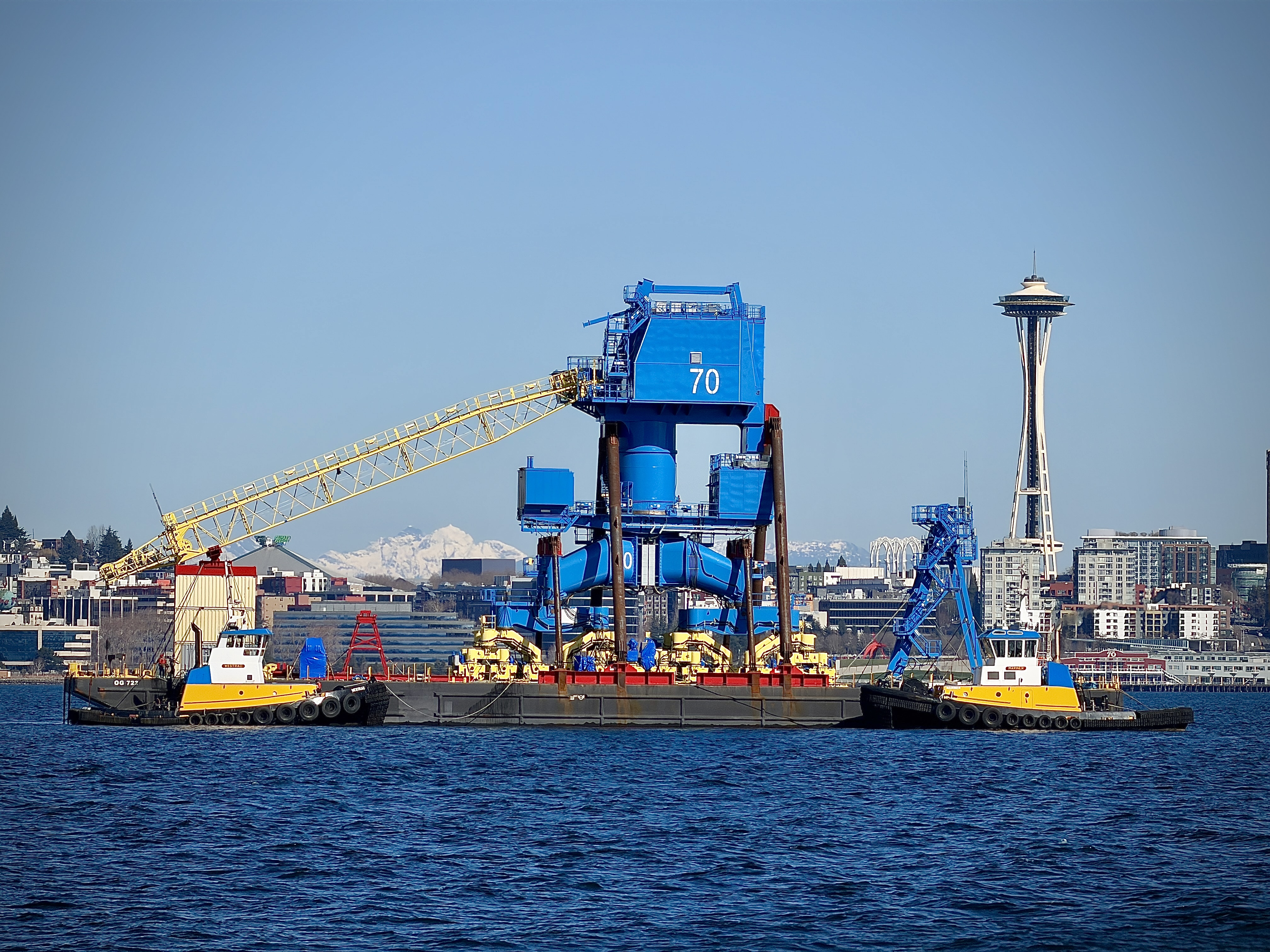
The $55 million heavy lift crane called Big Blue was seen off Harbor Ave SW on March 1 on its way to Vigor Shipyard and then finally to the Puget Sound Naval Shipyard in Bremerton. It was built in Wisconsin and made the journey through the Great Lakes, the St. Lawrence Seaway, down the east coast and through the Panama Canal, a 7000 mile journey.
Photo by Patrick Robinson
On March 1, the towering Big Blue #70 was spotted moving through Elliott Bay aboard barge OG 723, towed by the tug Ocean Tower. The massive, blue heavy-lift portal crane, which stands approximately 200 feet tall, is destined for the Puget Sound Naval Shipyard (PSNS) in Bremerton, but is making a critical intermediate stop at Vigor Shipyard for final preparations.
Built in 2023 by Manitowoc and designed by the Finnish company Konecranes, the $55 million crane is part of a major U.S. Navy modernization contract. Its arrival follows an epic 7,000-mile journey that began in Manitowoc, Wisconsin, and traversed the Great Lakes, the St. Lawrence Seaway, the Atlantic Ocean, and the Panama Canal. This high-profile transport route has made the crane a recurring subject in maritime and local news over the several months it took to complete its transit.
While its ultimate home is PSNS, Big Blue #70 was moved to Vigor Shipyard because the facility offers the unique combination of pier space and heavy-lift capability required for final assembly, inspection, and commissioning work. At Vigor, crews will perform load testing, structural integrity checks, and safety system verification. They will also reinstall structural components and reconnect electrical and hydraulic systems that were removed or secured for the long ocean transit. This intermediate stop ensures that these complex tasks do not disrupt active Navy traffic at PSNS operational piers.
Once commissioned, the 2.3-million-pound crane will provide essential heavy-lift support for submarine maintenance, including refueling, overhauls, and modernization cycles. It is capable of lifting large hull sections, propulsion modules, and sail components that are too heavy for standard mobile cranes. The deployment of Crane 70 is a visible step in the Navy's effort to reduce submarine maintenance backlogs and prepare for future Columbia-class vessels.
Despite the milestone of its arrival, the crane has faced significant timelines, including waiting over two years for transport following its completion due to custom fabrication schedules and shifting shipyard modernization sequences. After testing and certification are completed at Vigor, it will be re-secured to its barge for the final short tow across Elliott Bay and Sinclair Inlet to its permanent station at the naval shipyard.