
Sound Transit proposes billions in savings for West Seattle Link, sparing iconic businesses and landmarks
Sound Transit proposes billions in savings for West Seattle Link, sparing iconic businesses and landmarks

Though not yet approved, a cost savings approach proposed in a recent Sound Transit board retreat would not demolish Jefferson Square for the Alaska Junction Station for the West Seattle Link Extension. Instead it would relocate the underground station closer to 41st Street SW.
Thu, 03/19/2026
At a meeting of the Seattle City Council’s Transportation Committee on March 19, 2026, officials unveiled major design revisions for the West Seattle Link Extension that could save billions of dollars and prevent the demolition of several community pillars. These updates follow a high-stakes Sound Transit board retreat in Tacoma where the agency developed three distinct "starting point" scenarios to address a massive $34.5 billion agency-wide funding shortfall.
The future of the West Seattle Link Extension was the center of a marathon Seattle City Council Transportation Committee meeting on March 19, 2026, as officials revealed design breakthroughs that could save the project billions while preserving iconic local businesses.
The updates follow an all-day Sound Transit board retreat where the agency grappled with a $34.5 billion funding shortfall by developing three distinct "starting point" scenarios for the regional system.
Three Paths Forward The Sound Transit retreat produced three broad approaches to balance the budget:
- Approach 1: Prioritizes active projects, but terminates Ballard Link at Seattle Center.
- Approach 2: Prioritizes regional connectivity, which would keep an Eastside line to Issaquah but defer the entire West Seattle Link.
- Approach 3: Phases all projects, turning West Seattle Link into a "stub line" only reaching Delridge Way.
Billions in Savings Through Design
Despite the difficult scenarios, King County Councilmember and Sound Transit Board Member Teresa Mosqueda highlighted "sharpened pencil" efforts that have already drastically improved the West Seattle outlook. “$2.6 billion with a B is the low-end estimate of what we’re able to shave in terms of costs here,” Mosqueda told the committee. She emphasized that these creative design changes are essential for “preserving existing assets as we deliver light rail to West Seattle”.
Saving Jefferson Square and the Health Club
Jason Hampton, Sound Transit’s Commercial Director, detailed specific "Cost Saving Measures" (CSM) that would significantly reduce community displacement. One major revision involves shifting the Alaska Junction station and track geometry to avoid massive demolitions. “Notably on this, the Jefferson Square property would not need to be affected, and that included about 40 businesses as identified in the final EIS,” Hampton stated.
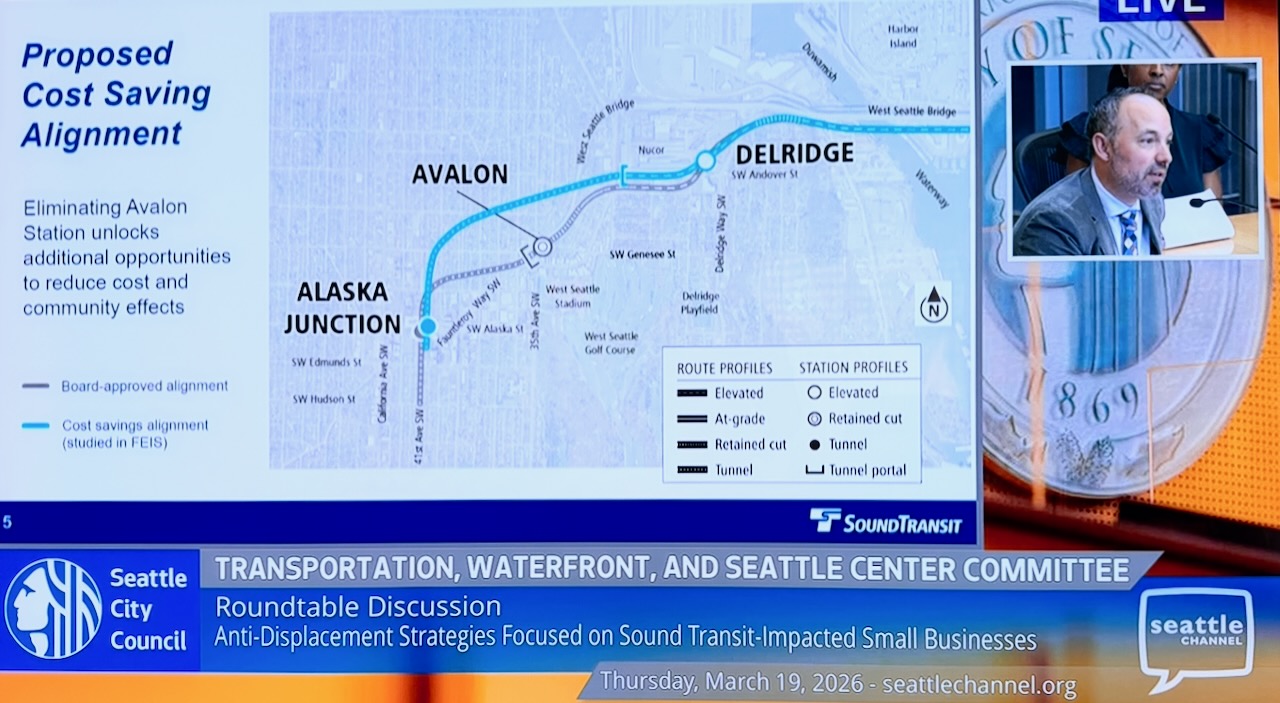
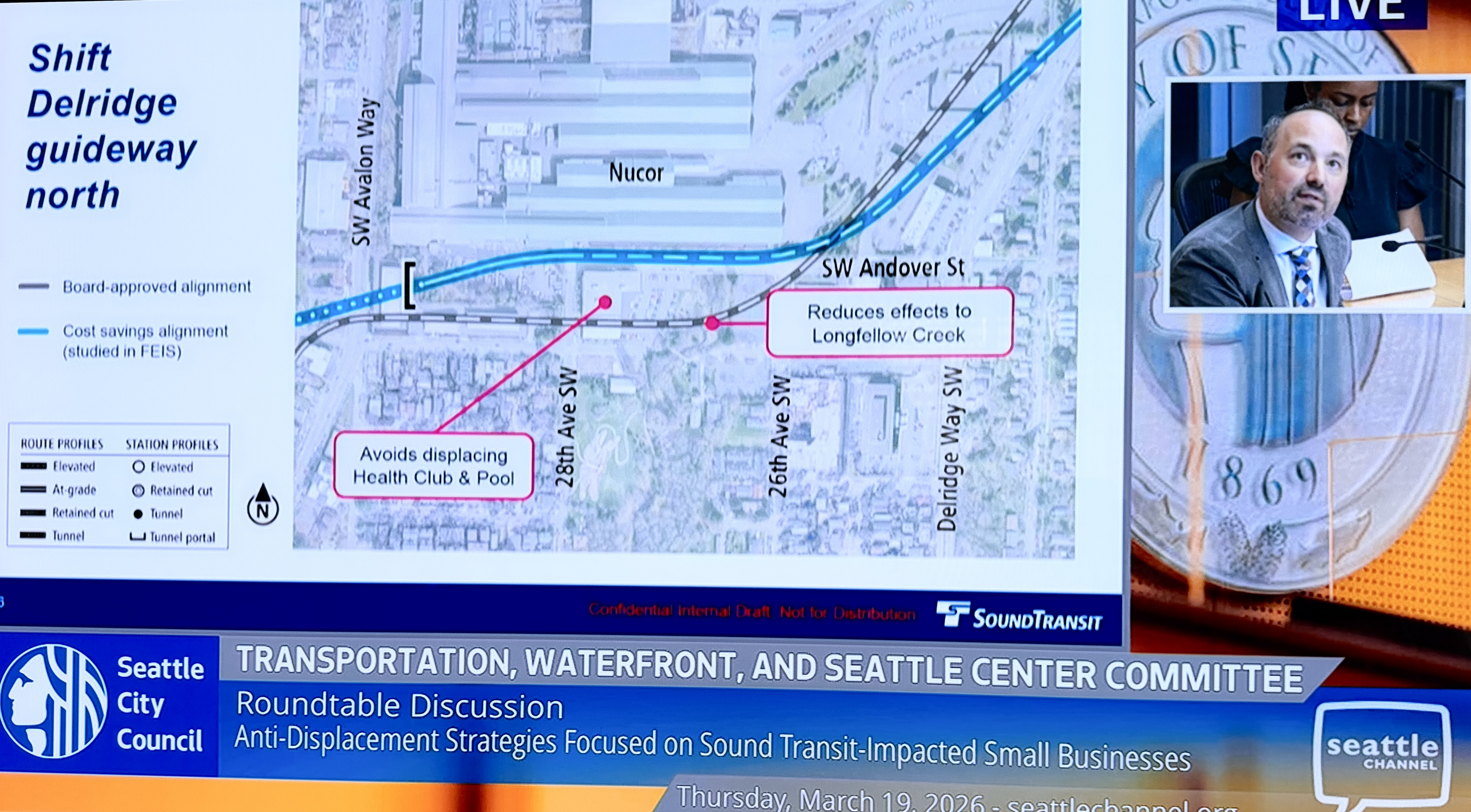
In Delridge, the agency proposed shifting the rail alignment one block north—moving from Yancy Street to Andover Street—after the elimination of the Avalon station. “We are able to avoid the displacement of the West Seattle Health Club by shifting the alignment to the north,” Hampton said. Councilmember Mosqueda noted the club is the "only swimming pool in the North Delidge corridor" and employs roughly 100 people.
Small Business Owners Demand Financial Clarity
Despite the design saves, business owners still on the displacement list shared harrowing accounts of the financial burden and years of "uncertainty". Laurel Trujillo, owner of Ounces Taproom and Beer Garden, questioned how businesses would survive the relocation gap. “My main ask is where does that money come from?” Trillo asked. “I know that Sound Transit doesn’t provide 100% of that cost... there’s a gap of funding in where the additional money comes from”.
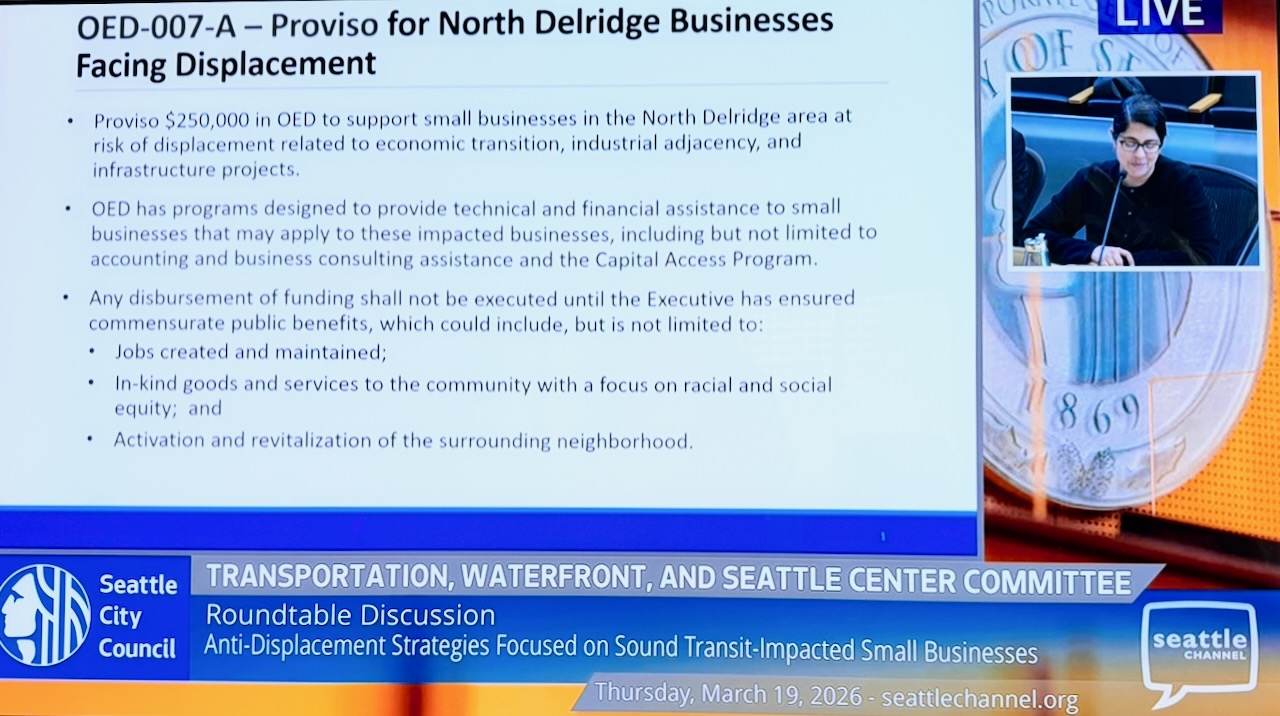
Erin Rubin, owner of Mode Music Studios, challenged Sound Transit’s claim of proactive engagement. “We're in kind of scrambling to make sure that we have financing behind us,” Rubin said. She added, “There were not open lines of communication... most of what we uncovered was done on the side of the small businesses”.
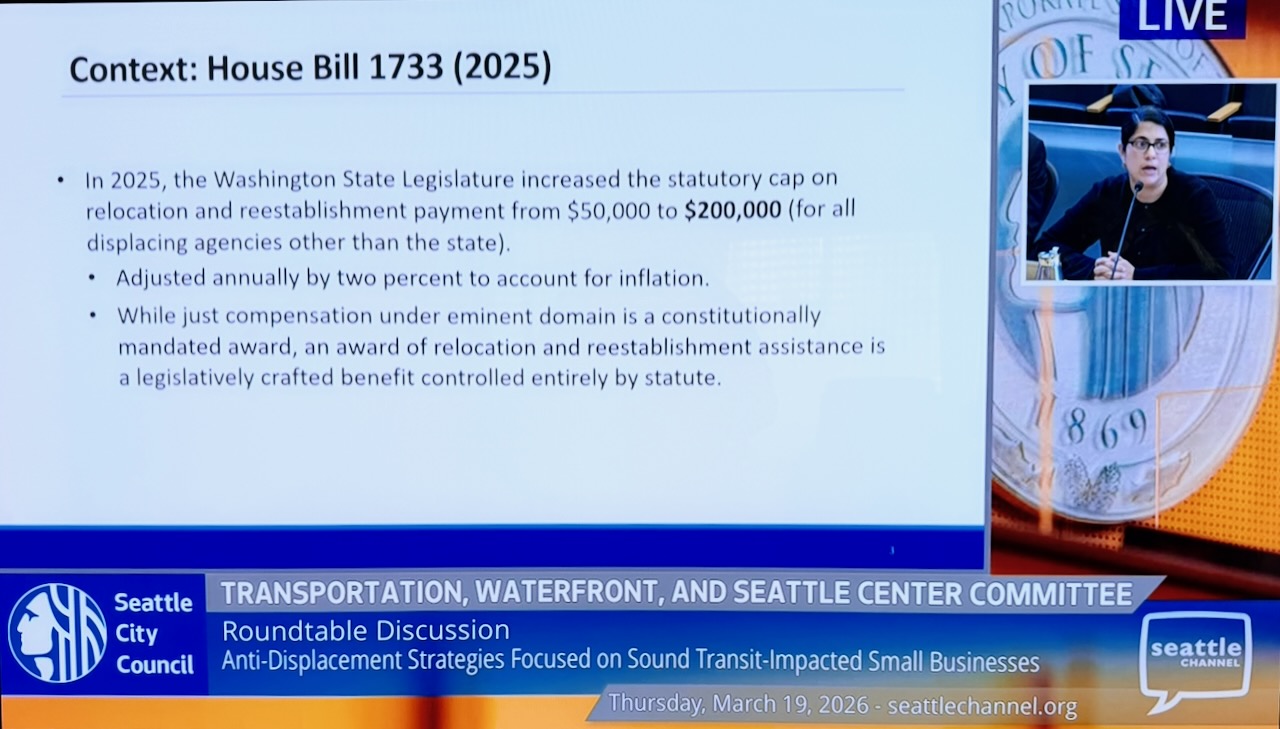
The cost of displacement was addressed previously in Olympia in House Bill 1733 sponsored by Rep. Brianna Thomas which took effect on July 27, last year. HB 1733 raises the reimbursement cap for moving and relocation expenses for individuals, farms, and small businesses displaced by agency actions.
• It increases the statutory cap from $50,000 to $200,000 for necessary relocation expenses.
• It also requires the Washington State Department of Transportation to adjust this cap annually for inflation starting August 1, 2025.
Leadership Vows to Act
Committee Chair Rob Saka acknowledged that "uncertainty is the single biggest challenge" for entrepreneurs. “We’re not going to stand by and watch our small businesses struggle through this challenge alone,” Saka vowed. “We’re going to show up. We’re going to lead and we’re going to act”.
Albert Brooks, Executive Director of the Rainier Valley Community Development Fund, offered his organization as a model, noting they have supported over 320 businesses. “Our ability to be able to come in and support that... has been integral and communities really being able to stay in where they’re at,” Brooks said.
Ballard Concerns Linger
While West Seattle saw progress, Councilmember Dan Strauss warned that the city must not lose sight of its highest-ridership goal. “It is unacceptable that we do not have a plan to get to Ballard,” Strauss said. “We have three approaches, none of these approaches maximize ridership”.
Sound Transit officials, including Deputy Executive Director Wells Lawson and Project Manager Kim Roscoe, pledged to move toward more "person-centered" relocation efforts. Roscoe suggested new strategies like "office hours" to "bridge that gap between the project and some of the silence". The Sound Transit Board is expected to identify a final path forward for the system plan by May 2026.
