
Seattle City Council unanimously approves $4.8 Million for Mayor Wilson’s 1,000-Unit shelter plan ahead of World Cup deadline
Seattle City Council unanimously approves $4.8 Million for Mayor Wilson’s 1,000-Unit shelter plan ahead of World Cup deadline

72 RV spaces in three rows, 20 tiny homes in a clustered village, Controlled entry + security office, Admin/services + staff office, Community building, Amenity area, Service area + exit gate, Full perimeter fencing and internal circulation roads.
Thu, 04/16/2026
By Liz Steen
Seattle City Council handed Mayor Katie Wilson two big wins, and a boost to her chances to meet a self-imposed deadline, with the approval of $4.8 million in funding for the mayor’s signature homelessness issue on Tuesday. In a unanimous vote for the Mayor’s signature proposal, the council voted to repurpose unused city funds to the Mayor’s plan of 1000 new shelter units in her first year, with the additional goal to open 500 before the World Cup starts in 60 days on June 15, 2026. Tuesday’s vote approved almost 60 percent of the funds for the planned $8.2 million project.
The council also voted, again unanimously, to allow the city’s Finance and Administrative Services to sign leases with property owners. This move puts the administration’s race to fund and implement the project just slightly ahead of schedule, assuming all funds are spent as planned. It’s been 43 days since the Mayor announced these two steps on March 4, 2026; there’s 60 days to go before the first World Cup match at Lumen Field. Earlier this year, the council also unanimously approved changes to the transportation management plans and cultural preservation requirements that will allow the city to update the permit process.
The administration’s new approach to homelessness requires multiple city departments to work together, and West Seattle, as the city’s largest neighborhood and home to the first 100 units at Glassyard Commons, appears set to play a large role. City workers and police responded to years of complaints Wednesday by clearing 16 tents from Rotary Viewpoint Park on 35th Ave SW, removing a sprawling site that stretched from the West Seattle golf course up the hill and into the woods. Area residents had complained of violence and illegal activities since June 2022, according to prior news reports. Three men were recently injured at the encampment on March 29, 2026, when Seattle police reported multiple suspects wielding a fire extinguisher, a wrench, and a crowbar lured three men and then beat them until they had to go to the hospital with critical injuries.
The camp was cleared and residents were assigned to the Universal Care Team. The care team is a key part of the administration’s “wrap around” approach to homeless services. The Mayor proposed behavioral health and 24/7 staffing, neighborhood referrals, and rental subsidies to support shelter residents and mitigate neighbor’s concerns. Costs and timelines for these additional projects and services do not appear to be part of the $8.2 million already announced for the project.
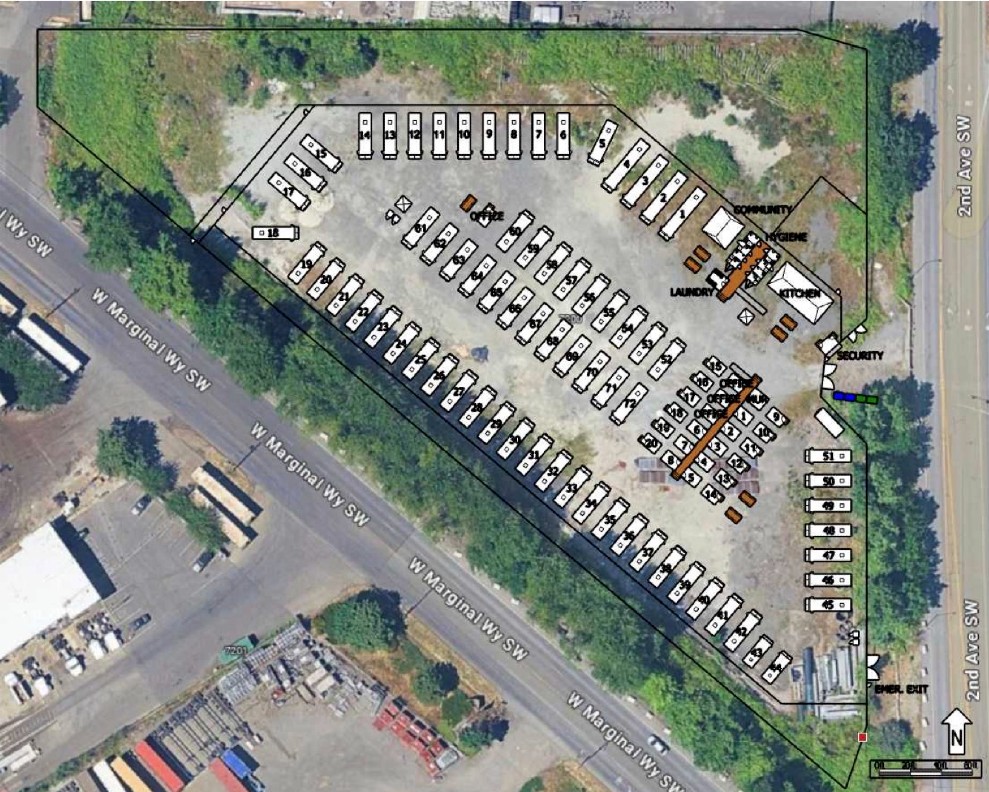
Glassyard Commons located at 7200 West Marginal Way SW will make up 20% of the city’s new shelter units. Glassyard Commons is a 72-RV park set to open in June. The park will also provide 20 tiny homes. Area news outlets have reported that the project will take up $3.3 million in funds, including a $63,000 lease with the property owner.
About the project
The site is designed for two distinct housing types:
- 72 RV parking spaces
- 20 tiny houses
This makes Glassyard Commons one of the largest combined RV safe‑lot + tiny‑house village models in Seattle.
Intake & occupancy process
Every resident goes through a structured, multi‑step process:
- Referral & outreach
- Outreach is led by the UHeights Vehicle Resident Outreach (VRO) team, focusing on District 1 RV residents.
- Initial intake with a case manager
- Residents review the code of conduct, safety expectations, and site rules.
- Case managers begin building an individualized service plan.
- Ongoing case management Case managers help residents secure:
- Identification
- Income support / SNAP
- Employment resources
- Healthcare and behavioral health services
- Long‑term housing options
- Transition planning
- The goal is to move residents from RVs → tiny homes → permanent housing.
- LIHI works with residents to sign over unsafe RVs for demolitiononce they are housed.
Security & onsite staffing
- 24/7 security presence
- Onsite Shelter Operations Manager
- Continuous staff monitoring, cameras, and controlled entry
LIHI notes that similar villages historically reduce crime in surrounding areas due to constant staffing and oversight.
