
Morgan Junction Park Expansion: Community gathers to review refined design as project eyes 2027-28 finish line
Morgan Junction Park Expansion: Community gathers to review refined design as project eyes 2027-28 finish line
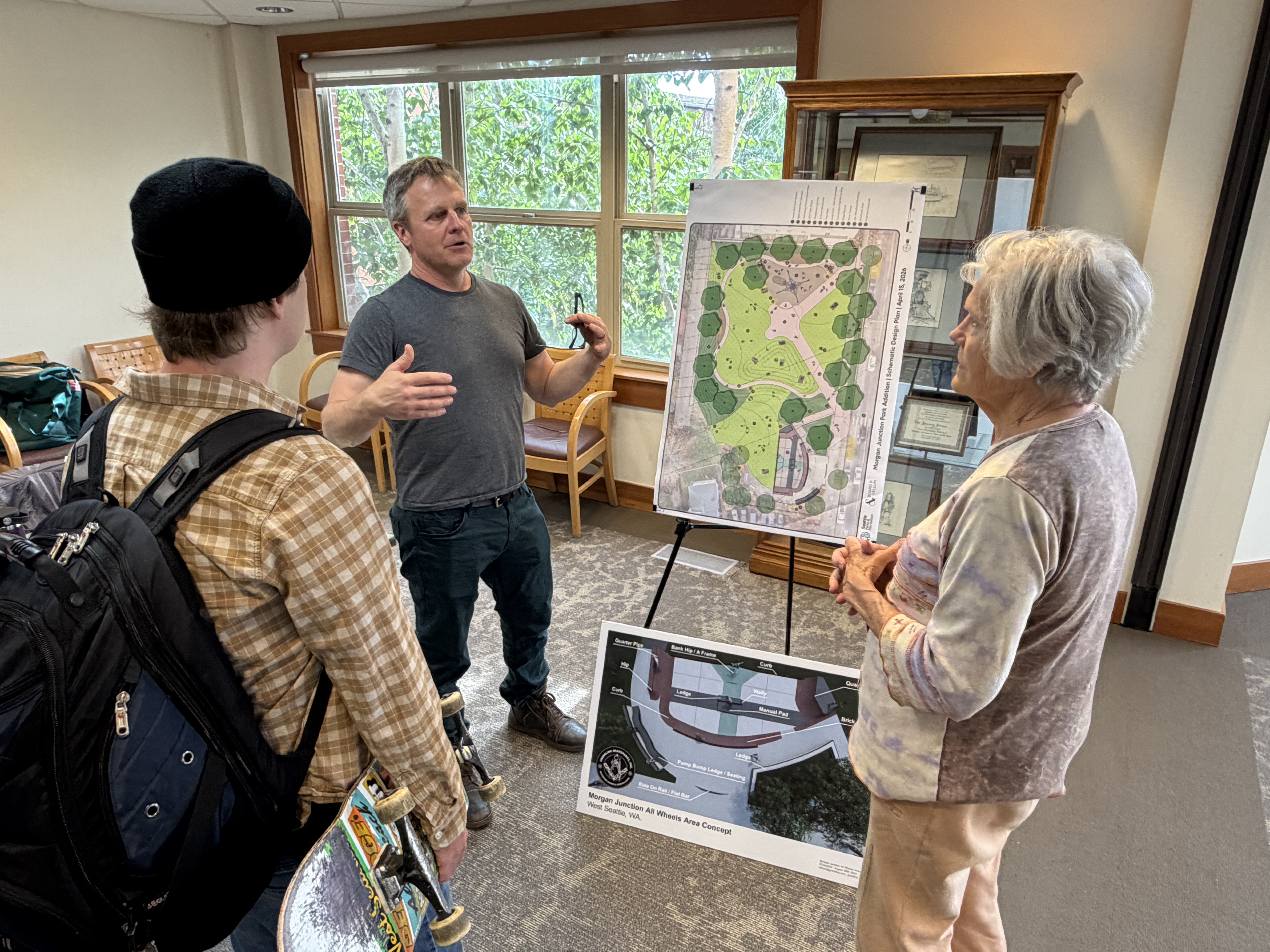
Zack Thomas, Board & Vellum Design Consultant answered questions about the Morgan Junction Park expansion at meeting May 13.
Photo by Patrick Robinson
Wed, 05/13/2026
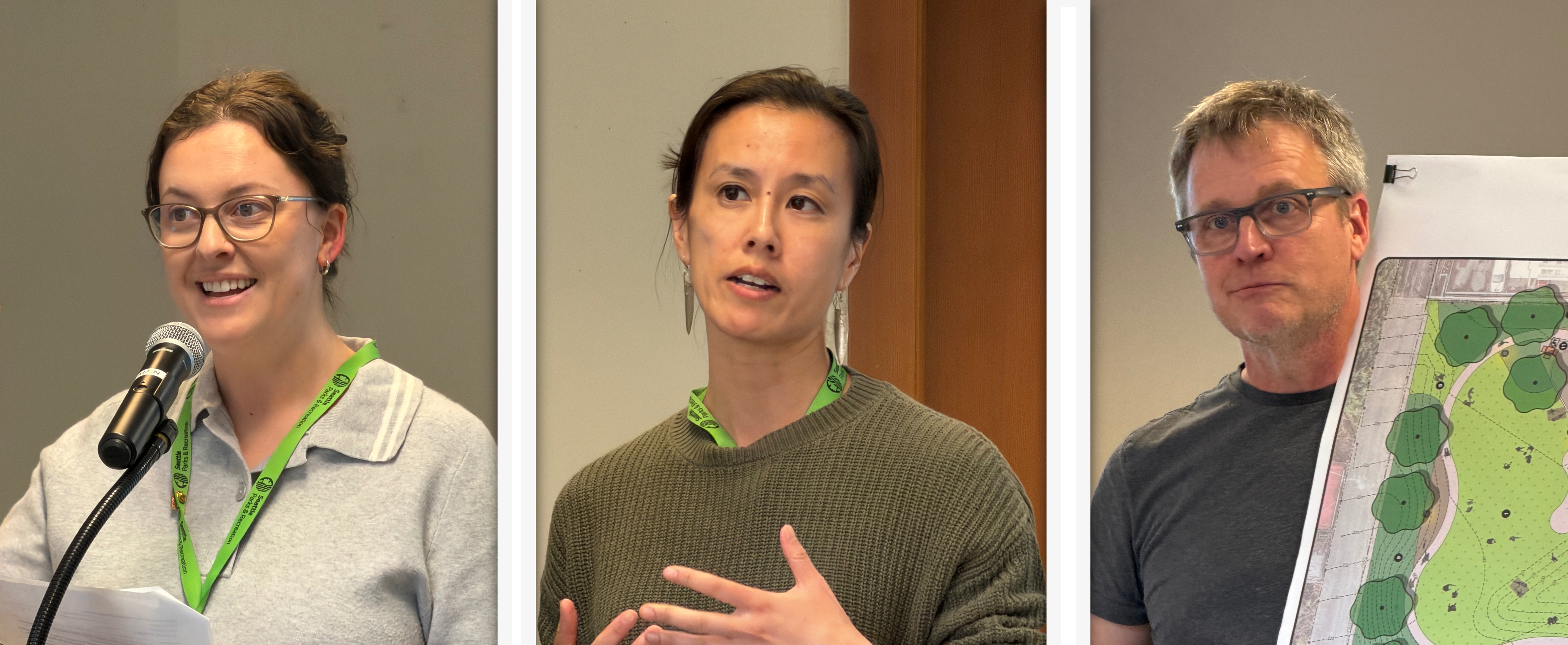
Seattle Parks and Recreation (SPR) and design consultants from Board & Vellum hosted a public update on May 13 to unveil the latest schematic designs for the long-awaited Morgan Junction Park expansion. The meeting marked a significant milestone in a "journey" that project planners noted began when the property north of the existing park was first purchased in 2014.
A Decade-Long Journey
The project has faced numerous hurdles, including a multi-year hiatus starting in 2020 due to the pandemic and significant budget escalations. Olivia Reed, an SPR Planner, opened the meeting by thanking the community for their persistence, noting, "Many of you have been following this project for a long time and I want to give you all a huge thanks for being continued advocates for this project over the years".
The project recently completed "Phase 1," which involved extensive earthwork to remove contaminated soil—a remnant of the site’s former life as home to a Dry Cleaner. While the fencing finally came down in April 2026, Project Manager Trae Yang warned that the site remains technically "contaminated" in state databases due to groundwater issues, which imposes strict limitations on how stormwater can be managed.
Balancing Vision with Budget Reality
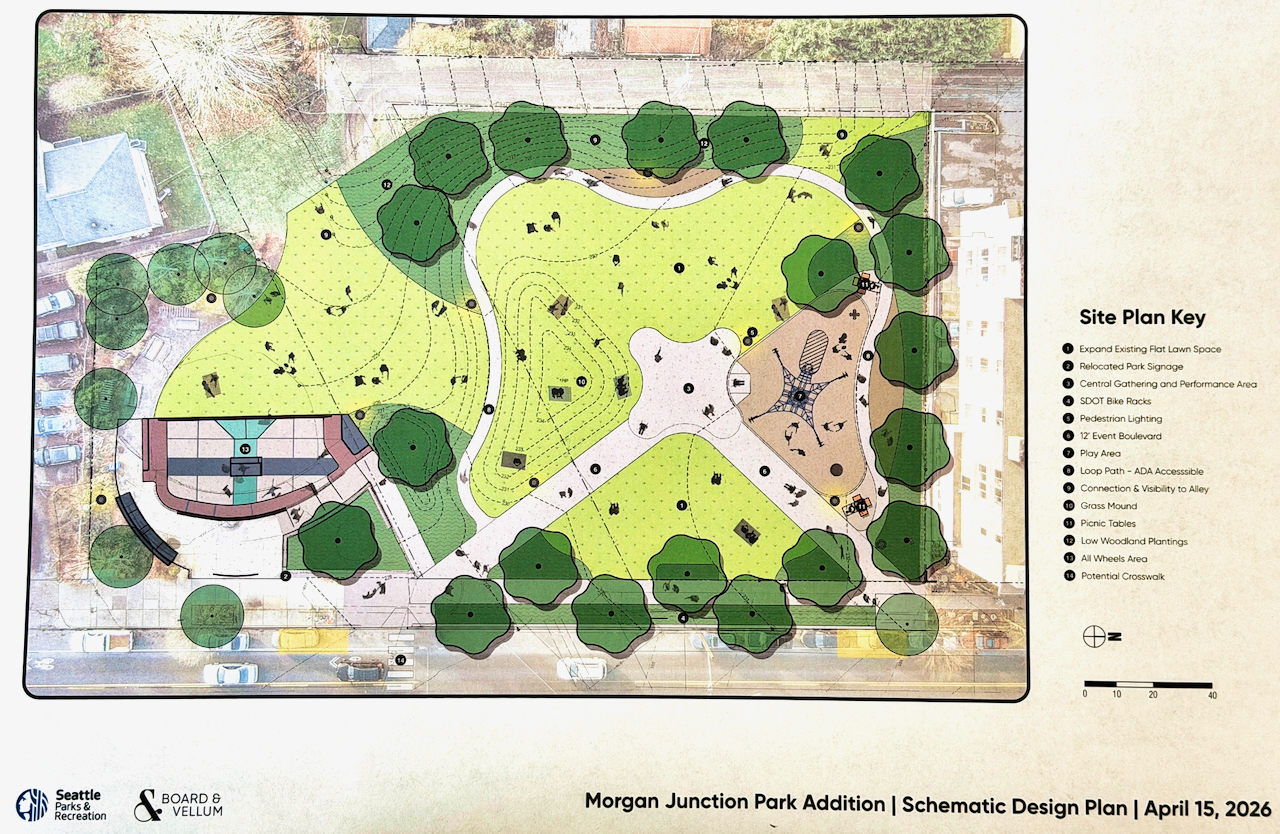
The updated design presented at the meeting is the result of "value engineering," a process required to keep the project viable amid unforeseen soil remediation costs and cross-departmental constraints. Despite these challenges, the team has worked to preserve high-priority community features, including a skate dot, a play area, an "event boulevard," and an informal play lawn.
“We did our best to preserve a majority of the original design concepts and park features, especially those that were a high priority to the community,” Reed explained, though she admitted some elements, like the "sentinel tree" and expanded nature play, are currently listed as "additives" that will only be included if final cost estimates allow. The estimated budget had been sent to them "two hours ago" Yang said, so they were unable to offer more insights into those numbers at the time.
The budget costs for the Morgan Junction Park expansion are being driven by several complex and unique site constraints, primarily involving environmental contamination, stormwater management mandates, and jurisdictional technicalities.
1. Soil Contamination and Groundwater Issues
The site’s history as a dry cleaner has left a legacy of contaminated soils that required extensive remediation in Phase 1.
- Unforeseen Costs: The need to remove the contaminant source led to significant costs that forced the project team to "value engineer" the original design.
- Ongoing Liability: Although the primary source was removed, the site remains technically classified as "contaminated" in state databases because of a groundwater plume at a depth of 16 feet.
- Excavation Risk: Project managers warned that further development in areas not touched during Phase 1 (such as the southwest corner) carries the risk of encountering more contaminated soil, which would have to be trucked off-site to Oregon at a high cost.
2. Stormwater Management and Infrastructure
The contamination status triggers strict Seattle Municipal Code requirements that significantly increase infrastructure costs:
- Prohibition on Infiltration: Because the site is classified as contaminated, the project is not allowed to infiltrate stormwater anywhere on the property. This prevents the use of standard, lower-cost drainage solutions.
- Storm Main Extension: A Seattle Department of Transportation (SDOT) director's rule requires the project to extend the storm drain main across the full frontage of the property on California Avenue. This extension is described as an "expensive thing" that must be negotiated with the city.
- Conflicting Drainage Basins: While the city requires connection to the main on the east (California Ave), the site naturally drains west toward an alley and ravine. Forcing water against its natural grade creates expensive engineering challenges.
3. Eddy Street Right-of-Way (ROW) Technicalities
The fact that the park expansion covers two parcels divided by the Eddy Street ROW introduces jurisdictional hurdles and mandatory costs:
- Permitting and Jurisdiction: Managing the park as a single entity requires either a complex Transfer of Jurisdiction from SDOT to the Parks Department or special agreements to develop the ROW to "look like a park" while it remains a street.
- Mandatory Crosswalks: Because the project "touches" the ROW, city code currently requires the installation of two crosswalks at the intersection, adding further technical and financial burdens to the project.
4. Economic and Maintenance Factors
Beyond site-specific physical constraints, the project is also managing broader financial pressures:
- Market Escalation: General budget escalations and pandemic-related cuts have strained the original funding. Project planners noted that market uncertainty regarding future labor and material costs requires them to "start lean" and treat certain features as "additives".
- Long-term Maintenance: Costs are not limited to construction; for example, the $10,000 price tag for a single donor bench includes 10 years of ongoing maintenance, highlighting how long-term upkeep is factored into current budget decisions
Eddy Street ROW issues
Seattle City code requires the installation of two crosswalks because the Morgan Junction Park expansion project involves developing parcels on the Eddy Street right-of-way (ROW).
The specific reasons and context for this requirement include:
- Development Trigger: Per city code, when a project develops parcels adjacent to or on a right-of-way, it is required to install crosswalks at all intersections of that ROW.
- "Touching" the ROW: Project Manager Trae Yang noted that because the park expansion is "touching" the Eddie Street right-of-way, the code mandate is triggered, even though there are currently no crosswalks at that location.
- A Technicality: Yang described this as a "technicality" and a "code requirement" that he is currently negotiating with the Seattle Department of Transportation (SDOT).
The project team has expressed concerns about this requirement, noting potential safety issues due to how close these new crosswalks would be to the existing Morgan Junction intersection. They are exploring whether a "transfer of jurisdiction" or other agreements could waive this requirement
The "MJAWA" and Grindline Influence
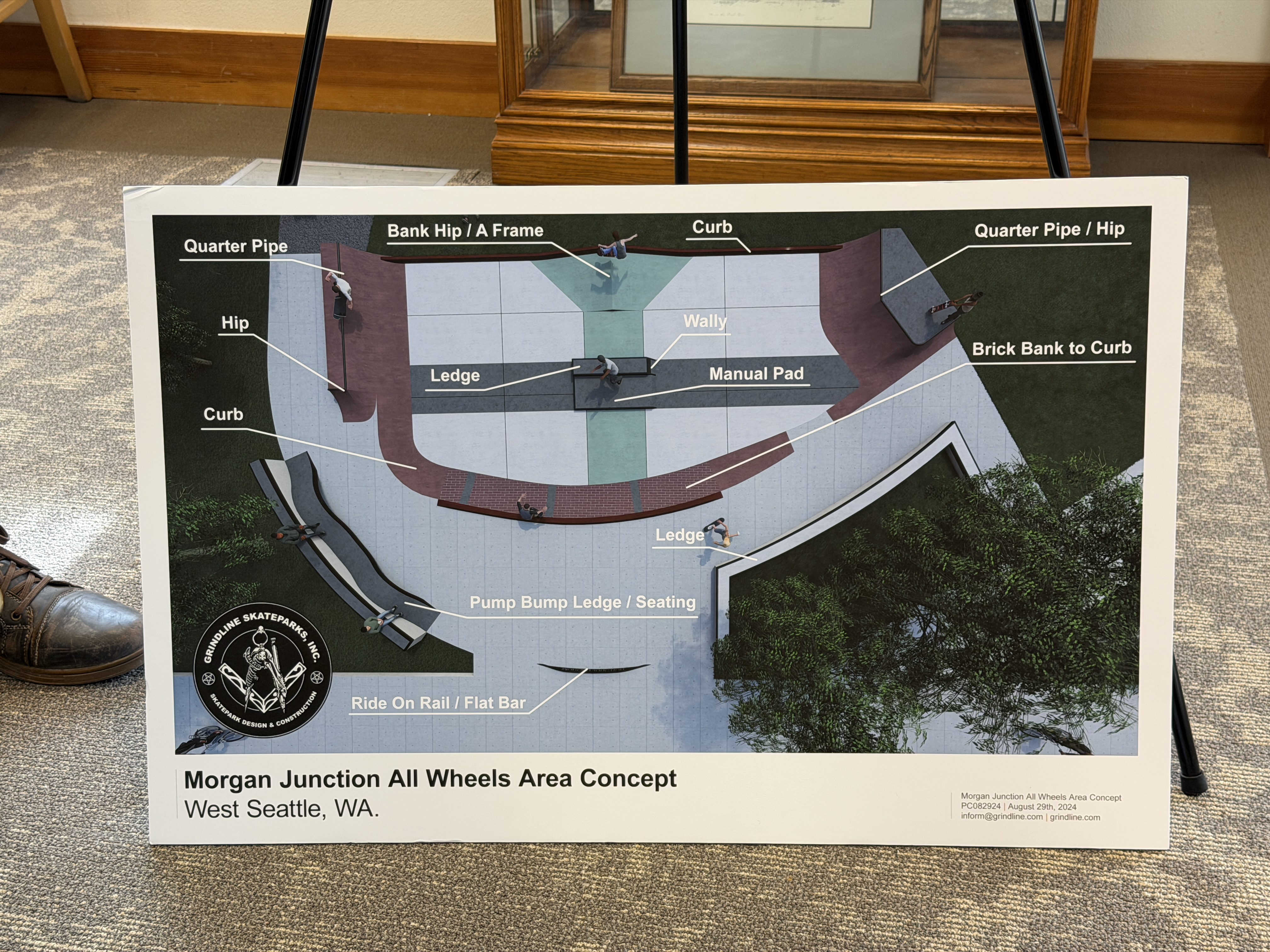
A major highlight of the meeting was the progress on the "skate dot" feature, which received a significant boost from a City Council budget action spearheaded by the Morgan Junction All Wheels Area (MJAWA). The reference to Grindline, a renowned West Seattle-based skate park design and construction company, was central to the technical discussions regarding the skate dot’s layout.
Matt Johnston of MJAWA expressed the group’s long-term commitment: "The MJAWA crew... we’re still engaged in the project. We’re all here... we care about the overall success of this project even after it’s done".
However, the design did face some technical scrutiny. Forest Rinaldi, a community member, raised concerns about the skate park's flow, stating, "This ride-on rail here, after you get off of it, you have a bit of speed, but you run right into the ledge right here. And I just don't think that is going to work".
Community Voices: From Safety to "Death by Paper Cuts"
Local residents expressed both excitement and practical concerns. Deb Barker of the Morgan Community Association (MoCA) praised the team for their persistence: “We appreciate all that’s occurred... thank you staff and consultant for sticking with this project. We’re anxious to have it going and get started”.
Others focused on the park's utility for the neighborhood. Cindy Barker, who manages the neighborhood emergency hub, voiced concerns about permitting logistics if the park remains a split jurisdiction between the Parks Department and the Department of Transportation (SDOT). “I just want to make sure that you guys work it so that I do not have to go get an SDOT permit. It will only be a park permit,” she noted.
John Kinmouth, a local resident, captured the general sentiment of the room: “Thank you for coming in and pushing these hard projects over the line. It’s not easy and I’m sure it’s just death by paper cuts... It’s going to be such a vibrant cool thing for generations”.
Sentinel Trees and why they matter
Sentinel trees centered on their role as a popular but high-risk feature from the original park design that has currently been categorized as a "potential additive" due to budget constraints.
The key points discussed include:
- Definition and Concept: A Sentinel tree was envisioned as a "really big evergreen tree" placed in a prominent location in the park. The design team explored planting it on a small mound and choosing a specimen already 12 to 14 feet tall to give it immediate presence.
- Community Popularity: The concept "captured a lot of imagination" during initial public engagement and was a popular feature. However, when project leaders had to prioritize elements to fit a reduced budget, it fell "just barely off the bottom of the list" compared to higher-priority items like the play area and skate dot.
- Cost and Risk Factors: SPR views the Sentinel tree as a financial risk because transplanting a tree of that size is expensive and its survival is not guaranteed. Additionally, the team is dealing with significant budget uncertainty and escalation, leading them to "start lean" with the design rather than including expensive features they might later have to remove.
- Current Design Flexibility: Although not currently funded, the design team is "eyeballing" specific areas for the tree to ensure the current schematic design remains flexible enough to accommodate it if funding becomes available.
- Community Suggestions: Audience members suggested "provisioning" for the tree by designating a spot for it now so that a future fundraising effort or private donation could eventually fund its installation. Another resident asked if trees could be planted sooner to benefit neighbors in the adjacent condos, but the team explained that a previous attempt to include a line of trees during Phase 1 (soil remediation) failed because there was no extra money left after the high costs of the earthwork.
Ultimately, whether the Sentinel tree is included depends on the final professional cost estimates for the project; it will be prioritized for re-inclusion alongside other "additives" like nature play and expanded vegetation if the budget allows
Looking Ahead
While the park expansion is currently open as a temporary lawn, residents will have to wait a bit longer for the final product. SPR anticipates that final design and permitting will be completed by the winter of 2027, with construction slated to begin in late summer or early fall of 2027.
As Zach Corum, a longtime community resident, summarized, "It’s time to get this project across the finish line. It’s time to stop start imagining how this park and design will improve our community... rather than driving by a forgettable eyesore".
