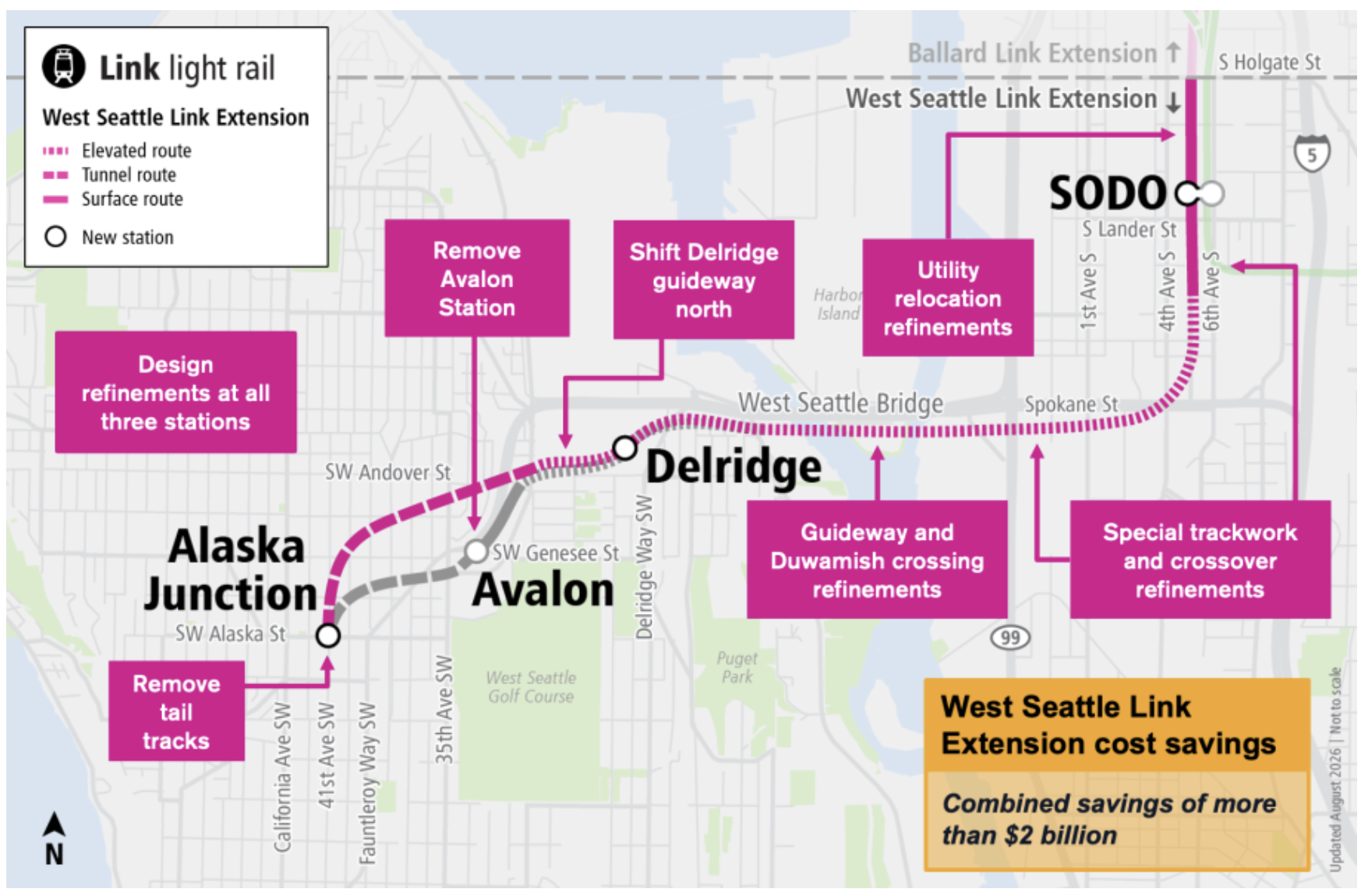
Through design refinements across the West Seattle Link Extension alignment, as shown in the map above, the project team has identified cost savings of more than $2 billion.
Sound Transit graphic
Sound Transit announced a major dual update for the West Seattle Link Extension today, shifting the projected start of light rail service to 2035 while simultaneously unveiling a breakthrough design refinement in the SODO segment that will save over $100 million and significantly reduce construction impacts on local businesses.
The update follows 18 months of intensive technical coordination between Sound Transit, the City of Seattle, Seattle City Light, and local community stakeholders. While the timeline shift represents a delay of approximately two to three years, officials emphasize that the updated schedule is a realistic delivery plan backed by both internal and independent third-party reviews.
West Seattle Service Scheduled for 2035
Following the adoption of an updated ST3 System Plan in May, which was designed to bring Sound Transit’s long-term financial outlook into balance, the agency completed a comprehensive project timeline review. Staff presented the updated 2035 service launch date at today's Board System Expansion Committee meeting from the previous launch year of 2032.
According to Sound Transit, the timeline adjustment was driven by two primary factors:
- Strategic Cost-Savings Work: In late 2024, facing significantly higher than expected cost projections, the Board directed the agency to execute a comprehensive cost-savings workplan. Alongside the Enterprise Initiative—Sound Transit's agencywide program addressing a projected $35 billion funding gap over the next quarter-century—the West Seattle project's final design, property acquisition, and right-of-way phases could not fully advance until an affordable ST3 System Plan was finalized [4]. This effort ultimately succeeded, with the project team identifying more than $2 billion in cost savings across the alignment.
- Refined Construction Timelines: Reviewing the schedule for the Board-selected project alignment selected in fall 2024, the team determined that building a brand-new, light rail-only crossing over the Duwamish River is highly complex and requires more time in the construction phase than previously scheduled.
Sound Transit CEO Dow Constantine called the updated timeline "a durable date for delivering light rail to one of the region’s most vibrant neighborhoods". He added, "Innovative solutions driven by our design team have reduced project costs by more than $2 billion... We stand ready to deliver this transformational investment on behalf of a region that is hungry for more high-quality transit options".
SODO Breakthrough Saves $100M and Spares 6th Ave S
The SODO segment, historically one of the most complicated parts of the 3.9-mile alignment, is seeing major design refinements. The newly announced design successfully relocates Seattle City Light's 230 kilovolt and 26 kilovolt transmission poles and lines, which act as regional electrical superhighways, completely within the SODO Busway light rail corridor footprint.
This refinement eliminates the previous plan's requirement to relocate the massive transmission lines onto 6th Avenue S, avoiding disruptive construction and permanent physical impacts on adjacent businesses and properties .
Key benefits of the SODO design refinement include:
- Cost Reductions: Saves the project more than $100 million and removes the risk of damaging critical City transportation and water infrastructure .
- Neighborhood Preservation: Eliminates construction on 6th Avenue S, preserving travel space and protecting development potential for nearby businesses.
- Property Clarity: Clarifies which properties will be affected and acquired, resolving years of uncertainty for local business and property owners.
"The updated SODO segment design provides significant advantages such as cost savings, fewer property and construction impacts, and reduced project risks," said Seattle Mayor Katie Wilson. "Sound Transit made a promise to voters to deliver light-rail to West Seattle and Ballard, and as a City we are taking every possible step to find savings and make refinements towards that goal".
Board Member Dan Strauss agreed, calling the refinement "a win-win solution". "This is a great example of Seattle, Sound Transit, and the community working together to find ways to expand light rail better and more affordably," Strauss noted.
Community and Regional Support
The collaborative effort has received strong support from local business leaders and regional board members.
Erin Goodman, Executive Director of the SODO Business Improvement Association, expressed gratitude for the agency's willingness to listen. “Today’s announcement on the 230-KV Lines is an important example of how continued engagement with the businesses and communities most affected by major infrastructure projects can lead to better solutions,” Goodman said. “We appreciate Sound Transit and the City of Seattle’s willingness to listen, revisit its plans, and find a path forward that advances the West Seattle Link Extension while allowing SODO businesses to remain in place and continue operating”.
King County Executive Girmay Zahilay noted that this collaborative model should serve as a template for other ST3 projects, "especially as we continue work to identify cost savings to advance the Ballard Link Extension".
Board Member Teresa Mosqueda added, "The cost-saving measures we’ve identified, along with the work to reduce impacts on businesses in SODO, are helping to complement existing community assets and put this project on a stronger path. This is more affordable and better addresses the needs of the SODO and adjacent communities".
Next Steps for the Extension
Despite the schedule shift, Sound Transit is moving forward rapidly with key project milestones:
- June 2026: The Board authorized final design contracts, locking in the identified cost savings.
- August 2026: The Board anticipates authorizing property acquisitions and appropriating funds to purchase properties, support relocations, and advance construction planning .
- Winter 2026/2027: The project will bring on construction management services in preparation for major construction contracts to be awarded in 2027 to build the bridge, tunnel, guideways, and stations.
For more information, residents are encouraged to visit the Sound Transit Blog.