A hydraulic crawler excavator on the site of the future Glassyard Commons RV Park and tiny home site.
Photo by Liz Steen
By Liz Steen
A photo earlier this week showed the wrong lot for Glassyard Commons, the $3.3 million RV Park and Tiny Home village coming to West Seattle this November.
Our photographer had assumed the city was using the only lot on the block that appeared large enough to accommodate dozens of RVs while meeting fire-code requirements. The city is not using that lot.
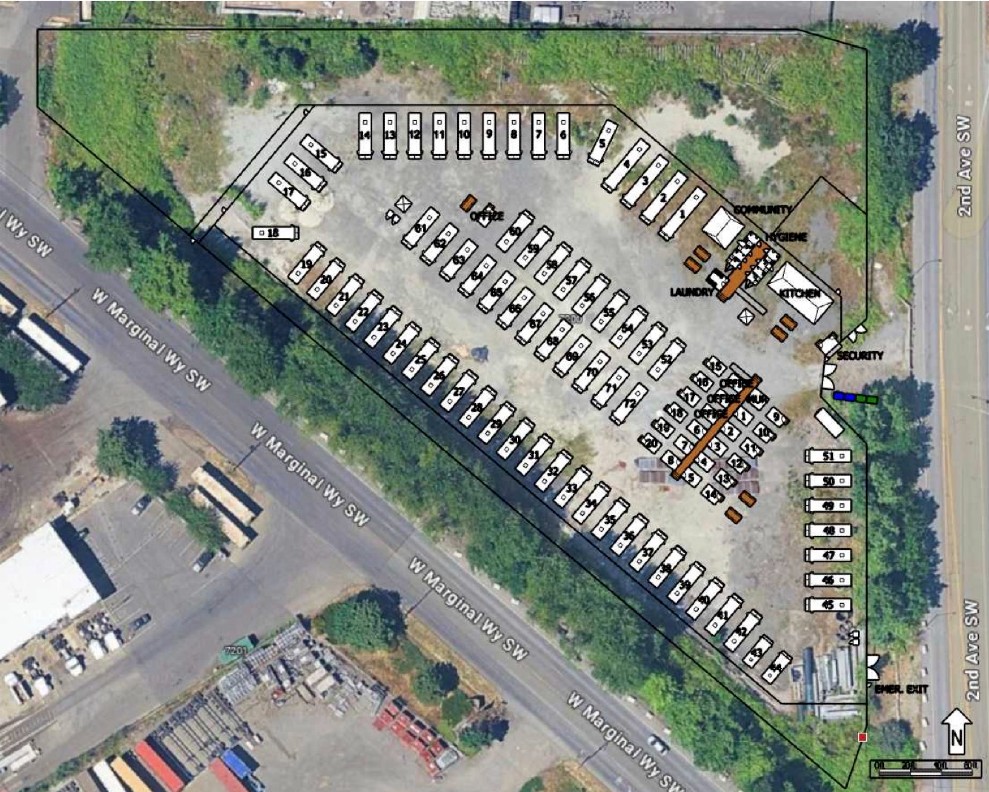
The city is using the other lot, a triangular piece, pictured, where the city plans to fit three rows of RVS for a total of 70 RVS, together with laundry and kitchen facilities, 30 tiny houses, and bathrooms for 100 people.
The city avoided the typical neighborhood friction associated with homeless housing facilities by placing this site in a heavy industrial buffer zone, surrounded by a dump truck storage lot and a solid waste transfer station [302404-9182].
That doesn’t mean everyone is happy. Council members offered amendments to ease those concerns.
A formal public-safety and neighborhood-mitigation plan, along with a “buffer zone” where camping is “strictly prohibited,” were added as requirements this week by Councilmembers Rob Saka and Maritza Rivera.
The Roxhill/South Delridge corridor, Alki Beach and the West Seattle Triangle corridor already operate under formal neighborhood safety plans.
Neighbors report rising violent, property, vehicle and drug-related crime in these areas, even as citywide statistics show reported crime declining overall.
Recent incidents underscore these concerns. In September 2025, a 31-year-old man was shot multiple times near Roxhill Park, where police recovered more than 20 shell casings of different calibers. In March 2026, a man was shot in the stomach at Alki Beach.
Most recently, police responded Monday to a possible shooting in the West Seattle Triangle, where news outlets reported a trail of blood but no victim. Camping is already prohibited across West Seattle outside designated areas available to rent in Camp Long, raising further questions about what the proposed “buffer zone” would add.
The city also proposed a single entry point, 24/7 staffing and camera surveillance—requirements that raise another question: cost. HUD guidance calls for roughly 10–20 staff per 100 shelter residents, with higher staffing for intensive case management. Some area shelters operate at roughly one staffer per dozen residents.
Even three workers, each on duty around the clock, at $20 an hour would cost about $10,080 a week, or $524,160 a year, before overtime, benefits, payroll taxes and other overhead. Those costs could add another 10–30%.
Which brings the Glassyard Commons plan back to its most basic constraint: space. The park is tight. Seattle fire code requires eight feet between RVs. For scale, the photo shows three pickups and a small RV spaced about eight feet apart. The proposed plan packs 10 rows of three vehicles and four rows of four into the lot, with little more than eight feet between rows, additional vehicles lining the trapezoid-shaped perimeter—and 30 tiny homes clustered at one end of the lot. The density raises questions about both safety and livability: whether staff can effectively monitor the site, and whether residents will find such close quarters workable.


