
Council drives RV-sized spending hole into city budget
Council drives RV-sized spending hole into city budget
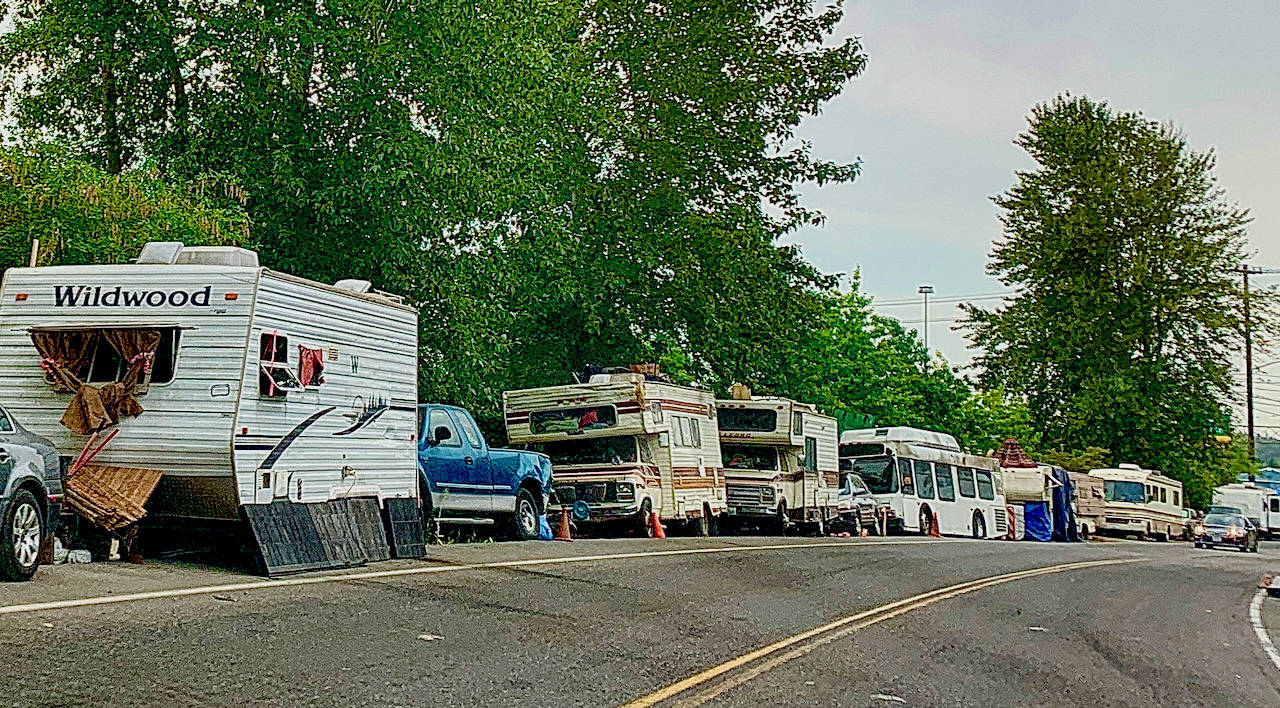
Under pending legislation from the Seattle City Council, still waiting for the Mayor's signature RV's will be towed without a permit or if parked for more than 72 hours. The full cost of that program remain unclear and apparently open ended. The program is slated to begin next April with warnings.
File photo by Patrick Robinson
Fri, 10/23/2026
By Liz Steen
Special Correspondent
Already underfunded and facing a $175 million shortfall, the Seattle City Council agreed Tuesday to pass an unfunded RV towing program without cost estimates or details in a three-hour plus meeting. Three progressive council members opposed its largest measure, which effectively bans RV parking beyond two hours within city limits without a hard-to-obtain permit issued in a census that will happen only one time next year, and never again.
The council split 6–3 on the package’s most significant RV towing measure, with moderates leading the majority and progressives opposing the new program.
Council Office Has No Cost Estimates
The council members could not answer questions about the cost. West Seattle Council Member Rob Saka’s office was asked to provide estimated costs associated with towing and storing RVs, including “information about who will be towing the RVs and where they will be towed.”
“Our office does not have immediate access to that information, so we unfortunately will not be able to assist with your research,” staffer Brendan Kolding said. He provided a general Parking Enforcement number. No one at the general information phone number was allowed to talk to reporters. SPD public affairs promised to ask the city council for the cost-related information they might have, if any was considered as part of the package.
Legislation Without Information
The Seattle City Council gave the City finance department freedom to spend more money towing and storing RVs without council approval– potentially millions more - in the three-hour-plus meeting Tuesday. Link to rule: CB 121279 - Summary and Fiscal Note
The council also expanded the number of vehicles that can be towed to include any vehicle wider than 80 inches “without a current certification of registration or a current and proper vehicle license.” Link to rule: SEATTLE CITY COUNCIL - Record No: CB 121280 Finally, the council passed a rule banning RVs parked longer than two hours without registration approved in a one-time census. Council members Cathy Lynn, Alexis Mercedes Rinck, and Sarah Foster voted no, according to the official transcript linked here: seattle-city-council-transcript-2026-10-20.pdf (The council’s website listed a unanimous vote
It is unknown if the city will pay towing yards or lots for rent per square foot, pay an operator per RV for towing the vehicles, or pay both costs simultaneously, for the towing and storage fees associated with the controversial RV towing plan that was approved on Tuesday, because the council provided too little information to estimate the cost of its towing plan that will, effectively, ban RVs from the city. Available figures point to a substantial bill that could impact budget talks as the council tries to vote to close the city’s $175 million deficit. There are two regularly scheduled council meetings left before the council’s December 2 deadline to approve a budget.
RV Plan Passed Without an RV Count
The council did not provide information Tuesday, or later, on how many RVs will be towed, or where they will be towed. Estimates are difficult because the city does not appear to count people living in RVs specifically. An estimated Point-in-Time count found that 3,967 people lived in vehicles across King County on a single night in 2026 and about 5,460 over a full year. The definition of “vehicles” included cars and other non-RVs. Residents of large vehicles, a definition that includes RVs, decreased from 928 in 2025 to 753 in 2026. Link to study: VehicleLiving_Short_Report.pdf The council’s memo said only, “Of those experiencing unsheltered homelessness, 27 percent or 2,569 people were living and sleeping in a vehicle such as a car, truck, van, trailer, small board or recreational vehicle.”
Most cars, vans, or small recreational vehicles are about 55 to 75 inches wide. RVs are at least 80 inches wide. The number of people specifically affected by the new RV policy for vehicles wider than 80 inches was not provided by the council.
Debate Focused on Towing Policy, Not Spending
What is clear: People are upset the council is towing RVs. More than 60 people commented Tuesday on whether or not the City should tow RVs that serve as people's primary homes after two hours of parking. There was no discussion as to how the City will pay for tracking, towing, and storing the RVs, and no discussion of a 2021 court ruling increasing the city’s costs associated with towing vehicles that people use as homes.
No one mentioned the costs. Council members sat silently Tuesday as members of the public cried and asked them to reconsider towing RVs, citing the towing project’s expected impact on domestic violence survivors and members of the Trans community who are, according to public comment, more than 30% more likely to experience homelessness due to biased employers or abusive family members. After the extensive public comment from more than 60 people, the council voted to remove public oversight for the spending on leases for transitional encampments, outdoor vehicle storage, or overnight driver respite areas, before approving the disputed plan to tow RVs parked more than two hours on city streets. The RV plan allows owners counted in a one-time census to continue to park in the city if they can provide the required documentation. No new RVs will be allowed after the one-time census, and RV owners can lose their census pass if they turn down a shelter more than six times.
Bigger Lots, No Price Tag
The council will now allow more towing lots to be in more places for more money, at an unspecified cost. Agenda Item 3, Council Bill 121279 authorized the Director of Finance and Administrative Services (FAS) to execute leases for transitional encampments, outdoor vehicle storage, or overnight driver respite areas without council approval. This move substantially increases the FAS director's leasing discretion, from 65,000 to 100,000 square feet per qualifying lease, with rent negotiated at market rates rather than subject to a fixed dollar ceiling. Linked here: CB 121279 — Seattle Councilmatic
The costs of negotiated agreements can rise significantly without council approval. Before the bill, the city could only spend $6 a square foot, or $120,000 a year for a 20,000 square foot lot. Now, without council approval, the city can spend “market rate,” an amount which was not specified in any of the available documents. As an estimate, the new rules would allow the city to spend $10 per square foot for a 98,000 square foot lot, or $980,000 a year.
The council also removed a previous rule that required the city to store RVs next to a shelter, allowing the city employees to rent lots anywhere in the city. Records of spending that does not go through the city council approval process are available to citizens who directly ask for the records. But the records are not generally kept in a format that allows the public to see them without an individual request. Further costs for the program could include the maintenance and oversight. Council member Strauss noted “We currently have no dedicated city teams for vehicle residents.” It appears the council will be adding teams, as several new positions were created on Tuesday.
How Many RVs? How Much Money?
Also unavailable Tuesday: the total number of RVs that will be affected by the new towing policy. Reported numbers are all over the place. The 2025 Clean City Annual Report found 102 RV public utilities remediation operations (the vehicles were not towed). The 2019 RV Pilot program, linked here, Encampment Trash Program RV Remediation Pilot described city efforts involving external partnerships with Lincoln Towing and several non-profit agencies. The city has several programs working with RVs, including a wastewater retrieval program. It is unclear how many RVs are connected to city programs.
In 2023, the city verified 460 RVs in January and 227 in December.
Council Member Dan Strauss said the bill authorizing leases of up to 100,000 without going through the city council “cuts red tape to bring safe parking lots and shelter storage online much faster.”
No Financial Information Offered
The council agenda listed a “Summary of Financial Implications” linked here CB 121279 - Summary and Fiscal Note Viewed in the council portal the day after the vote, on Wednesday, October 20, 2026, the summary did not answer the question, “Does this legislation create, fund, or amend a CIP Project?” Staff sometimes update the portal so this could change. As of Wednesday, the mark NA for Not available was added next to “Revenues/Reimbursements,” “Other Financial Impacts,” and a question on “longer-term, measurable goals.” The summary noted that services provided could offer a benefit to people of color “depending on program design.”
Towing is Legal, but Costly
Seattle can legally tow vehicles, but only at city expense. A 2021 Washington Supreme Court ruling limits Seattle’s ability to charge people for towing and storing vehicles they use as homes. The court found that the fees imposed on one homeless vehicle owner violated the constitutional ban on excessive fines. It also recognized his vehicle as a homestead protected under state law.
The court ruling did not ban towing. But Seattle could face further legal challenges—and potentially pay damages—if the city unlawfully impounds, sells or disposes of vehicles used as homes. Link to the Court of Appeals decision that was upheld by the Washington Supreme Court: 782304.pdf
As a result, the city can tow the vehicles at city expense, but without a change in the law, the city appears unlikely to be reimbursed for the costs of towing and storage through fines, impoundment, or other fees to the vehicle’s owners.
Prior Safe Lot is Now Pickleball Facility
The city currently owns one RV safe lot under construction, Glassyard Commons in West Seattle. The site is expected to finish construction in November, after a planned June opening date was pushed back, and will have 72 RV stalls and 20 tiny homes with capacity for about 140 people. The city rents another lot that can serve about 20 people.
The city opened the $1.9 million Salmon Bay Village in Interbay as the first RV safe lot in the Interbay neighborhood in 2023 and closed the lot in 2025. The space is currently being used for pickleball. Funding for the closed lot went through the King County Regional Homelessness Authority, which is under investigation after a 2026 audit found about $17 million in missing funds that had not been properly accounted for.
Understaffed, Overworked City Departments
The legislation passed Tuesday appears to pile more work onto three departments that are already understaffed for minimum guidelines and, in the case of the city’s transportation department, running a deficit by spending more money than budgeted. The city’s memo says the legislation passed Tuesday will, “Encourage coordination between the Human Services Department (HSD), Seattle Department of Transportation (SDOT) and Seattle Police Department (SPD) on parking enforcement, service referrals and permit compliance.” Link here CB 121283 - Central Staff Memo
HSD announced a staffing “crisis” in 2023 and the council considered a plan to offer eligible city employees a “voluntary early separation program” in October in a plan to reduce staffing costs.
SDOT announced last month that services will be cut to cover negative cash balances and a projected $113 million deficit by 2028 (if no changes are made to spending). SDOT announced a task force that will explore more funding.
SPD has tried to boost hiring but the training facility for new officers has limited capacity, leading to struggles to hire more officers than retire. In the last five years, the city hired a net total of 40 officers despite spending $10 million on advertising and recruitment. SPD has asked for more steps to increase the officers and the council has, in the past, promised to hire more officers. Among other challenges, the Southwest Precinct in West Seattle has posted a sign saying that staffing in the precinct is “open to the public when staffing allows.” If not open, the public is directed to call 911. Link here: https://www.seattle.gov/police/about-us/police-locations/southwest-precinct
City Spends Without Counting the Cost
Seattle's City Council approved an expanded RV towing program without knowing how many vehicles it would affect, where they would be stored, or what taxpayers would pay. The legislation removes spending restrictions, expands leasing authority, and adds responsibilities for already strained departments. With a $175 million budget shortfall and a December 2 deadline approaching, the council has committed to a program without establishing its cost.
