
Unrecognized: The fight of Seattle’s first people and the screenings telling their story
Unrecognized: The fight of Seattle’s first people and the screenings telling their story
Wed, 11/18/2026
The story of the Duwamish Tribe (dxʷdəwʔabš, meaning "People of the Inside") is inextricably bound to the origins, growth, and identity of Seattle. As the original indigenous inhabitants of the Puget Sound region where settlers arrived in the 1850s, the Duwamish signed away over 54,000 acres of ancestral lands under the explicit promise of federal protection and a dedicated reservation. More than 170 years later, that promise remains unfulfilled by the United States government.
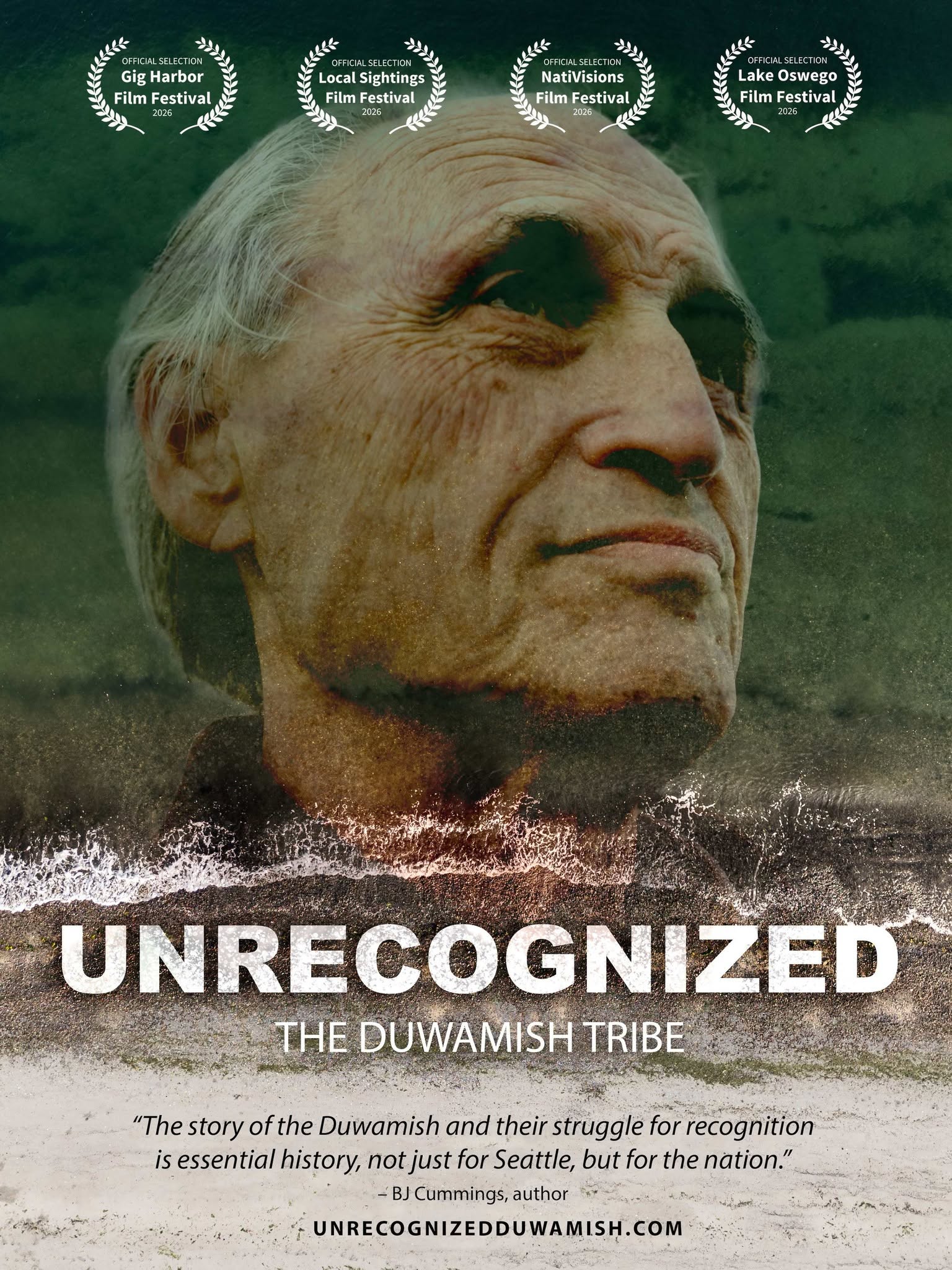
A half-hour documentary, Unrecognized: The Duwamish Tribe, brings this persistent conflict to the screen. Directed and presented by local documentarian B.J. Bullert, a member of the Center for Active Living, the film explores how the descendants of Seattle’s First People continue to fight for their sovereignty, cultural identity, and legal recognition despite decades of administrative denials, shifting federal rules, and pushback from neighboring federally recognized tribes.
Through historical records, personal reflections, and behind-the-scenes glimpses into public art decisions, Unrecognized demonstrates that the Duwamish refusal to be erased is as much a cultural movement as a political one.
Bringing the Story to Seattle Audiences: Upcoming Film Screenings
To mark Native American Heritage Month and engage the public in the ongoing dialogue surrounding tribal sovereignty, local venues across Seattle are hosting a series of screenings of Unrecognized: The Duwamish Tribe. These events combine film presentations with live panel discussions featuring filmmaker B.J. Bullert and Duwamish Tribe Council Member Ken Workman—a featured figure in the documentary and a direct descendant of Chief Si'ahl (Chief Seattle).
The screening schedule provides multiple opportunities for community members, historical scholars, and civic advocates to view the documentary and participate in post-screening Q&A sessions.
Date & Time |
Location & Neighborhood |
Program Details & Admission |
Featured Participants |
|---|---|---|---|
Thursday, November 19 (1:00 PM – 2:00 PM) |
Center for Active Living |
Presented in honor of Native American Heritage Month. • Free for members; $5 for non-members. • RSVP required via front desk (206-932-4044). |
Filmmaker B.J. Bullert |
Saturday, November 28, 2026 (7:00 PM) |
The Beacon (Columbia City) |
Double-bill screening alongside The Burning of Moses Seattle. |
Filmmaker B.J. Bullert & Council Member Ken Workman |
Wednesday, December 9, 2026 (6:45 PM – 8:15 PM) |
Saint Mark's Episcopal Cathedral (Capitol Hill) |
Part of the Cathedral Commons series in Bloedel Hall. Includes a dedicated post-screening discussion. |
Filmmaker B.J. Bullert & Council Member Ken Workman |
These public presentations emphasize the film's message that public art, civic dialogue, and historical documentation remain vital tools for educating the broader public about the survival of the Duwamish people in their ancestral homeland.
The 170-Year Fight for Federal Recognition
The legal and political campaign waged by the Duwamish Tribal Organization (DTO), headquartered in West Seattle, represents one of the longest-running tribal acknowledgment struggles in United States history. Rooted in unfulfilled treaty commitments, urban displacement, shifting administrative criteria, and complex inter-tribal dynamics, the tribe's journey spans nearly two centuries.
"Despite organized opposition from recognized tribes and legal pushback from the federal government, 'Unrecognized' shows how the Duwamish descendants of Seattle’s First People refuse to be erased."
Treaty Rights, Land Loss, and Early Tribal Organization (1855–1934)
The legal foundation of the Duwamish fight rests upon the Treaty of Point Elliott, signed on January 22, 1855. Chief Si'ahl (Seattle) was the first leader to sign the treaty on behalf of both the Duwamish and Suquamish peoples. Under the terms of the treaty, the Duwamish ceded more than 54,000 acres of land to the United States in exchange for a promised reservation, retained fishing and hunting rights, and federal infrastructure support. Although the U.S. Congress formally ratified the treaty in 1859, the federal government never created the promised Duwamish reservation.
As Seattle expanded rapidly, local settlers successfully petitioned Congress against establishing an Indian reservation near the growing city. Major urban development projects further eroded the physical footprint of the tribe's ancestral domain. Most notably, the 1916 engineering projects that lowered Lake Washington and drained the Black River destroyed core Duwamish village sites, longhouses, and riverine fisheries.
Facing displacement, many Duwamish families relocated to surrounding reservations created for other tribes—such as the Port Madison/Suquamish, Muckleshoot, and Tulalip reservations—and enrolled in those tribal governments. However, a significant population of Duwamish descendants chose to remain in their traditional territory around Seattle. In 1925, these non-reservation Duwamish formally organized by adopting a constitution and bylaws as the Duwamish Tribal Organization. Their legal standing gained crucial validation in 1934 when the U.S. Court of Claims ruled that the Duwamish Tribe held legal standing to enforce the 1855 treaty and awarded a monetary judgment for uncompensated lands.
The Bureau of Indian Affairs Process and the 48-Hour Recognition (1977–2015)
In 1977, under the leadership of Tribal Chairwoman Cecile Hansen—a great-great-niece of Chief Si'ahl—the Duwamish Tribe submitted its formal letter of intent seeking federal acknowledgment through the newly established Bureau of Indian Affairs (BIA) regulatory process.
The subsequent administrative journey was marked by decades of delays, policy shifts, and unprecedented political reversals:
- The 1996 Preliminary Denial: After reviewing the petition for nearly two decades, the BIA issued a preliminary negative finding, asserting that the DTO had failed to prove continuous political authority and social community from historic times to the present.
- The January 2001 Recognition: In the final days of the Clinton administration, Assistant Secretary of Indian Affairs Michael Anderson signed an official decision granting federal recognition to the Duwamish Tribe, finding that they met the necessary criteria.
- The 2002 Administrative Reversal: Within days of taking office, the incoming George W. Bush administration froze all pending midnight regulations. In 2002, the Department of the Interior formally suspended and reversed Anderson's decision, stripping the Duwamish of their newly restored status.
- Federal Court Remand and Re-Denial (2013–2015): The tribe challenged the reversal in court. In the landmark case Hansen v. Salazar (2013), a federal judge ruled that the Department of the Interior acted arbitrarily and capriciously by applying different acknowledgment standards to the Duwamish than to other petitioner tribes, ordering a formal review. Despite the court order, the Interior Department issued another final denial in July 2015.
Matrilineal Descent, the 2025 Judicial Order, and Modern Litigation (2022–Present)
Refusing to accept the 2015 BIA denial, the Duwamish Tribe launched a new federal lawsuit in May 2022, Duwamish Tribe v. Haaland. The lawsuit contended that the BIA's acknowledgment criteria unlawfully discriminated against matrilineal lineage—specifically penalizing tribal families where Duwamish women married non-Native settlers during the 19th and early 20th centuries—and violated the 1994 Federally Recognized Indian Tribe List Act.
In January 2025, U.S. District Judge Jamal N. Whitehead issued a decisive ruling ordering the Department of the Interior to reopen the Duwamish petition and re-evaluate it under updated 2015 BIA regulations. Unlike the older regulatory framework, the 2015 rules:
- Require petitioners to prove continuous social and political identity starting from 1900 forward, rather than from original contact in historic times.
- Provide explicit flexibility and realistic standards for out-marriage patterns and historical dispersion caused by urban development.
As of 2026, the petition remains active before the BIA as the Duwamish Tribal Organization submits supplemental historical documentation to satisfy the updated criteria.
2.4 Structural Challenges and Regional Tribal Opposition
The effort to achieve federal acknowledgment faces two distinct hurdles: administrative criteria and regional inter-tribal politics.
- Federal Regulatory Criteria: Proving continuous governance without a land base has historically presented an immense evidentiary burden. Because the federal government failed to provide a reservation, Duwamish families were forced to assimilate, intermarry, or disperse throughout the urban core, making rigid documentation of continuous political institutions exceptionally difficult under pre-2015 BIA standards.
- Opposition from Recognized Neighboring Tribes: Several federally recognized tribes in the Puget Sound area—including the Muckleshoot, Tulalip, and Suquamish tribes—actively oppose the Duwamish Tribal Organization's petition. These tribes argue that historical Duwamish individuals absorbed into their respective reservation communities after 1855, and that modern descendants are already represented by existing federally recognized treaty tribes. Furthermore, they express concern that recognizing a separate Seattle-based Duwamish entity would dilute existing treaty rights regarding fisheries, hunting grounds, and regional cultural resource management.
Cultural Resilience and Moving Forward
The fight for the Duwamish Tribe extends far beyond courtroom filings and administrative hearings. Through public education, documentary storytelling by filmmakers like B.J. Bullert, and leadership from figures like Council Member Ken Workman, the Duwamish continue to assert their presence as the original caretakers of the land.
By pairing historical documentation with community screenings across Seattle, the tribe and its allies ensure that the debate over federal acknowledgment remains a living civic discussion. As federal authorities re-examine the tribe’s petition under revised regulatory standards, the descendants of Chief Si'ahl remain steadfast in their pursuit of official legal recognition and the fulfillment of the 1855 Treaty of Point Elliott.
Unrecognized: The Duwamish Tribe trailer
BJ Bullert
