
Why the Sweeney Blocks are stalled — and what it reveals about the West Seattle Triangle’s unfinished future
Why the Sweeney Blocks are stalled — and what it reveals about the West Seattle Triangle’s unfinished future
Fri, 04/03/2026
For more than a decade, the West Seattle Triangle has been the neighborhood where Seattle’s big plans go to wait. It’s the place where the city envisioned a walkable, transit‑rich gateway district; where Sound Transit once promised a major light‑rail station; and where developers were told to design for a future that never quite arrived.
Now, the Triangle’s most significant private development, the two‑building Sweeney Blocks project, is caught in the same limbo. And the reason, according to owner Lynn Sweeney, comes down to a single bureaucratic demand from the Seattle Department of Transportation (SDOT):
Show us how your project will “respond to and inform the public realm.”
It sounds like planning jargon. But in the Triangle, it’s become a flashpoint that exposes a deeper problem: the city’s vision for the area has been rewritten so many times that no one, not SDOT, not Sound Transit, not developers, can say with confidence what the “public realm” is supposed to be anymore.
Westside Seattle reached out to SDOT for comment and will update this story or provide a followup if and when we hear from them.
A neighborhood shaped by plans that never materialized
To understand why Sweeney is frustrated, it helps to understand the Triangle’s history.
2011: The Triangle Plan
The city adopted the West Seattle Triangle Plan, envisioning:
- Wider sidewalks
- Active ground‑floor retail
- A more urban street grid
- A pedestrian‑friendly Fauntleroy Way
It was ambitious, but it depended on major transportation investments that were still years away.
2016–2023: Light rail becomes the anchor
When Sound Transit announced the West Seattle Link Extension (including the Avalon Station) the Triangle suddenly became the front door to the peninsula.
The Avalon Station was expected to bring:
- At a minimum hundreds of daily riders to start
- A transit plaza
- New bike and pedestrian routes
- A reconfigured Fauntleroy Way
- Higher density and more mixed‑use development
SDOT, SDCI, and private developers all began designing around this future.
2024–2025: The station disappears
Then, in a series of cost‑cutting decisions, Sound Transit removed the Avalon Station entirely, announced formally on April 1, though the final Board decision, which looks quite likely, will come in May.
The Triangle’s future and its public‑realm assumptions, essentially evaporated overnight.
The city, as could be expected, has not yet replaced those assumptions with a new plan. In fairness their requirements may be in flux too since the Avalon Station has been a part of the plan for years.
Into this vacuum steps the Sweeney Blocks
The Sweeney family has operated in the Triangle for generations. Their lumberyard (which was sold to Marine Lumber and whose doors closed March 27) was one of the last industrial holdouts in an area the city has been trying to urbanize for 15 years.
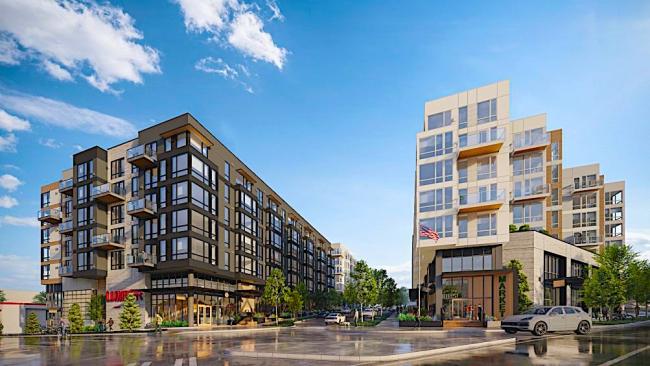
Their redevelopment proposal, two multi‑story mixed‑use buildings with housing and commercial space, is exactly the kind of project the Triangle Plan envisioned.
But Sweeney says SDOT is now requiring her to redesign portions of the project to “respond to and inform the public realm,” even though the public realm itself is undefined.
She describes the situation as “handcuffs” and “roadblocks,” saying SDOT’s shifting expectations are preventing her from breaking ground.
In the meantime they are attempting to “activate” the space with food trucks, and other ideas to keep it a place with public activity. They’ve also developed some added security for the now mothballed building.
What SDOT means and why it’s so hard to satisfy
In SDOT’s vocabulary, the “public realm” includes:
- Sidewalks
- Street trees
- Lighting
- Bike lanes
- Transit access
- Pedestrian circulation
- How buildings meet the street
For most projects, this is straightforward.
But in the Triangle, the baseline assumptions have been blown apart.
SDOT’s dilemma
SDOT cannot finalize its street concept plan for Fauntleroy Way and 36th Ave SW until it knows:
- Where building entrances will be
- How pedestrians will move
- How loading and utilities will be handled
Sweeney’s dilemma
Sweeney cannot finalize her building design until SDOT tells her:
- What sidewalk widths to assume
- Whether bike lanes are coming
- Whether transit stops will shift
- What the new street edge should look like
It’s a circular dependency created by the collapse of the Avalon Station plan. Hence the even greater significance of the Sound Transit Board's decision in May.
A neighborhood caught between eras
The Triangle today is a patchwork of:
- Legacy industrial uses
- New apartment buildings
- Vacant lots
- Half‑implemented streetscape improvements
- A transit plan that no longer exists
Developers are being asked to design for a future the city hasn’t defined.
City departments are reviewing projects using standards tied to a station that was erased.
And residents are left wondering why the area still feels unfinished after 15 years of planning.
The Sweeney Blocks are simply the first major project to hit the wall created by this uncertainty.
What needs to happen next
For the Sweeney Blocks and the Triangle as a whole to move forward, the city will need to:
- Clarify which parts of the old street plan still apply
- Publish interim public‑realm standards until a new plan is adopted
- Stop requiring developers to redesign to shifting assumptions
- Coordinate SDOT and SDCI expectations so applicants aren’t caught between agencies
- Acknowledge the impact of the Avalon Station cancellation on the neighborhood’s future
Until then, the Triangle remains a district defined by plans that never quite materialize and the Sweeney Blocks remain a symbol of a neighborhood waiting for the city to decide what it wants to be.
