
The span that almost wasn’t: A century of connecting West Seattle
The span that almost wasn’t: A century of connecting West Seattle
Sun, 05/03/2026
For the residents of the West Seattle peninsula, the high-level bridge is more than just a piece of infrastructure; it is a lifeline that has been shaped by a century of frustration, political scandal, and a catastrophic ship collision that changed the city’s skyline forever.
The "Sycamore Log" Days
The journey began in the late 1890s with a simple wooden trestle wagon road across the tideflats. By 1902, the first true bridge across the Duwamish River arrived at Spokane Avenue. It was a fickle, plank-decked structure hinged on a turntable. This bridge was so notoriously unreliable that frustrated locals once plotted to use a "tall Sycamore" log as a lever to force the mechanism to move when it jammed, illustrating the long history of transit-induced desperation in the neighborhood.
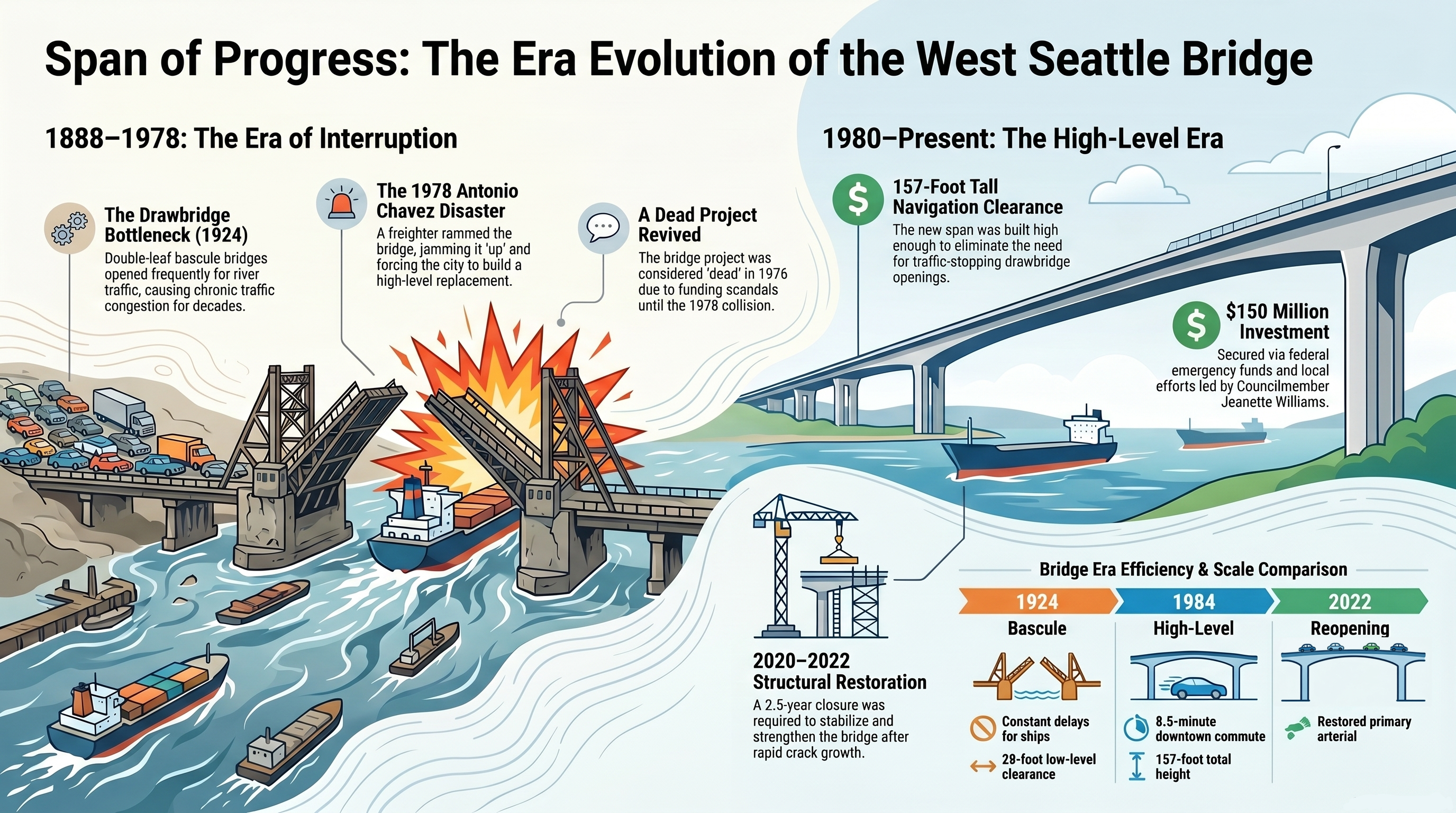
As the population surged, the city responded with more robust structures: a temporary wooden drawbridge in 1917, followed by the double-leaf Bascule Bridge No. 1 in 1924 and its twin, Bridge No. 2, in 1930. While these bridges offered a permanent connection, they created a new kind of hell for commuters: chronic congestion caused by the constant opening of the spans for maritime traffic on the Duwamish Waterway.
A Scandal and a Shipwreck
By the 1960s, city planners recognized that a high-level, non-drawbridge replacement was the only permanent solution to eliminate traffic delays. However, the project was nearly derailed by human greed. In 1976, a bribery scandal involving the project caused the State of Washington to withdraw its funding. By early 1978, the high-bridge dream was considered "dead".
Nature—and a 500-foot freighter—had other plans. On June 11, 1978, the Antonio Chavez slammed into the north drawspan of Bridge No. 1. The impact was devastating, jamming the bridge in the "up" position and damaging it beyond repair. Suddenly, a major artery to the peninsula was severed, and the city was forced to act.
The Political Fight for a Freeway
In the wake of the disaster, the debate over how to proceed was fierce. City officials weighed various options, including repairing the old bridge, building a tunnel, or even a curved bridge. Councilmember Jeanette Williams, chair of the Transportation Committee, took the lead in navigating the political minefield.
In April 1979, the City Council finally approved "Alternative Number 10"—the plan for the high-level bridge we see today. Political heavyweights like Senator Warren Magnuson were instrumental, securing $110 million in federal emergency funds to jumpstart the $142.3 million to $150 million project.
Building a Concrete Giant
Construction began in late 1980, employing a 1,300-person workforce to build the cantilevered segmental concrete structure. The new bridge was designed with 140 to 157 feet of navigational clearance, ensuring that ships could pass underneath without ever stopping traffic again.
When the bridge finally opened on July 14, 1984, it transformed the commute. Studies at the time showed that drivers could suddenly reach downtown in roughly 8½ minutes, a miracle compared to the drawbridge era. The bridge was eventually dedicated in a ceremony on August 9, 1991, and in 2009, it was officially named the Jeanette Williams Memorial Bridge to honor the woman who fought for its existence.
The Modern Crisis
The bridge’s resilience was tested again in March 2020, when engineers discovered rapidly growing structural cracks that forced an immediate, emergency closure. The neighborhood was once again isolated, echoing the days after the 1978 collision. After a grueling 2.5-year repair program to stabilize and strengthen the structure, the bridge finally reopened on September 17, 2022, continuing its century-old legacy as the indispensable link between West Seattle and the world.
