
Pickleball vs. Tennis: Seattle Residents clash over future of Alki courts as city hosts final Public Engagement sessions
Pickleball vs. Tennis: Seattle Residents clash over future of Alki courts as city hosts final Public Engagement sessions

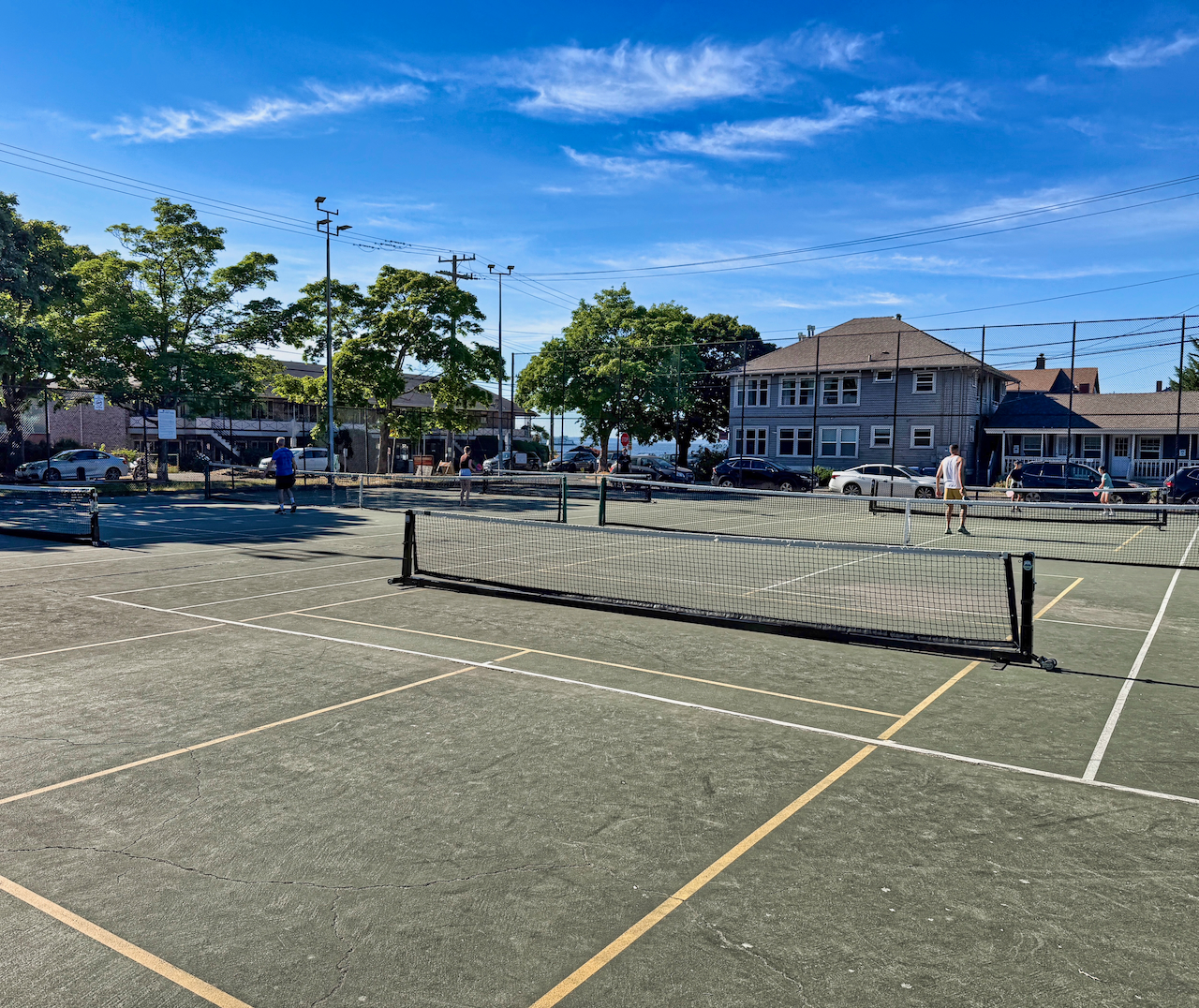
What is the future of pickleball near Alki? That's a question that will be discussed in upcoming public meetings led by Seattle Parks and Recreation.
Photo by Patrick Robinson
Sun, 06/21/2026
A deep divide has emerged in the West Seattle community over the future of local racquet courts at Whale Tail Park (Alki Playground) and beyond, as Seattle Parks and Recreation (SPR) prepares to host a series of public meetings this month.
The meetings are designed to present findings from initial public engagement and gather feedback on the 2026 Outdoor Racquet Sports Strategy, a plan that seeks to resolve friction by ending "dual use" — the practice of painting pickleball lines on existing tennis courts.
While SPR argues that dedicated courts will reduce conflicts such as "large groups encroaching into adjacent areas," the proposal has met fierce resistance from the pickleball community.
Anthony “Tony” Pisa, president of the Seattle Metro Pickleball Association (SMPA), argues that the current strategy unfairly targets specific neighborhoods and ignores the sport's explosive growth.
The "Three-Year Gap" and Neighborhood Impact
The primary concern for advocates like Pisa is the immediate loss of access. Under the draft plan, sites like Alki Playground are slated to become dedicated tennis courts, while new dedicated pickleball facilities are not expected to be ready for years.
“Essentially, there are 36 public courts that would be taken away from pickleball for about the next 2 to 3 years,” Pisa stated, highlighting a major timeline flaw. He expressed deep skepticism regarding the city's ability to build new infrastructure quickly, noting, “You think that's going to happen in a year? No way... it’s not possible”. Pisa argues that the proposal essentially asks taxpayers to wait or pay for private memberships while public access is stripped away.
Tearing Apart a "Social Hood"
Beyond logistics, Pisa emphasizes the social toll of removing pickleball from neighborhood hubs. He describes the sport as having a “zero barrier of entry,” allowing anyone to walk onto a court and find a community.
“Technically, yes, you're taking down access to public courts... but what you're doing is tearing apart a community,” Pisa said. He shared stories of residents who used the sport to escape isolation: “We had people come out and share their stories of how they were introverts and what COVID did to them in their homes... all of a sudden, they have a social hood of friends”.
Growth Rates and Data Disputes
The conflict is further fueled by a disparity in growth data. SPR aims to "equitably address the needs of court users," yet Pisa points out that while tennis is growing at roughly 10% in Seattle, pickleball is expanding at a rate of 54%.
Pisa remains highly critical of the city’s recommendations, stating, “The data was there—there was nothing supporting their recommendations whatsoever”. He also frequently reminds officials of the sport's status: “By the way, this is the official state sport... I'm just trying to remind you here that this went to the state capital and they made it the official sport”.
Public Meetings and the "Community Movement"
Following a petition that garnered 3,500 signatures, SPR has officially paused the plan's implementation to conduct further study. Pisa views this as a victory for organized advocacy. “This is a community movement, not just some one-off of a few people writing some letters,” he said. “The tide is definitely shifting”.
The city will present updated findings and hear from the public at the following 90-minute in-person sessions:
- Tuesday, June 23 at 6:30 pm: Dakota Place Park Building (4304 SW Dakota St. 98116)
- Thursday, June 25 at 6:30 pm: Mount Baker Rowing and Sailing (3800 Lk WA Blvd. 98118)
- Saturday, June 27 at 10:30 am: Magnolia Community Center (2530 34th Ave. W. 98199)
- Tuesday, June 30 at 6:00 pm: Loyal Heights Community Center (2101 NW 77th St. 98117)
For now, the status quo remains as the city considers several pilot programs to test "part-time" scheduling and other remediation efforts before a final strategy is implemented.
