
West Seattle neighbors air raw safety fears at community forum
Police pledge closer partnerships at meeting; SW Precinct Commander Bair and Interim Chief Sayles spoke
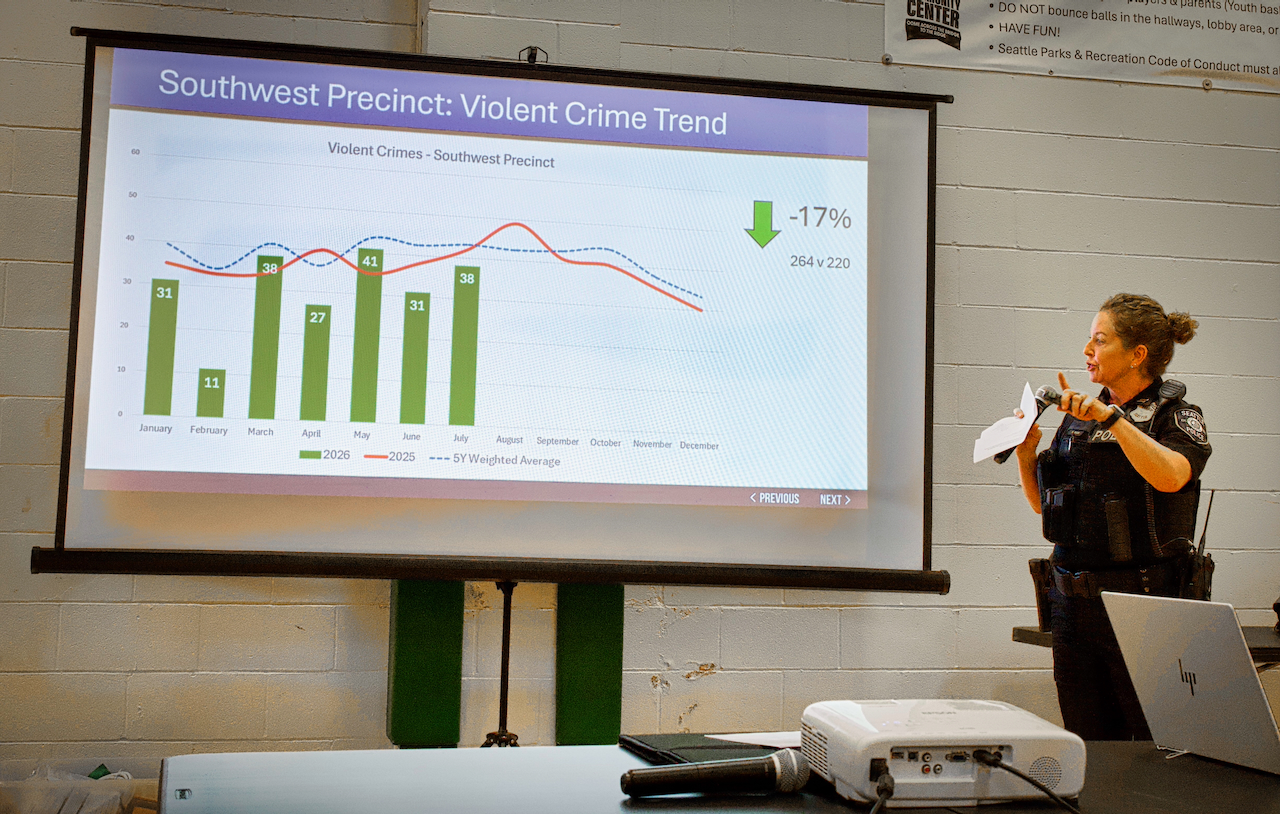
Southwest Precinct Commander Captain Krista Bair, shared revealing crime statistics for the area during the Our City , Our Safety community forum on Aug. 12. She noted that violent crime is down 17%.
Photo by Patrick Robinson
Wed, 08/12/2026
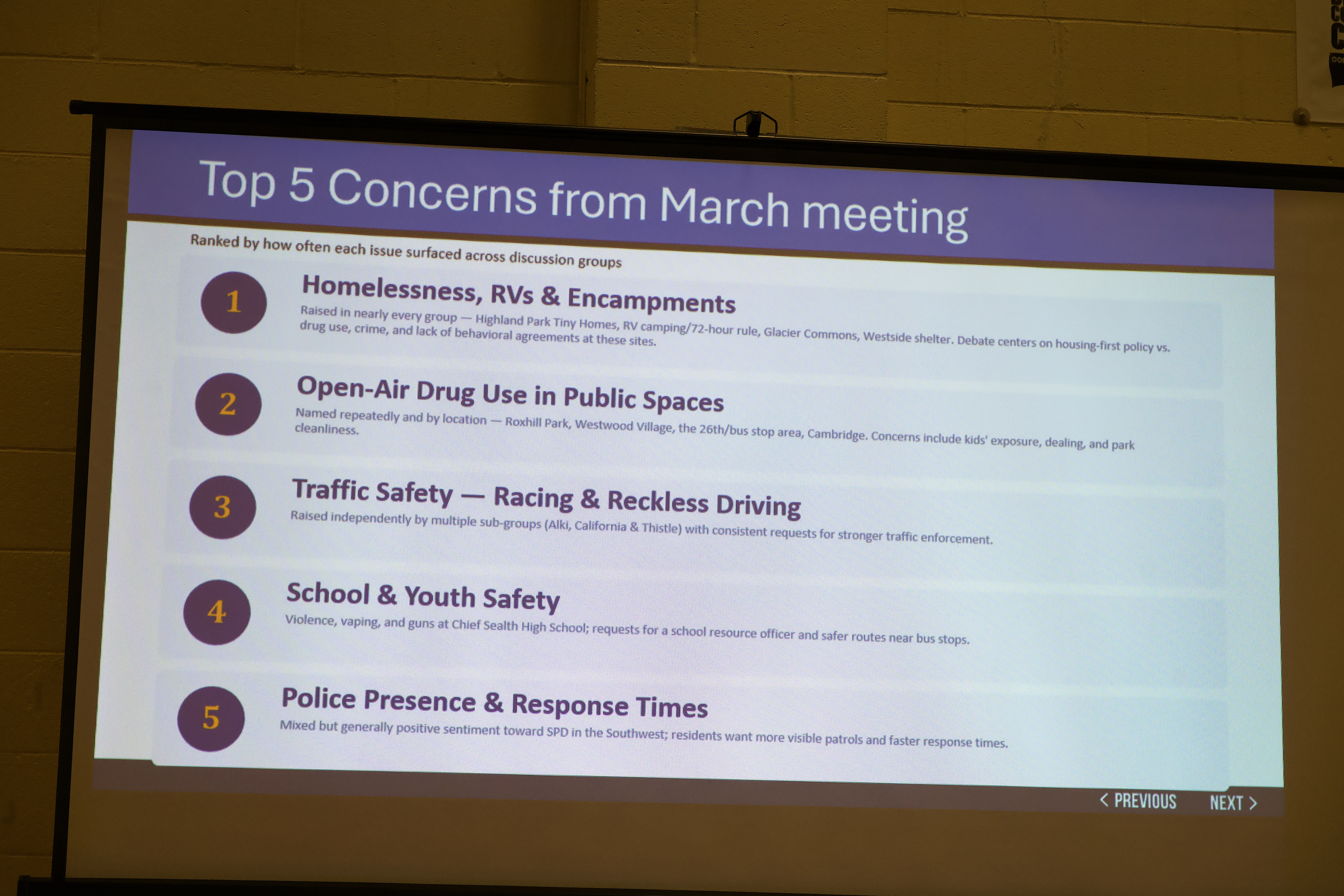
Neighbors from Southwest Seattle packed the Delridge Community Center on August 12 to share raw, emotional concerns about gun violence, open-air drug use, and speeding traffic during a public safety forum. The event, titled "Our City, Our Safety," was part of an ongoing series of community meetings co-hosted by the Seattle Police Department (SPD) and the Seattle Department of Neighborhoods. Designed to build collaborative relationships and listen directly to neighbor concerns, the forum brought together city executives, precinct leaders, and local residents seeking both immediate and long-term solutions to a recent uptick in neighborhood crime.
The meeting opened with a dramatic update regarding a delay in the arrival of Interim Police Chief Andre Sayles, who had to divert to an active scene where shots were fired at officers in the South Precinct.
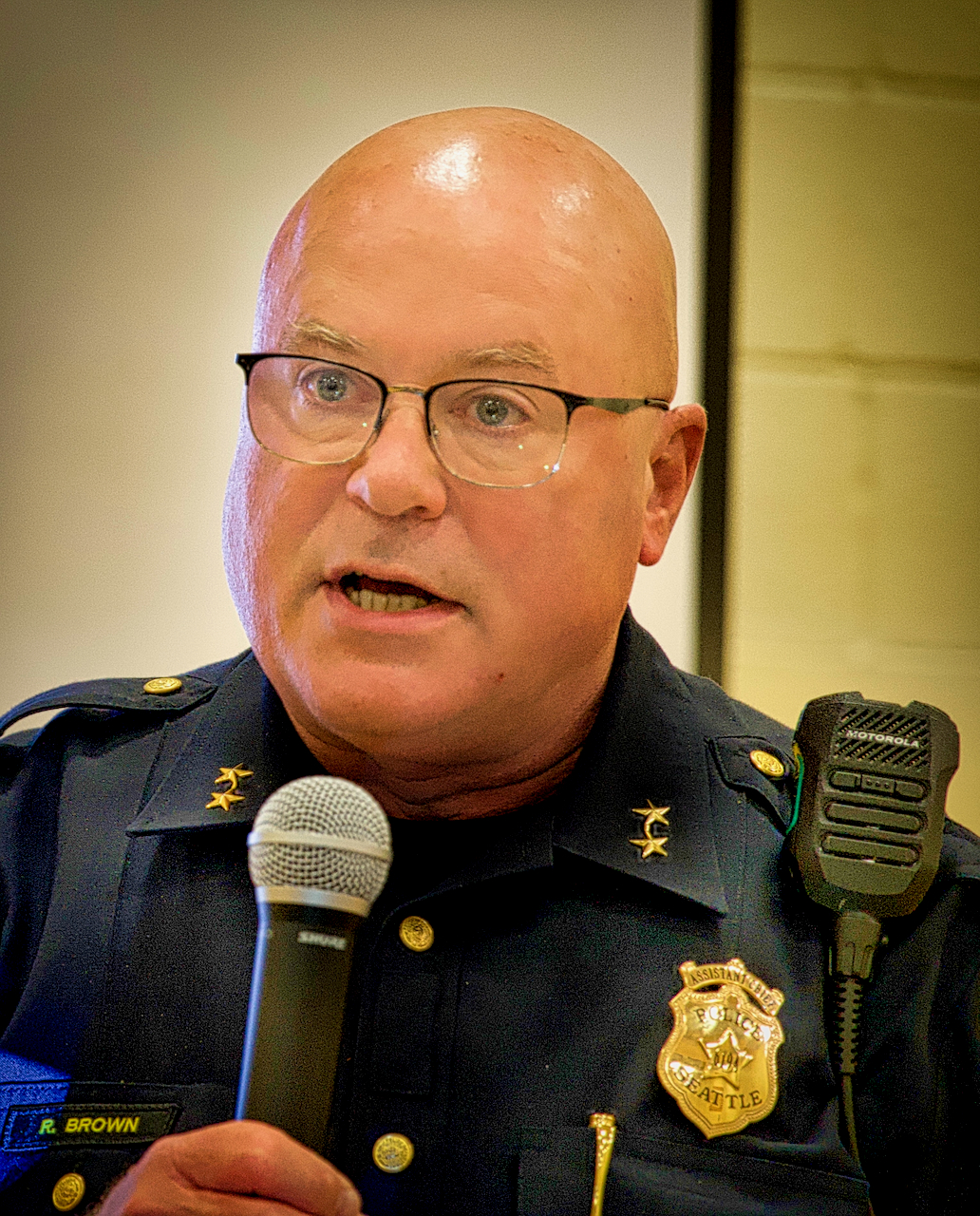
Stepping in to open the forum, Patrol Operations Chief Robert Brown explained the situation and emphasized that the evening belonged to the community. "I am Chief Robert Brown, patrol operations chief," Brown stated, defining his role over patrol uniforms and 911 response. "These are good opportunities for you to share with us with the Seattle Police Department what is foremost in your concerns for public safety. We learn a lot from these things... Really this is not, even though it's, you know, 'Our City, Our Safety,' this is led by you, not by us. We're not going to be speaking at you. We're going to be hearing from you".
Dr. Lee Hunt, the SPD Executive Director for Crime and Community Harm Reduction who served as the evening’s master of ceremonies, welcomed the robust turnout, contrasting it with a sparsely attended meeting in March.
"Our city, our safety is not just about SPD. It's about the partnerships we have with our other city departments," Hunt remarked, before introducing other city officials in attendance. Among them was Denise Calvin, Community Capacity and Safety Manager at the Seattle Department of Neighborhoods, who highlighted the city's commitment to community-led dialogue. "Our mission is to build trust, belonging, and collaboration between the city and the residents of Seattle," Calvin said. "We believe that when communities feel seen, heard, and empowered, they can create a lasting change that strengthens, and enriches our city".
Seattle City Attorney Erica Evans also addressed the room, introducing her office's precinct liaison and emphasizing their accessibility to neighborhood concerns. "Our office is here to hear you, to be accessible to you, and to meet your concerns," Evans stated, explaining that her office represents the city in both civil matters and misdemeanor criminal prosecutions. "We are essentially the lawyer for the city of Seattle, and I am your lawyer, and I want you to all know that we are here to serve you and to hear your concerns and partner with you to make our city safe". Representatives from Councilmember Saka’s office, the Unified Care Team, and Seattle Parks and Recreation were also on hand to listen to residents and take notes.
SW Precinct Commander Krista Bair presented a detailed overview of local crime statistics and precinct-level initiatives, pointing to several long-term priority areas on her presentation slides: the Alki Waterfront, Alaska Junction, and High Point. Commander Bair, who has served with SPD for just over 30 years, expressed a deep personal connection to the precinct. "Southwest has a special place," Bair shared. "That's where I was promoted to sergeant in that location and that kind of gave me my footing for supervision".
While Bair acknowledged the community's anxiety, she sought to provide perspective on overall crime trends, reporting that year-to-date violent crime in the Southwest Precinct was down 17 percent and property crime had decreased by 8 percent. However, she noted that proactive police activity had dropped by 15 percent, largely due to staffing limitations and a focus on responding to 911 calls. To help maximize officer availability, Bair urged residents to utilize online reporting or the non-emergency line for non-emergent issues. "If you don't need a police officer in front of you, if you can look to those other two alternatives, you allow our officers to be out to be preventative and to be proactive," Bair requested.
Bair also explained the science behind the precinct's "directed patrol" strategy, which is currently deployed in hotspots like High Point, Highland Park, Westwood Village, and Alki Waterfront. Drawing on the criminological "Koper Curve" model, Bair explained that keeping officers mobile in 20-minute intervals is far more effective than static patrols. "It actually is more effective if you have short amounts of time in each of these areas and you can keep that officer moving from one location to another as well as coming back at different random times," she said. Using a medical analogy, she described the quick patrol visits: "It's kind of like you go into an area and you get a shot, right? And so, that should help you out for about 20 minutes. Then you leave and it gives you about 90 minutes of coverage... So, you go back and you do a booster shot for another 20 points".
When addressing the difficult topic of public encampments and RVs, Bair was candid about the challenges city crews face. "The issue with RVs and tents and all that's a very very tricky topic... It's kind of like 'whack-a-mole.' So, you know, if you have them in your community and you move them, they just go somewhere else. So, it is something that is being worked on diligently," she noted, referencing weekly coordination with the city's Unified Care Team.
Following the formal presentations, the forum transitioned to small-group table discussions where residents shared deeply personal and distressing testimonies. Concerns about gun violence, particularly in the High Point neighborhood, dominated the conversations.
A High Point resident recounted a terrifying afternoon in a public park with his wife and dog. "In the middle of broad daylight there was suddenly that sound... we later heard about 40 shots," the resident recalled, describing the trauma of "seeing my wife, you know, hit the ground." He warned officials that "two people have died in that same spot within the last two years".
Another resident, who serves as a local summer youth program coordinator in High Point, spoke of the toll the violence has taken on children. "Kids are no longer kids. Kids are no longer feeling safe to play outside with their friends," the coordinator lamented, adding that youth interns now must walk with "buddies" or be dropped off directly at the facility to attend programs.
A local high school principal who resides in High Point shared an account of waking up in the middle of the night to gunshots. "There was a individual, young man that was shot right outside of my window. Woke me up in the middle of the night," she recounted, explaining that the victim was a local student. "It really affected our community for sure".
Other neighbors described a sense of lawlessness and a lack of consequences for open crimes. "We see crimes being committed in our community sort of very openly without much fear of... being contacted by a police officer, being arrested, being arrested even being fined or cited," one table representative reported, citing issues with open-air drug use, illegal park fires, and reckless driving. A resident of Snake Hill described a six-week pattern where masked young men drop off and retrieve stolen cars in their neighborhood.
Residents also lamented a "catch-22" regarding community safety. "The most effective method for crime prevention in neighborhoods... is community engagement and people are fearful to engage. It's, I think, it's gone on too long now. There's just not the trust isn't there really in general," a resident noted.
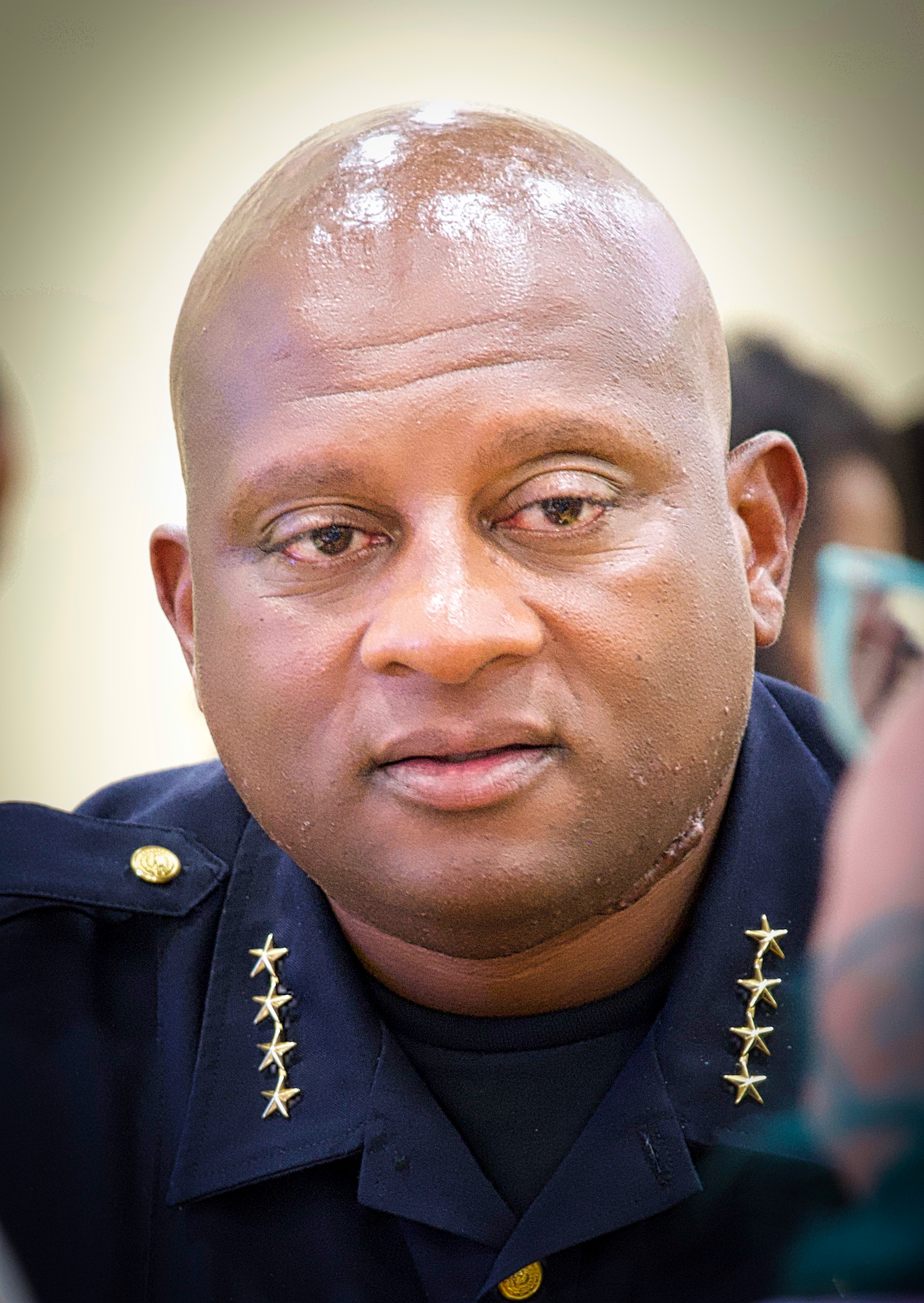
Interim Police Chief Andre Sayles arrived later in the evening after working with officers on the South Seattle shooting incident, and spoke directly to the anxious crowd. "I want you all to understand that I'm hearing what you're all saying. The police department's hearing what you're saying," Sayles assured attendees.
Sayles announced that the department's Community Response Group (CRG) is now working closely with investigators to target active crime areas. "They are going to be, I call them, our proactive team that's going to be very proactive in some of the things that we're hearing throughout the city of Seattle," Sayles said. He emphasized that establishing trust must precede traditional community policing. "I truly believe before we get to community policing, we have to develop those relationships... Build relationships first. Then we can get to that community policing and we can really build this thing out".
Sayles noted that the presence of several high-level SPD executives at the meeting was a deliberate effort to establish those vital connections. "Very too often, sometimes you really don't see the top people at these meetings, but you look around today, you have several of us that are, quote-unquote, the executives within our police department that's here because we really want to hear what's going on," Sayles explained. He concluded by urging residents to keep talking to the department. "Please give us the feedback because without that feedback, we don't know what's happening and we can't solve some of the issues that's going on in the community specifically here, specifically at High Point... There's never too much information. That information helps us be better at what we're doing".
The forum concluded with neighbors and city staff working collaboratively to clear the room, folding tables and chairs together. While deep frustrations remain, residents expressed a shared determination to continue the dialogue, utilizing local community meetings and neighborhood associations to keep public safety as a top priority.
____________________________

© 2025 Robinson Communications Inc. All Rights Reserved.