By Liz Steen
For two years, a nearly six-figure cyber-harassment campaign consumed our family’s time, money and ordinary life while Seattle failed to stop it.
Most people who hear the story start with the mayor for understandable reasons. Wilson faces a possible recall over public safety. Blaming Wilson,or “communism” or “left-wing politics”, is satisfying.
It just doesn’t explain what happened.
“Have You Checked the Website?”
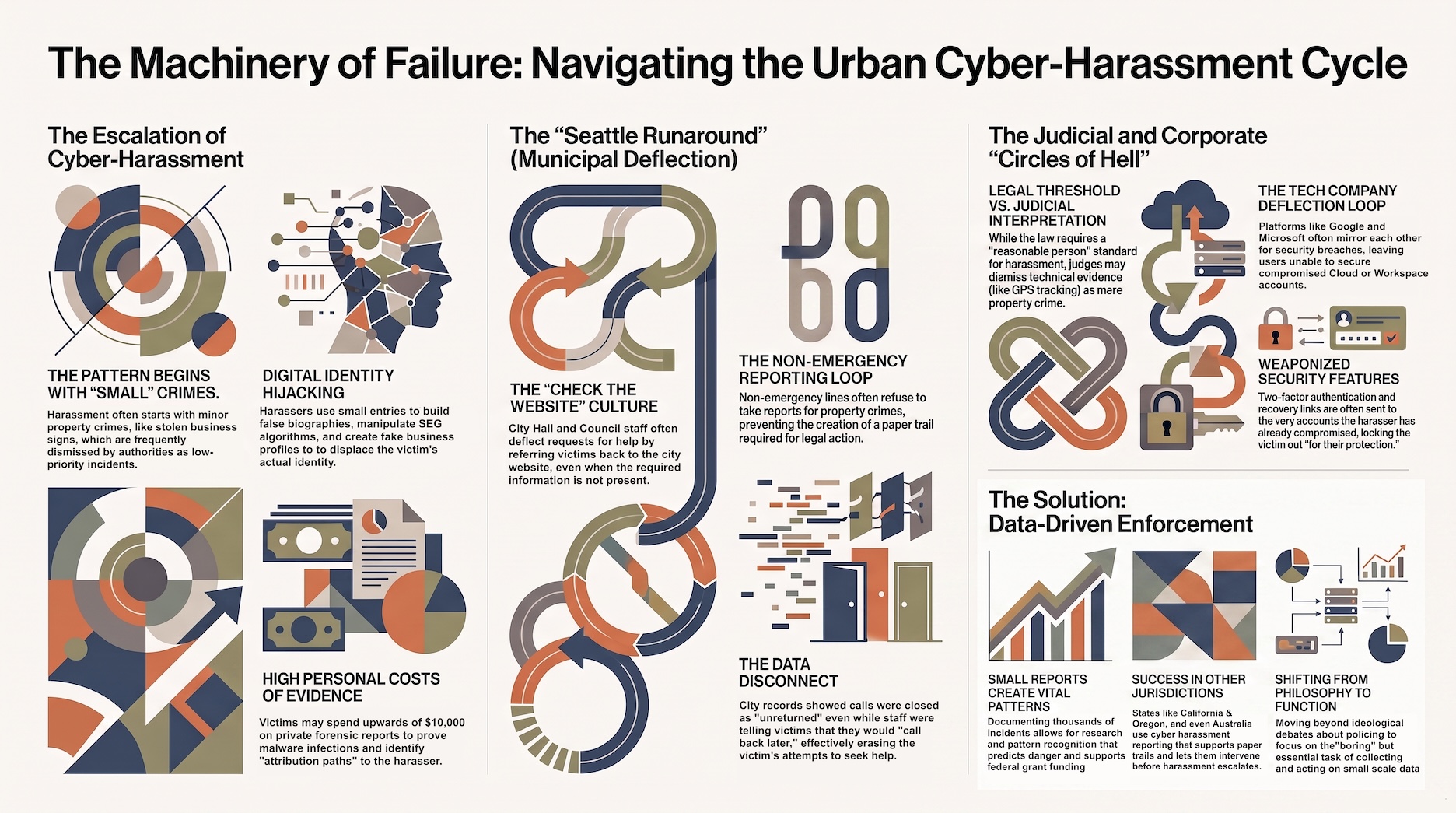
Three months into Wilson’s term, and two years into our cyber harassment situation, I went to the information booth at City Hall. One staffer ignored me while another answered my questions by reading from the city website. I explained that I had already read it. “I’m not reading the website,” she said, looking at the website.
Wilson had been mayor barely longer than a Netflix limited series. She did not create this culture. Upstairs, I tried my City Council member’s office. “Did you check the website?” I had.
Stolen business signs and strange calls had become compromised accounts, impersonation profiles and malware.
We needed evidence to get reports and reports to get evidence.
I knew the pattern from years of domestic-violence work. I also knew where it could lead. I left the council office a preliminary forensic report that cost us $12,000.
“I think what you need is really on the website,” the staffer said. It wasn’t.
The Small Things
When the harassment started, the city website sent me to the neighborhood crime-prevention coordinator. She sent two emails explaining why my complaint wasn’t her job, then disappeared.
The non-emergency line often rang more than 30 minutes before someone picked up to tell me they couldn’t help.
Meanwhile, my business signs disappeared. A tracker followed one to a man’s office, home and brunch, where I found it and asked for it back. I sought a protection order. “I think you did it,” the judge told him. “Cut it out.”
Then she told me to file a property crime report. The non-emergency line wouldn’t take one.
And Then the Police Helped
Eventually, I uncovered connections between accounts I controlled and accounts I didn’t. I called police. The officer understood immediately.
She documented what she could and connected it to an earlier police report. A Seattle prosecutor later spent her lunch break helping me after another official refused to accept protection-order paperwork. I wish this story fit neatly into Seattle political camps of Team Police or Team Harm Reduction. It doesn’t.
Both sides deserve respect. Police helped. Almost nobody else did.
“Cut It Out”
After collecting a forensic report, account records, years of messages and investigators ready to testify, we sought another protection order. Neither investigator was allowed to testify. The judge again turned to the man we accused and yelled, “Cut it out!” That night, I checked my most secure account. Its password had been changed that day. “Cut it out” had not worked.
The Seattle Runaround
Police told me to keep filing reports to build a record. The non-emergency line wasn’t letting me. Later, I pulled city records and found that, repeatedly, at the same moment the city texted that someone would call me later, a staffer had closed my call because I supposedly had not returned a voicemail. I went back to my council member.
His office finally responded, with another number from the city website. That led to a suggestion that I speak with a social worker. I did not need a social worker. I needed paperwork.
Staffers eventually referred me back to the same crime-prevention coordinator who had disappeared years earlier. She never called.
A Google-Lawyer Circle of Hell
Google had its own version of the Seattle runaround. In one of many incidents, Google locked an account “for my protection,” then repeatedly sent the recovery link to the account it had locked me out of. Every company held a piece of my data and a practiced spiel to point me in another direction.
My data belonged to everyone. Responsibility belonged to no one. Then I learned my council member’s previous profession: lawyer for Google and another major tech company. His staffer’s faith in the website now made sense.
The Data We Throw Away
At City Council meetings, residents beg officials to end the “Seattle runaround” our family found. Small reports are deflected. Large problems hit staffing shortages. Without the small reports, patterns disappear. That is the part we could fix. Domestic-violence advocates know terrible incidents rarely start terrible. They start small. Document one and you have a report. Document thousands and you have research. Seattle is a tech city. We need fewer circles of bureaucratic hell and better data. Collect the small reports.
Find the patterns.
We already have an information desk.
Use it.