
Highland Park Action Committee tackles crime trends, affordable housing development, and drainage infrastructure at community meeting
Highland Park Action Committee tackles crime trends, affordable housing development, and drainage infrastructure at community meeting
Wed, 09/23/2026
At a Highland Park Action Committee (HPAC) meeting held at the Delridge Library on September 23, 2026, neighborhood residents gathered for an extensive three-part agenda addressing pressing community safety and local development issues. Southwest Precinct police leadership delivered a detailed crime update highlighting shifting statistical trends, ballistics tracking, and targeted retail theft enforcement.
Following the police briefing, leadership from the Homestead Community Land Trust presented updated architectural plans and funding strategies for a 20-unit permanently affordable homeownership project at 16th Avenue SW and SW Holden Street.
To close the meeting, Seattle Public Utilities (SPU) outlined upcoming construction plans for the Holden Street Natural Drainage Systems project, designed to filter polluted runoff and alleviate localized flooding.
Crime Statistics, Gun Tracking, and Public Safety Concerns Dominate Police Briefing
Southwest Precinct Commander Captain Krista Bair, accompanied by Operations Lieutenant Patrick Daly, opened the meeting with an in-depth review of crime statistics across Highland Park and West Seattle. According to public dashboard data, overall crime in Highland Park is down 27 percent compared to the previous year, while crime across all of West Seattle has decreased by 9 percent. Property crime has seen notable declines: reported thefts in Highland Park fell from 131 to 94, and motor vehicle thefts dropped from 71 to 33.
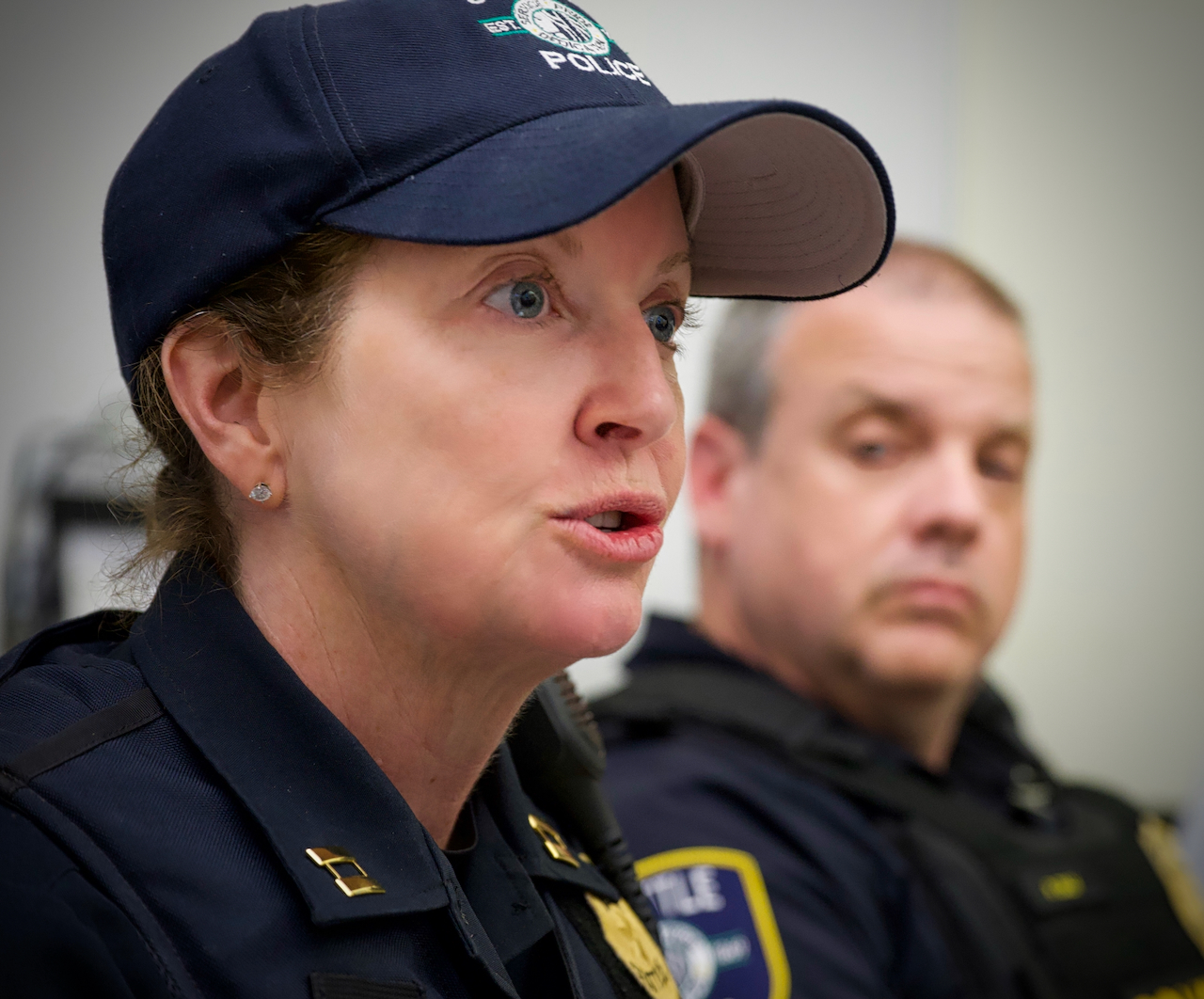
However, shots fired incidents in Highland Park have risen to 15 year-to-date, up from 10 at the same point last year. Across West Seattle, police have recorded 73 shots fired incidents year-to-date, resulting in 11 injuries and 62 cases involving property damage or recovered shell casings, primarily occurring between 11:00 p.m. and 2:00 a.m. on weekends.
Addressing the gap between statistical trends and community experience, Captain Krista Bair emphasized that statistics do not outweigh resident lived experience.
"We all know stats. We all know that we have evidence-based stuff that supports the stats. That's great and that helps us figure out where we need officers," Captain Bair stated. "However, the community's perception is so much more important because you are the ones that are living through it. And so, if I were to sit here and say, 'Well, gun violence is down,' that's not what you're feeling."
Captain Bair detailed SPD's ballistics processing protocol, pointing out that the department thoroughly processes every recovered shell casing through the National Integrated Ballistic Information Network (NIBIN) to trace specific firearms across multiple crime scenes. She explained that a recent spike in recovered shell casings is directly tied to illegal firearm modifications, such as trigger switches that convert semi-automatic handguns into fully automatic weapons.
Lieutenant Patrick Daly and Captain Bair also highlighted targeted enforcement efforts against organized retail theft rings. Captain Bair shared that the Ulta Beauty store at Westwood Village currently holds a troubling national distinction.
"Our Ulta at Westwood Village is the number one hit Ulta in the nation," Captain Bair noted.
To combat this, First Watch Lieutenant Wes Collier partnered with store management to place GPS tracking devices inside commonly stolen items. When a tracker was recently activated, precinct officers coordinated with downtown units to track the suspect, resulting in a successful arrest at 12th Avenue South and South Jackson Street.
To enhance student safety, Captain Bair explained that SPD has established automated direct patrols through CARE 911 dispatch at five key high schools, including Chief Sealth International, Garfield, Franklin, Ingraham, and Rainier Beach, ensuring officer presence during morning arrivals, lunch periods, and dismissals.
During the Q&A portion, community members voiced intense frustration over localized public safety disruptions. A local fourplex owner across from the Salvation Army on 16th Avenue SW described ongoing squatter fires, property destruction, strangers using her building's water spigots resulting in $1,500 water bills, and tenants wielding baseball bats to defend against late-night intruders. Another resident recounted late-night street racing and slow police response times, sharing that he had been shot at in the neighborhood two years prior.
In response, Captain Bair offered Crime Prevention Through Environmental Design (CPTED) assessments with Crime Prevention Coordinator Jennifer Satterwhite, committed to adding direct patrols to problem blocks, and explained that precinct staffing averages about 10 officers per shift covering all of West Seattle. Lieutenant Patrick Daly reinforced police commitment to ongoing communication with HPAC leadership.
"This is why we come as a pair," Lieutenant Patrick Daly noted, affirming that precinct leadership will continue attending monthly meetings to follow up on neighborhood concerns.
Homestead Land Trust Outlines Plans and Funding Strategy for Permanent Affordable Homeownership
The second segment focused on the redevelopment of the former City Light power substation property at 16th Avenue SW and SW Holden Street. Homestead Community Land Trust, in partnership with SMR Architects, is moving forward on a plan to convert the 9,400-square-foot surplus parcel into a four-story building featuring 20 permanently affordable for-sale homes and ground-floor commercial space.
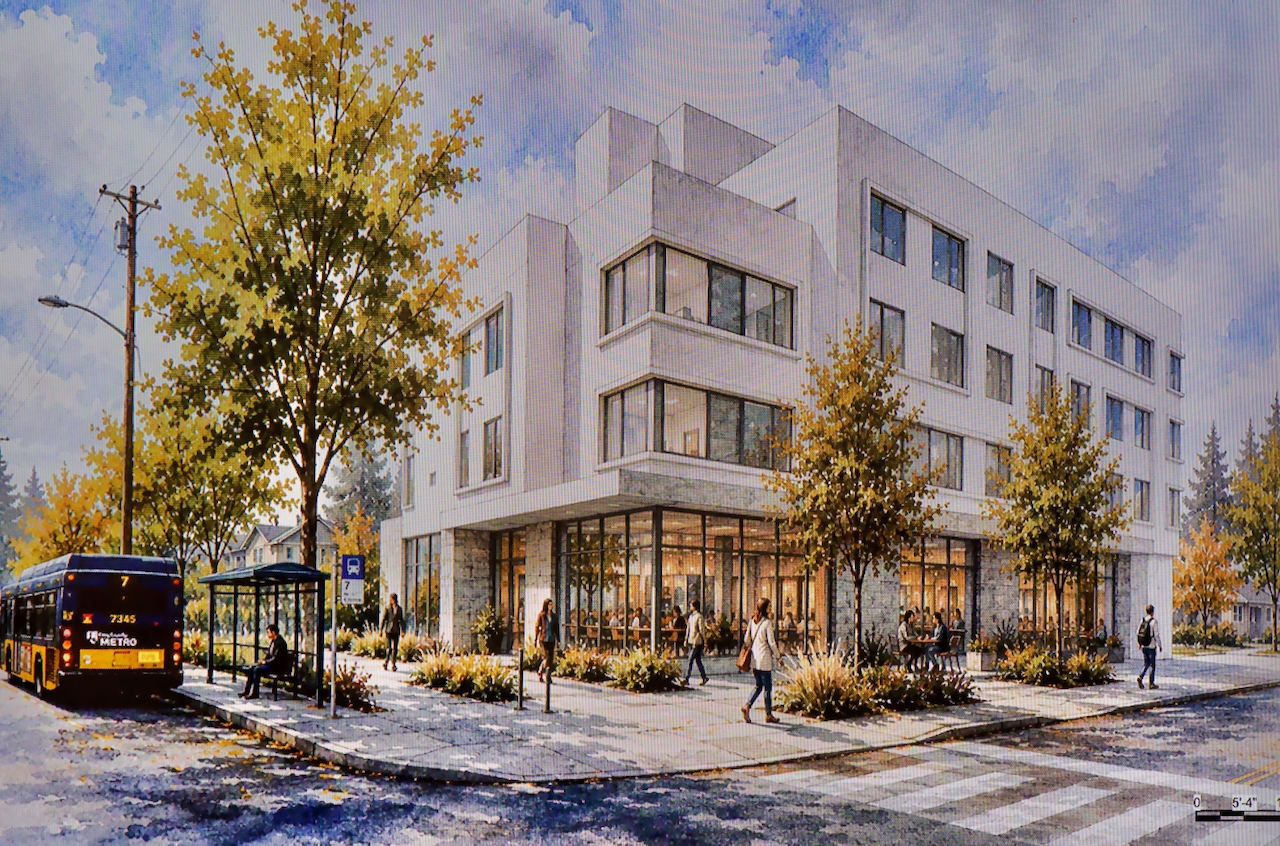
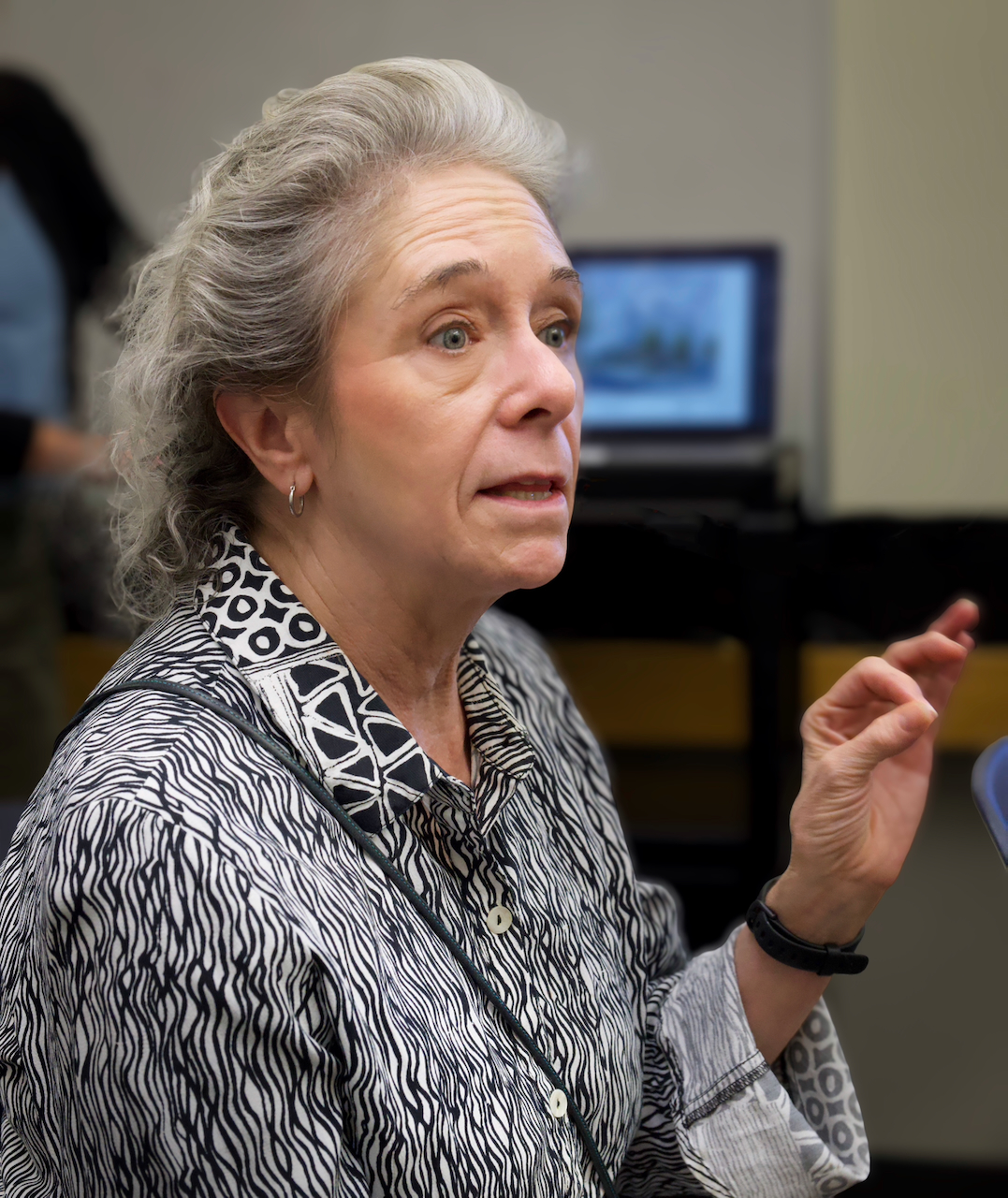
Kathleen Hosfeld, Chief Executive Officer of Homestead Community Land Trust, praised former City Councilmember Lisa Herbold for securing the property transfer before leaving office. She explained that the project design directly reflects community priorities for homeownership above street-level commercial space.
"This project got started because the City of Seattle made this property available," Hosfeld said. "The main thing that I'm going to ask Eric to address when he does his comments is the affordable housing world works on an annual cycle of funding. And we have, this is the third year that we've applied for State of Washington Housing Trust Fund funds. That's what we're being held hostage to is getting the Housing Trust Fund money."
Hosfeld expressed optimism that state funding will be awarded in January 2027, allowing site preparation and construction to begin by early summer.

Eric Pravitz, Director of Real Estate Development at Homestead, explained the financial structure required to keep land trust homes affordable to buyers earning 80 percent or below area median income (AMI).
"Because all these homes are going to be sold to households that have incomes at 80% or below of median income, we try to actually sell them at a price that is more in the 65 to 70% affordable level," Pravitz explained. "If the home cost us $600,000 to build it, we're selling it for $300,000. We need $300,000 in capital subsidy in there."
Pravitz noted that the project has secured $3 million from the Seattle Housing Levy and has applied for state Department of Commerce CHIP infrastructure funds for utility connections. Under Homestead's 99-year ground lease model, buyers agree to a restricted resale formula that limits equity gains upon sale, ensuring each home remains permanently affordable to future low- and moderate-income purchasers.
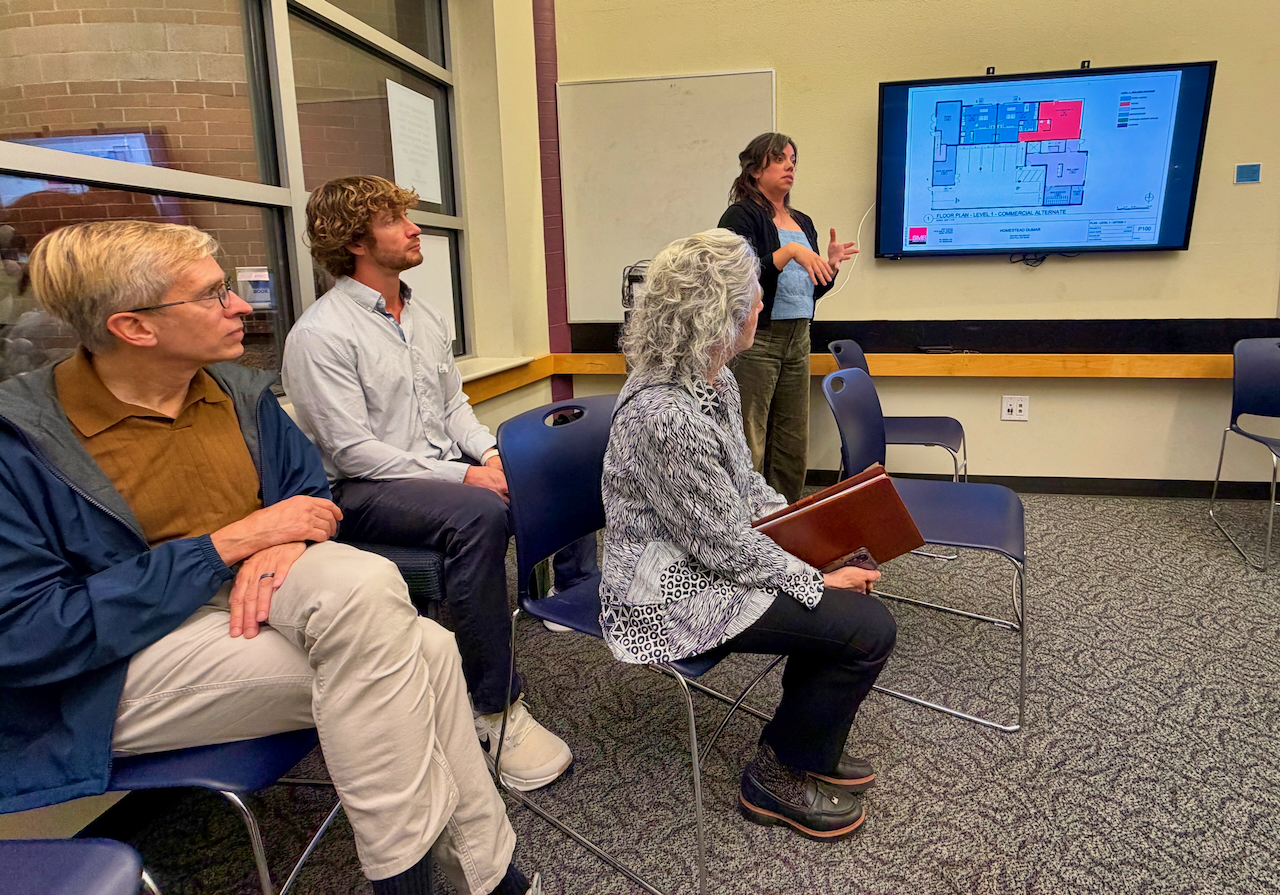
Megan Espinosa, Lead Architect with SMR Architects, presented two ground-floor layout options for community input. Option 1 pairs an 800-square-foot commercial space with two live-work lofts for local artists, while Option 2 features a larger 1,450-square-foot commercial footprint paired with one live-work space.
"This is one option for the first floor," Espinosa presented. "We have an option to have a smaller commercial space on the corner and then having some live-work artists in the blue as an option for folks who would live there but also have a small business."
Espinosa detailed that the upper floors will contain a mix of one-, two-, and three-bedroom homes. The fourth floor will set back from 16th Avenue SW due to high-voltage power line clearances, accommodating six residential units, a green roof for stormwater management, and a rooftop amenity space for residents. Homestead is coordinating with the Cultural Space Agency to facilitate long-term community ownership of the ground-floor commercial units.
Seattle Public Utilities Details Upcoming Holden Street Drainage Infrastructure Construction
The meeting concluded with a presentation from Seattle Public Utilities (SPU) regarding the Holden Street Natural Drainage Systems (NDS) project. Located along SW Holden Street between 16th Avenue SW and 17th Avenue SW, the project will construct roadside rain gardens and bioretention cells designed to capture, slow, and filter polluted stormwater runoff before it empties into Longfellow Creek and Puget Sound.
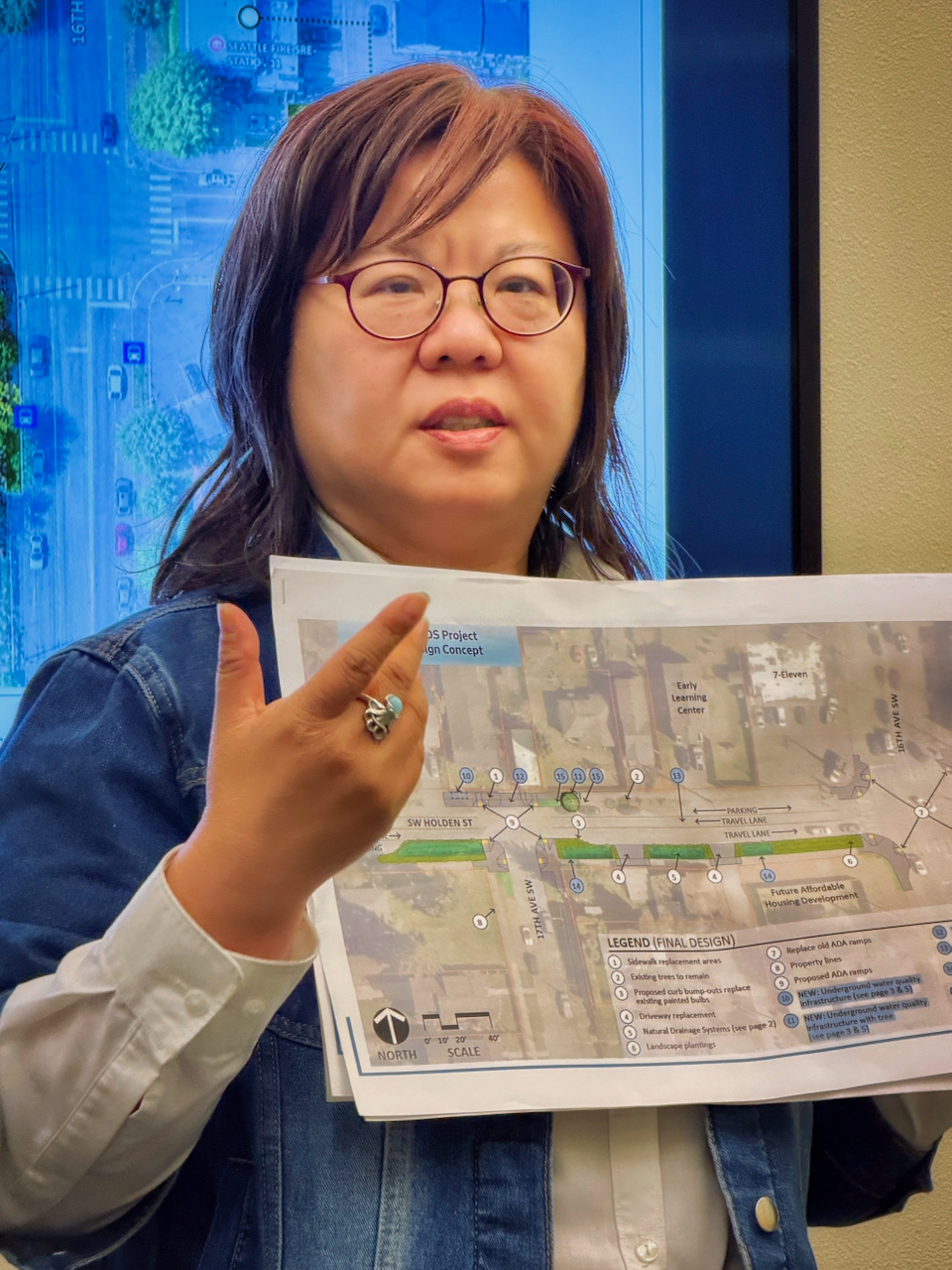
Wan-Yee Kuo, Senior Project Manager at SPU, clarified the core purpose of the project while pointing out additional localized benefits.
"This project is about water quality. It's a water quality project," Kuo explained. "Although we are solving a localized flooding issue at the intersection of 17th and Holden... water is going to come into the system. It's going to go through the plants and the filter soil and get cleaned up and then go back to Longfellow Creek."
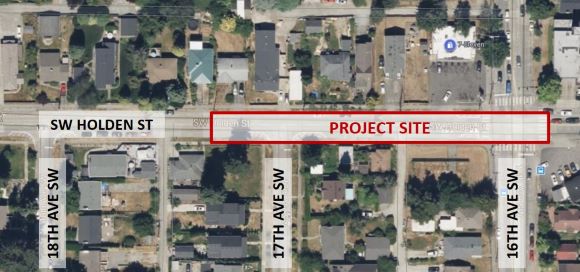
Kuo outlined street modifications along SW Holden Street, including roadway narrowing, new ADA-compliant curb ramps at 16th and 17th Avenues SW, pushing out the southern curb line (which will eliminate street parking on the south side of SW Holden Street), and removing speed cushion #13 near Fire Station 37 at the request of the Seattle Fire Department.
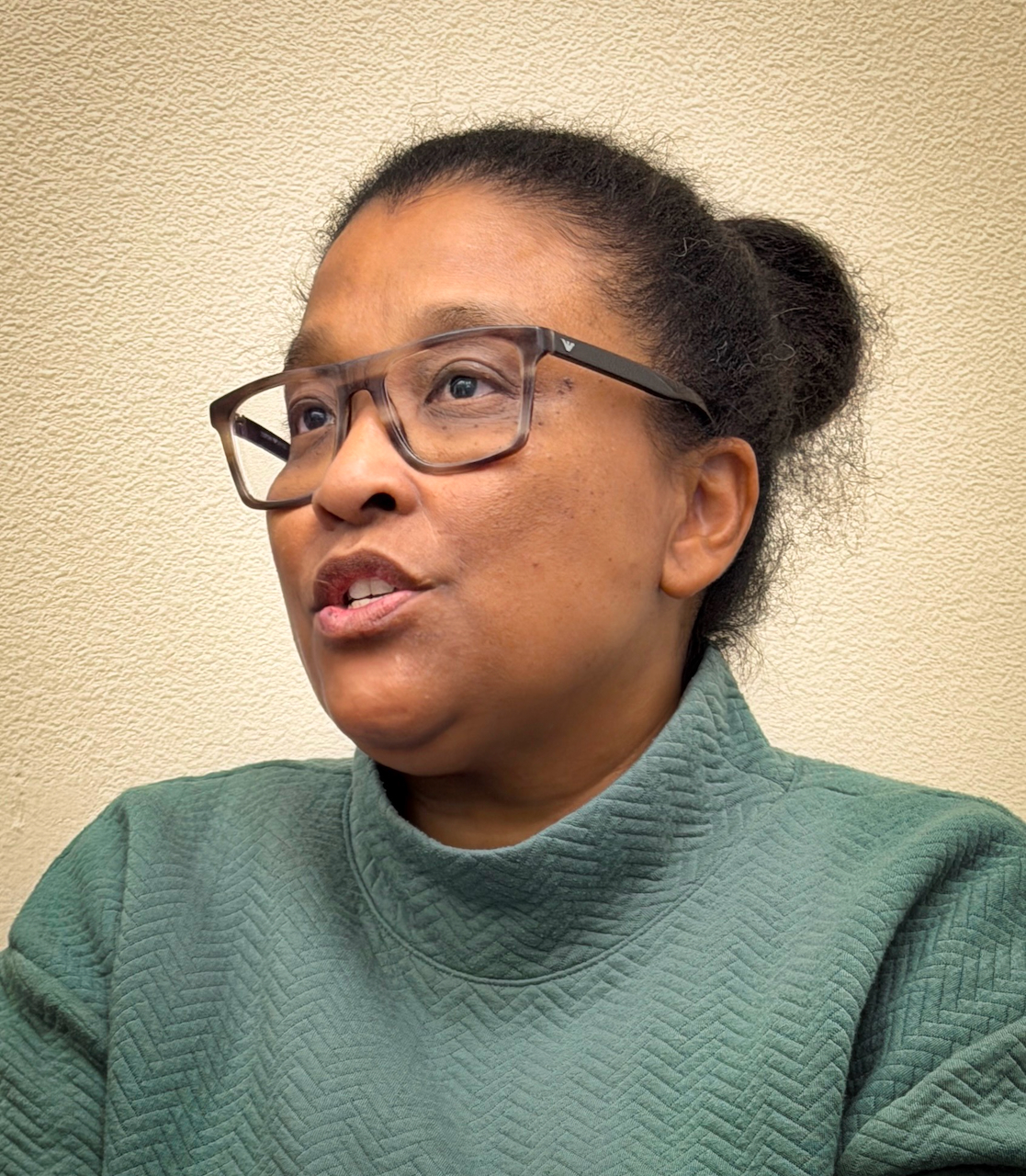
Yolanda Neal, SPU Resident Engineer overseeing daily construction operations, announced that South Park-based Laser Construction has been selected as the project contractor.
"Laser Construction is the awarded contractor. They are a local construction company. Actually, their main office is right down at South Park," Neal shared. "So they have a vested interest in the community and its growth... They do great quality work, and they are very responsive towards the community, the stakeholders, and the impacted residents."
Neal noted that Laser Construction previously completed the Sylvan Way natural drainage project ahead of schedule. She assured neighbors that SPU and the contractor are coordinating traffic management with local emergency services and managing access for a home daycare on 17th Avenue SW. Job site security measures will also be implemented to prevent equipment theft.
Construction is slated to begin in mid-October 2026 and will take approximately 8 to 10 months, with completion anticipated by summer 2027. SPU team members invited community members to attend an informal drop-in information session on Saturday, October 3, 2026, from 9:00 a.m. to 11:00 a.m. at BedHead Coffee (1513 SW Holden Street).
