
UPDATE: Fauntleroy Ferry Terminal reopens with 3 boat service following engine room workers call out
UPDATE: Fauntleroy Ferry Terminal reopens with 3 boat service following engine room workers call out
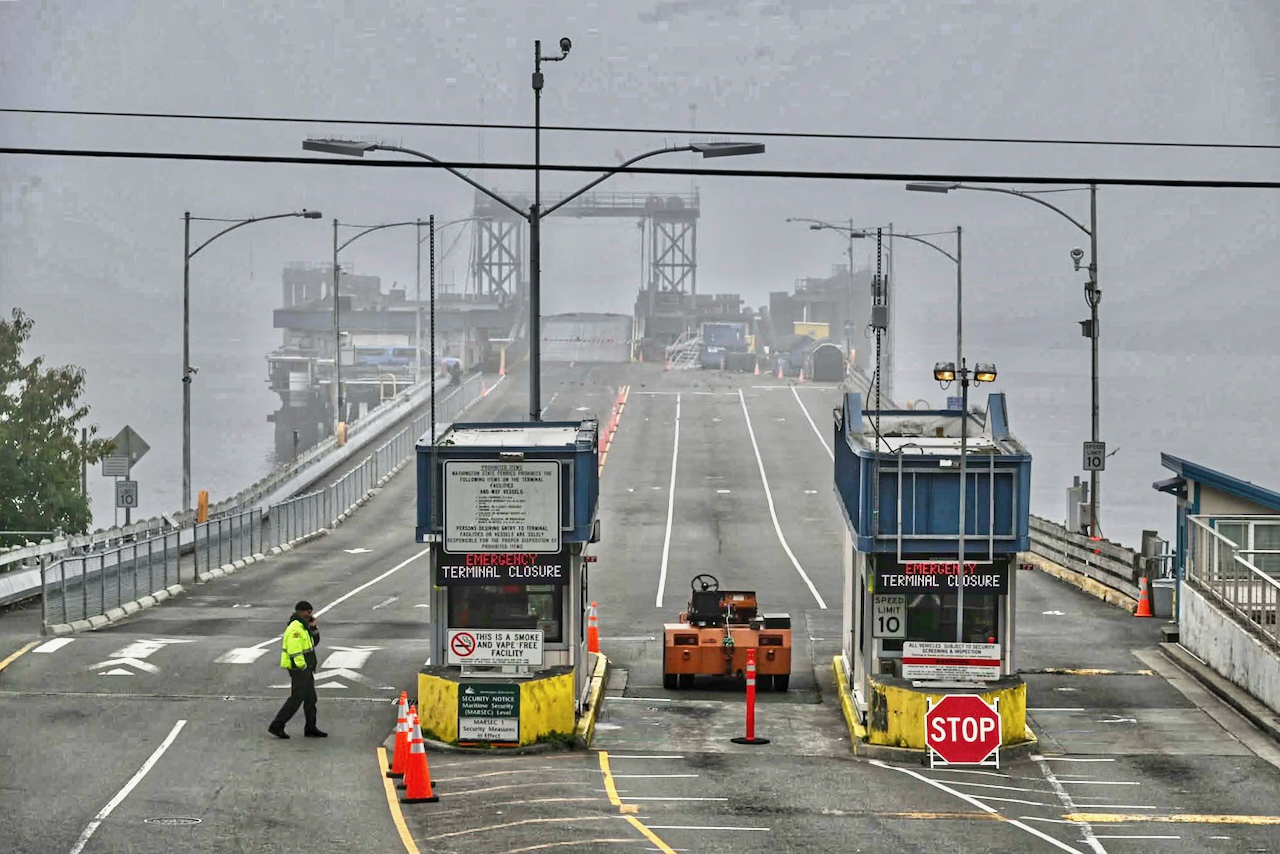
No ferries coming or going at the Fauntleroy Ferry Terminal on Oct. 5 due to a worker calllout.
Photo by John Skerratt
Mon, 10/05/2026
UPDATE 6:30pm
Three boat service has resumed on the Fauntleroy/Vashon/Southworth ferry route this evening.
The route will run 2-boat schedules with the 3rd unscheduled boat.
You can follow updates on the callout and service on the Washington State Ferries website. https://wsdot.com/Ferries/Schedule/scheduledetailbyroute.aspx?route=f-s
or on the WSDOT App for your phone.
Other routes are returning to service as well though the sailings are not clear at this time
Sea/Brem - Additional Kitsap Transit Fast Ferry Sailings Today, Oct. 5
Kitsap Transit is providing additional fast ferry sailings today, Monday, Oct. 5, to help accommodate passengers affected by WSF service disruptions.
Additional Bremerton Fast Ferry departures are scheduled for:
- 6:30 p.m. from Bremerton
- 7:10 p.m. from Seattle (Pier 50)
Fast ferries are passenger-only and do not carry vehicles.
For schedules and service information, visit Kitsap Transit’s Fast Ferries page
In response to widespread ferry disruptions today Governor Bob Ferguson issued a statement addressing the union negotiations and setting a firm expectation for service restoration.
Key points from Governor Ferguson's statement:
-
Acknowledgment of Impact: He noted that as a regular ferry rider himself, he knows how critical the system is to Washingtonians and acknowledged the severe inconvenience caused to thousands of residents.
-
Meeting with Union Leadership: Ferguson confirmed he met on Monday morning with both local and national leadership from the Marine Engineers' Beneficial Association (MEBA) to listen to their concerns regarding membership challenges and staffing levels
He demanded an immediate return to service in the meetings.
Original Post 10:00am
A sudden worker callout has paralyzed the Washington State Ferries (WSF) network, leaving the Fauntleroy terminal in West Seattle completely idle and tying up 13 of the state's 18 active vessels.
Fauntleroy Route Closed and Local Transit Alternatives
The entire Fauntleroy-Vashon-Southworth route, known locally as the Triangle Route, is completely out of service due to an acute shortage of engine room crew. The shutdown has halted all vehicle ferry sailings from the West Seattle terminal, leaving commuters and drivers stranded without direct water connections to Vashon Island or the Kitsap Peninsula.
To manage the disruption, transit officials and local advisory committees are directing commuters toward regional alternatives. Walk-on passengers from West Seattle can utilize the King County Water Taxi, which operates passenger-only service from Seacrest Park directly to Pier 50 in Downtown Seattle. A second water taxi route provides passenger connections between Vashon Island and Downtown Seattle.
For bus riders, King County Metro's RapidRide C Line provides service along Fauntleroy Way SW and Westwood Village, carrying passengers across the West Seattle High Bridge into Downtown Seattle. Meanwhile, drivers traveling toward Southworth and the Kitsap Peninsula are advised to take land-based detours around Puget Sound via Interstate 5 and State Route 16 across the Tacoma Narrows Bridge.
Systemwide Shortage Grounds 13 Ferries
The shutdown at Fauntleroy is part of a broader network crisis after 23 engine room employees called in sick. Every qualified off-duty replacement represented by the Marine Engineers' Beneficial Association declined to cover the open shifts, leaving dispatchers unable to staff the vessels.
Under U.S. Coast Guard safety regulations, ferries cannot legally depart without minimum required technical crew, including licensed engineers and captains. Because these positions remained unfilled, 13 of the 18 vessels in service were forced to remain docked. WSF noted that Chief Engineers earn a base salary of $157,000 and can exceed $350,000 annually with overtime, alongside sick leave, vacation, and retirement benefits.
WSF posted the following: " This morning, 23 engine room employees called in sick. Every employee qualified to fill those positions has declined to fill them and keep the ferries running. All of the employees calling in sick, and declining to fill those vacancies, are represented by the Marine Engineers’ Beneficial Association (MEBA) who represent engine room employees. The ferries cannot run without these roles being filled. As a result, 13 of our 18 ferries are not in service. We understand how disruptive this is to thousands of Washingtonians. We expect our employees to return to work as soon as possible.
The employees who work in the engine room play a vital role in providing WSF’s safe service, which is why Staff Chief Engineers have a base salary of $157,000, and can make more than $350,000 a year with overtime, as well as annual sick and vacation leave, and retirement accrual.
All WSF vessels are fully staffed at the beginning of every service day at U.S. Coast Guard required levels. When an employee calls in sick, request dispatchers work to fill the position as quickly as possible. When those positions aren’t filled, the boat cannot sail, which is what we’re experiencing today across 13 of the 18 vessels currently in service."
The callout triggered cancellations across the region. Route closures have halted service on the Seattle-Bainbridge and Edmonds-Kingston runs, while the Mukilteo-Clinton and Seattle-Bremerton routes were forced onto reduced one-boat schedules. WSF has blocked new reservations, waived no-show fees, and announced that displaced reservation holders will be loaded on a first-come, first-served basis.
Underlying Fleet and Workforce Vulnerabilities
This acute labor dispute overlays a decades-long structural crisis across the ferry system. WSF requires 26 operational vessels to comfortably maintain baseline service across its 10 routes, but currently operates only about 21 active boats with zero spare vessels.
The fleet's vulnerability stems from several long-term factors:
- Dedicated Funding Loss: The 1999 repeal of the Motor Vehicle Excise Tax via Initiative 695 eliminated WSF's dedicated revenue stream, forcing the agency to compete for general state transportation funds and leading to over two decades of delayed maintenance.
- Construction Delays: No new ferries have been built since 2016, and state mandates to transition to hybrid-electric vessels have faced delays, pushing expected vessel deliveries to late 2028 or beyond.
- Workforce Pressures: Mass retirements, strict Coast Guard certification requirements demanding thousands of sea hours, higher pay in the private maritime sector, and workforce attrition from 2021 have depleted the labor pipeline.
With no backup vessels and strict staffing mandates, any sudden spike in sick leave immediately forces route cancellations across Puget Sound.
