
Parking, development and meters collide, putting the Junction's future in question
Parking, development and meters collide, putting the Junction's future in question
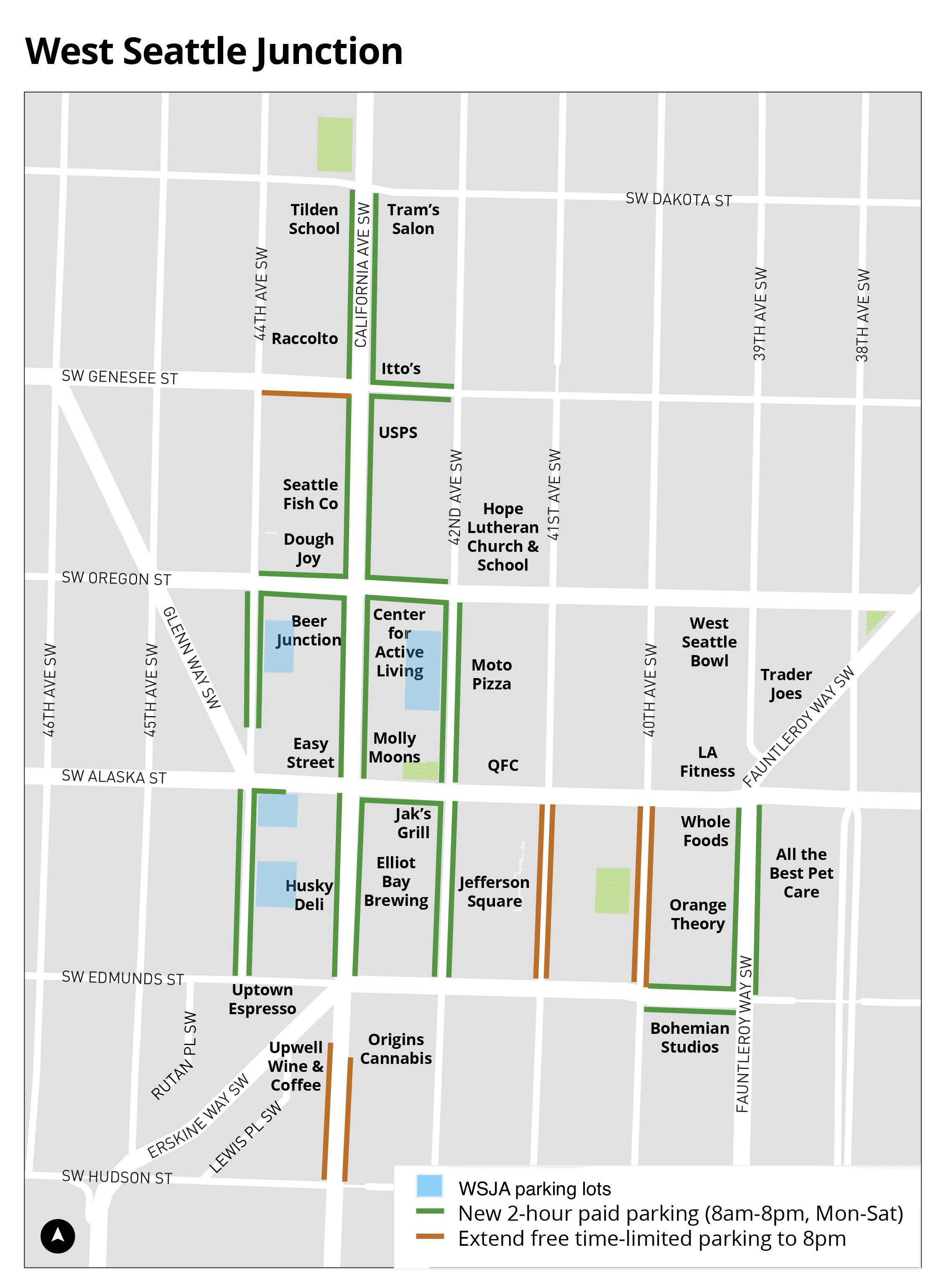
The West Seattle Junction parking is changing. The brown lines show where parking meters will be installed in 2027 and the blue boxes show the lots leased by the West Seattle Junction Association from the West Seattle Trusteed Partners.
Wed, 10/07/2026
A lease dispute over 281 paid parking spaces, new city meters and a wave of coming density could reshape how, and whether, customers reach West Seattle's business core
The future of parking in the West Seattle Junction is uncertain. The two organizations that control the district's off-street lots are at an impasse, and the city has now announced it will add parking meters to Junction streets, likely in 2027.
At the center of the dispute are 281 surface parking spaces. The landlord, West Seattle Trusteed Partners (WSTP), says it will not approve a $1 parking rate increase unless its sole tenant, the West Seattle Junction Association (WSJA), agrees to revise the 20-year lease signed in 2018 to allow the land to be developed.
SEE A LIST OF THE WEST SEATTLE JUNCTION ASSOCIATION MEMBERS HERE
Meters Divide the Junction
Opinions on the city's meter plan vary. Jack Miller, owner of Husky Deli and one of the Junction's longest-tenured merchants, is against it. "It's another thing they are taking away from us. It's going to hurt," he said.
WSJA Executive Director Chris Mackay disagrees. "I honestly feel strongly that this is the right thing for the Junction," she said. Mackay said employees and employers have told her that workers regularly park on California Avenue for hours at a time. "They figure it's worth the risk of getting a ticket," she said.
The top complaint in the city's outreach, she said, was a lack of parking. For a shopper making a quick stop at Paper Boat or Easy Street Records, "it's very challenging to find parking. And who wants to pay $4 for an hour in the paid lots when you just want a quick run in and out?" Meters, she said, will encourage turnover. "I can't imagine that 50 cents for 30 minutes is a deal breaker. It's the cheapest in the city. And the meters can take coins."
An informal WestsideSeattle social media poll found opposition above 80 percent to the question of whether readers favor meters, despite knowing they will likely increase turnover and make street parking easier to find.
WSTP President Joe Erickson said the meters could strengthen the organization's hand. "WSTP's lots are already heavily used, and paid on-street parking could make our lots even more competitive by eliminating the current choice between free street parking and paid off-street parking," he said. "It reinforces our view that parking will remain important to the Junction, even as we look at how our properties can evolve over time."
A History of Resistance
The Junction has fought paid street parking before. After meters were first installed in the late 1940s, local business and property owners formed WSTP in 1954. They bought land east and west of California Avenue SW for four free customer lots, making the Junction the only fully free parking and shopping district in the city. The approach made more sense after the free-parking Westwood Village mall opened in the 1960s.
Pushback eventually persuaded the city to remove street meters in favor of free, time-limited zones anchored by the merchant-funded lots. When the Seattle Department of Transportation tried to bring back pay stations between 2009 and 2011, resistance from business owners and residents forced the agency to shelve the plan.
The Money Behind the Standoff
The economics changed in the late 2010s, when the King County Assessor reappraised the land's "highest and best use," raising its valuation to more than $22 million and sending property taxes sharply higher. WSTP and WSJA introduced paid customer parking, short-term commercial leases on parts of the lots, and time limits to cover taxes and maintenance. Worth noting is that the Junction Association has a contractural agreement with Diamond Parking to administer the lots and collect payments. Diamond Parking has no ownership interest.
The lots now generate about $416,000 a year under a revenue agreement, but WSJA receives only half. It remains responsible for all property taxes, maintenance and operating costs, which total $365,355 a year. Even after Business Improvement Area assessments, WSJA says it absorbs an annual parking deficit of about $77,000. It has also had to hire private security in recent years to keep crime down also at considerable expense.
Erickson said that figure, while accurate, is misleading. "Historically, providing public parking was a considerably larger expense for the Junction Association. The introduction of paid parking fundamentally changed that equation," he said. "Parking now generates substantial revenue that is shared equally between WSJA and WSTP, significantly offsetting WSJA's parking-related expenses."
If WSJA wants parking to be self-supporting within its budget, Erickson said, "that's a legitimate budget objective to discuss, but it's different from saying that the cost of providing parking has increased. In fact, WSJA's net cost of providing parking has declined significantly since paid parking was introduced. Parking isn't creating the increased budget pressure; other priorities and spending decisions are."
Rates Tied to the Lease
The lease says parking rates are set by a joint parking committee with equal representation from both boards. That committee voted 4-0 for the $1 increase, but Erickson said the vote doesn't settle the matter. "The parking committee is advisory and does not have authority to approve a rate change. Under our Parking Operator agreement, any change in parking rates requires approval by both the WSTP and WSJA Boards of Directors before it can be implemented," he said.
WSTP's price for that approval is the lease changes. "The primary issue we are trying to resolve is WSTP's ability to redevelop its properties over time while continuing to provide meaningful public parking for the Junction," Erickson said. "We have proposed allowing development to occur one property at a time, maintaining substantial parking during the process, and reducing WSJA's rent and operating obligations as parking areas are removed from the lease. We believe the requested parking-rate increase and these longer-term lease issues should be resolved together rather than addressing rates in isolation."
Less Parking, More Housing
WSTP says it still wants to redevelop. "Higher interest rates and construction costs certainly affect the near-term economics and could influence the timing of a project, but they don't change our long-term view that these properties can contribute more to the Junction through a thoughtful mix of housing, commercial uses and public parking," Erickson said.
He acknowledged that parking would shrink. "We expect redevelopment would reduce the total number of parking spaces from today's 281 surface spaces, but our goal has never been to eliminate public parking. It is to preserve a meaningful amount of convenient public parking while putting these properties to better long-term use and helping the Junction grow." WSTP leaders have indicated the reduction could leave about 60 percent of today's spaces, or roughly 170.
Developers have been approached about the lots. Early discussions focused on replacing the 42nd Avenue SW lot with a multi-story mixed-use building of about 260 apartments plus retail. Those talks were exploratory, and any project would depend on multiple factors.
Erickson said construction would be staged to limit disruption. "Any redevelopment would need to be carefully phased—one property at a time—to minimize the temporary loss of parking during construction," he said. "We recognize that parking is important to Junction businesses and their customers."
Without a deal, WSJA could be forced to cut funding for neighborhood safety programs or even give up its parking leases entirely, which could open the lots to essentially unrestricted development.
Mackay explained, “The fundamental problem is that the Junction Association receives only half of the parking revenue while paying 100% of the expenses. Those costs continue to rise—by roughly $30,000 last year alone—and the current arrangement is no longer financially sustainable. We have asked WSTP to approve a reasonable rate increase so the lots can better support themselves, but they have declined several times. That leaves us in the very difficult position of asking our ratepayers to choose between continuing to subsidize the parking lots or maintaining critical services like security.”
Since the Seattle Police Department is still understaffed, security is a critical issue for the business district. That cost to the Junction Association for private secuity is $70,875 annually. Even they could not prevent or stop the recent robbery and beating of a 51 year old woman in the lot on 42nd SW or the $2 million smash and grab robbery of Menashe and sons Jewelers last year.
Beyond that, keeping the lots and district clean (meaning removing everything from garbage and graffiti to human waste) is costly too, totaling more than $80,000.
Today they face an approximate $11,000 deficit every month. A $1 rate increase in the WSTP controlled lots would cover all these expenses.
Pressure From Every Direction
The lot dispute is unfolding as the Junction's surroundings face change. Construction of the West Seattle light rail extension is now slated for completion by 2035, with no parking planned. Areas around the Junction are also being rezoned to allow much larger apartment buildings, which will bring more density and more competition for the same curb space.
Nearby residential streets are less of a refuge than they may appear. Restricted parking zone permits are required near the shopping area, but any household, from a studio apartment to a single-family house, can apply for four spaces and one guest space. Visitors without permits can park in an RPZ during the day within posted limits, usually two to four hours, and the restrictions often lift in the evening. Employees also commonly park in the neighborhood and move their cars when required.
Speaking on behalf of the WSTP Board Erickson said they want to be part of the solution. "We believe a successful Junction needs thriving local businesses, convenient access and parking, and the ability to evolve as West Seattle grows," he said. "We think thoughtful, phased redevelopment can add housing and commercial activity while preserving meaningful public parking and strengthening the customer base for Junction businesses. We want to work collaboratively with WSJA, the City, businesses and the community to find that balance."
