
Mayor Wilson vetoes controversial RV permit bill, pivoting to executive strategy and safe lot expansion
Rob Saka reverses his previous vote and appeared with the Mayor to express support
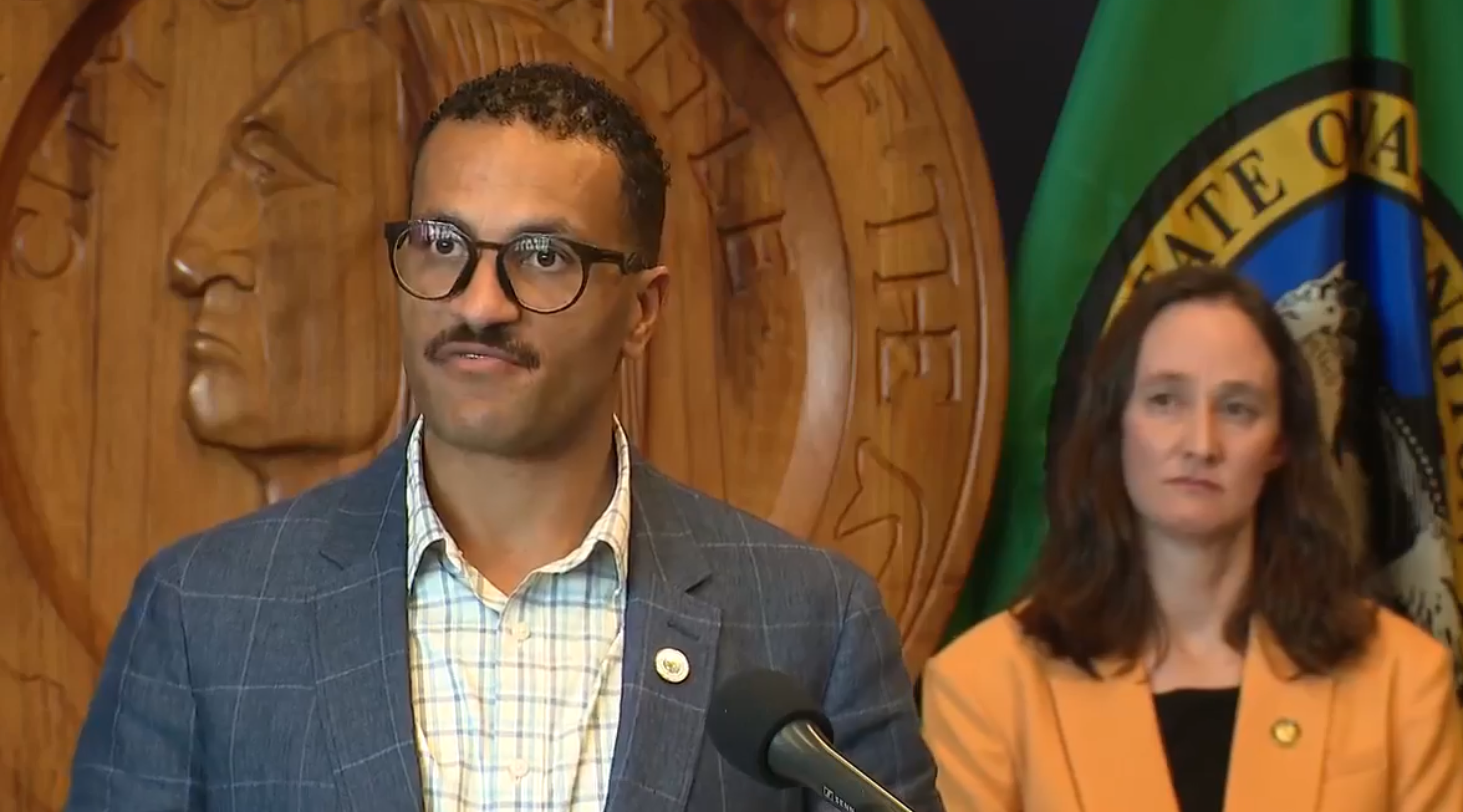
District 1 Seattle City Council member Rob Saka came out in support of Mayor Katie Wilson's veto of controversial RV safe lot legislation
Seattle Channel
Tue, 11/03/2026
Seattle Mayor Katie Wilson has vetoed Council Bill 121283, rejecting a controversial proposed permit program for recreational vehicles parked on city streets. While vetoing the permit framework, Wilson signed the remaining four ordinances in the city council’s five-bill legislative package and issued a sweeping Executive Order aimed at restructuring how Seattle handles vehicle residency, public safety, and shelter connections.
Speaking at a news conference alongside city department leaders, community advocates, and key council members, Wilson argued that the proposed permit program would establish a costly, inefficient bureaucracy without solving the operational and legal hurdles surrounding vehicle encampments. Instead, the mayor's executive action focuses on immediate investments in shelter—including the long-awaited opening of Glassyard Commons by the end of this month—paired with a 60-day interdepartmental working group to develop targeted policy and legislative remedies.
Mayor Wilson stated that her decision followed extensive consultations with city operational departments, where she evaluated the practicality and budget impact of standing up a brand-new permitting structure.
"As the mayor, it is my responsibility to ensure that our city policies and programs are feasible, are a cost-effective use of public resources, and have a reasonable likelihood of achieving their stated goals," Wilson said. "I vetoed this bill because I'm concerned that the permit program outlined in council bill 121283 does not meet that threshold, and I wanted to give the council an opportunity to consider an alternative pathway."
Wilson voiced deep concern that administering the permit framework would pull personnel away from core municipal duties and public safety functions, estimating that the council's proposed permit apparatus could cost upwards of $10 million in 2027.
"My concern with the permit program is partly that it's constructing a very complicated big new city bureaucracy to administer this permit program," Wilson explained during the press availability. "So my hope is that we can be much more surgical in the interventions we need to make in order to get better results."
The mayor also highlighted significant legal complications tied to impounding vehicles used as residences. "When someone is living in an RV, that RV is their personal property and any other property they have in or around the RV is their personal property," Wilson noted, emphasizing the complex constitutional and statutory protections involved when seizing inhabited vehicles.
Acknowledging that her position shifted late in the legislative timeline after initially indicating she did not plan to veto, Wilson framed her decision as a pragmatic response to operational realities.
"If the council sustains my veto, I commit to tackling our RV challenges from both ends in collaboration," Wilson promised. "On the one hand, we will smooth the path for homeless RV residents to access safe lots, shelter, and services. And on the other, we will focus on identifying the barriers to addressing the most problematic RVs on our city streets and overcoming them."
The veto marks a pivotal moment for members of the Seattle City Council who previously voted in favor of the permit bill, most notably District 1 Councilmember Rob Saka. Saka, whose district includes West Seattle and South Seattle, represents the geographic area with the highest concentration of problematic RVs in the city.
Addressing the media, Saka reaffirmed his motivation for voting in favor of the original five-bill package while signaling a willingness to give the mayor’s executive framework room to work.
"As the council member representing council district 1, I know firsthand the challenges associated with RV homelessness," Saka said. "My district has the highest concentration of problem RVs in Seattle. And I've heard directly from residents, small businesses, and families who are understandably frustrated and want meaningful action from the city, from our region, from the county, and from the state."
Saka defended his initial vote while explaining why he welcomes Mayor Wilson's executive alternative rather than seeking a legislative override.
"I voted in favor of the council's recent RV legislation because I believe the status quo is totally unacceptable. I stand by that vote and the urgent need for action that motivates it," Saka stated. "But I've also learned through my experience in public service that we achieve the best results when the executive branches and the legislative branches are aligned around a shared strategic approach."
Saka outlined three mandatory pillars that he insists must guide any long-term city policy on vehicle residency:
Saka confirmed he is willing to support the mayor's 60-day working group process, though he underscored that patience would depend strictly on tangible outcomes. "I'm prepared to give the mayor and her workgroup the time and space to develop their recommendations," Saka said. "But that patience must be matched with progress. Our residents deserve results, not just another process."
Central to Mayor Wilson’s executive order is an immediate push to expand vehicle shelter infrastructure, headlined by the opening of Glassyard Commons by the end of November.
Seattle Human Services Department (HSD) Director Tanya Kim revealed that the city has lacked an operational RV safe lot for over a year and a half, leaving outreach workers without viable placement options when contacting vehicle residents.
Glassyard Commons, located on state-owned property, will offer 92 spaces for vehicle residents. The facility will be operated by the Low Income Housing Institute (LIHI), with Therapeutic Health Services providing dedicated on-site behavioral health and supportive care.
"Glassyard Commons is coming online this month at the end of the month," Kim reported. "We have not had a safe lot for over a year and a half. So that means that when we have been engaging folks, we didn't have a place that was a realistic option for many who wanted to make sure that the home that they have is being taken care of while they are taking care of themselves."
Mayor Wilson directed HSD to immediately deploy 2026 funding to support Glassyard Commons and finance intensive outreach efforts. The executive order also instructs HSD to establish a citywide "by-name list" and conduct individual needs assessments for vehicle residents to facilitate tailored housing placements.
To expand capacity further, Director Kim noted that the city is accelerating plans to open a second safe lot in 2027, effectively doubling Seattle's safe lot capacity. Both Wilson and Kim emphasized that safe parking environments represent a temporary stabilizing step toward permanent housing rather than a final destination.
The veto drew praise from Councilmember Alexis Mercedes Rinck, who was one of the vocal votes against Council Bill 121283 during council deliberations. Rinck lauded Mayor Wilson for stepping in to block what she characterized as an unworkable and punitive policy.
Rinck illustrated the human stakes by describing a family she encountered in Georgetown who moved into a used RV following a sudden economic shock to keep their children enrolled at Maple Elementary School. Under the vetoed legislation, Rinck argued, families unable to register during a one-time census after July 31, 2027, would face immediate displacement.
"She is vetoing a permit program that is harmful, costly, and impossible to implement, one that won't deliver on what it promises," Rinck said of Mayor Wilson. "And she's issuing an executive order that will actually help move people out of RVs and into shelter and housing while addressing problematic and criminal activity."
Community and legal advocacy groups, including the ACLU of Washington and the Seattle King County Coalition on Homelessness, also rallied behind the veto. Hi Willis, Community Policy Manager for the Coalition, expressed gratitude to the mayor for heeding feedback from service providers and thousands of residents who wrote to City Hall opposing the permit ban.
Under the terms of Mayor Wilson's Executive Order, an interdepartmental working group—comprising representatives from the City Budget Office, Human Services Department, Seattle Police Department, Department of Transportation, Finance and Administrative Services, Seattle Public Utilities, and community service providers—will convene immediately.
SPD Deputy Chief Yvonne Underwood confirmed that police personnel and parking enforcement officers will actively participate in the working group, supporting safe lot referrals while maintaining investigations into criminal conduct linked to problematic vehicles.
The working group is directed to deliver initial policy and legal recommendations within 60 days. Mayor Wilson pledged to transmit any necessary enabling legislation resulting from the working group's findings to the City Council by March 31, 2027.
"Our goal is simple," Wilson concluded. "Better outcomes for people living in vehicles, fewer people living in vehicles over time, and cleaner, safer public spaces for everyone."

© 2025 Robinson Communications Inc. All Rights Reserved.