West Seattle businesses and residents push back against proposed Alaska Street traffic closure
West Seattle businesses and residents push back against proposed Alaska Street traffic closure
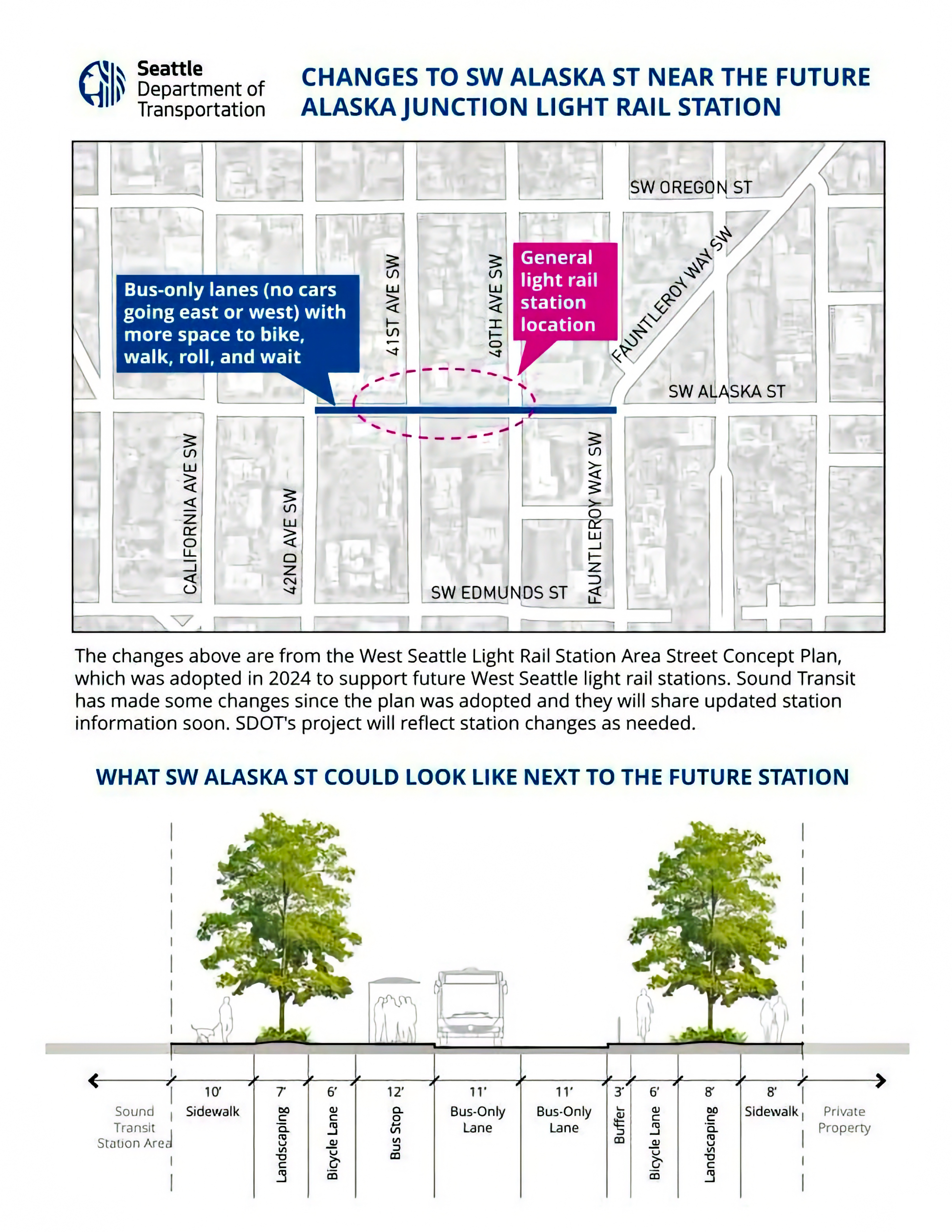
The proposed changes to SW Alaska Street between Fauntleroy Way SW and 42 nd Street SW to ready it for the eventual opening of the West Seattle Link Extension for Sound Transit are being met with strong opposition from both the public and the local business community.
To see a larger version of this graphic click here.
SDOT Graphic
Tue, 11/24/2026
A controversial proposal by the Seattle Department of Transportation (SDOT) to eliminate general vehicle traffic on portions of Southwest Alaska Street has met strong resistance from local neighborhood merchants and residents. Newly released survey data compiled by the West Seattle Junction Association (WSJA) reveals widespread opposition to the street closure, with a majority of community members and a clear majority of local business owners asking the city to reconsider the design.
The proposed redesign stems from long-term planning for Sound Transit's upcoming light rail extension to West Seattle. Under SDOT's current plan, portions of SW Alaska Street in the heart of the Junction commercial district would be closed to general through-traffic to prioritize dedicated bus lanes, protected bicycle facilities, and expanded sidewalk space. Under this configuration, general vehicular traffic approaching the Junction via Fauntleroy Way SW would be diverted onto SW Oregon Street or SW Edmunds Street.
Community Survey Reveals Divide on Access and Awareness
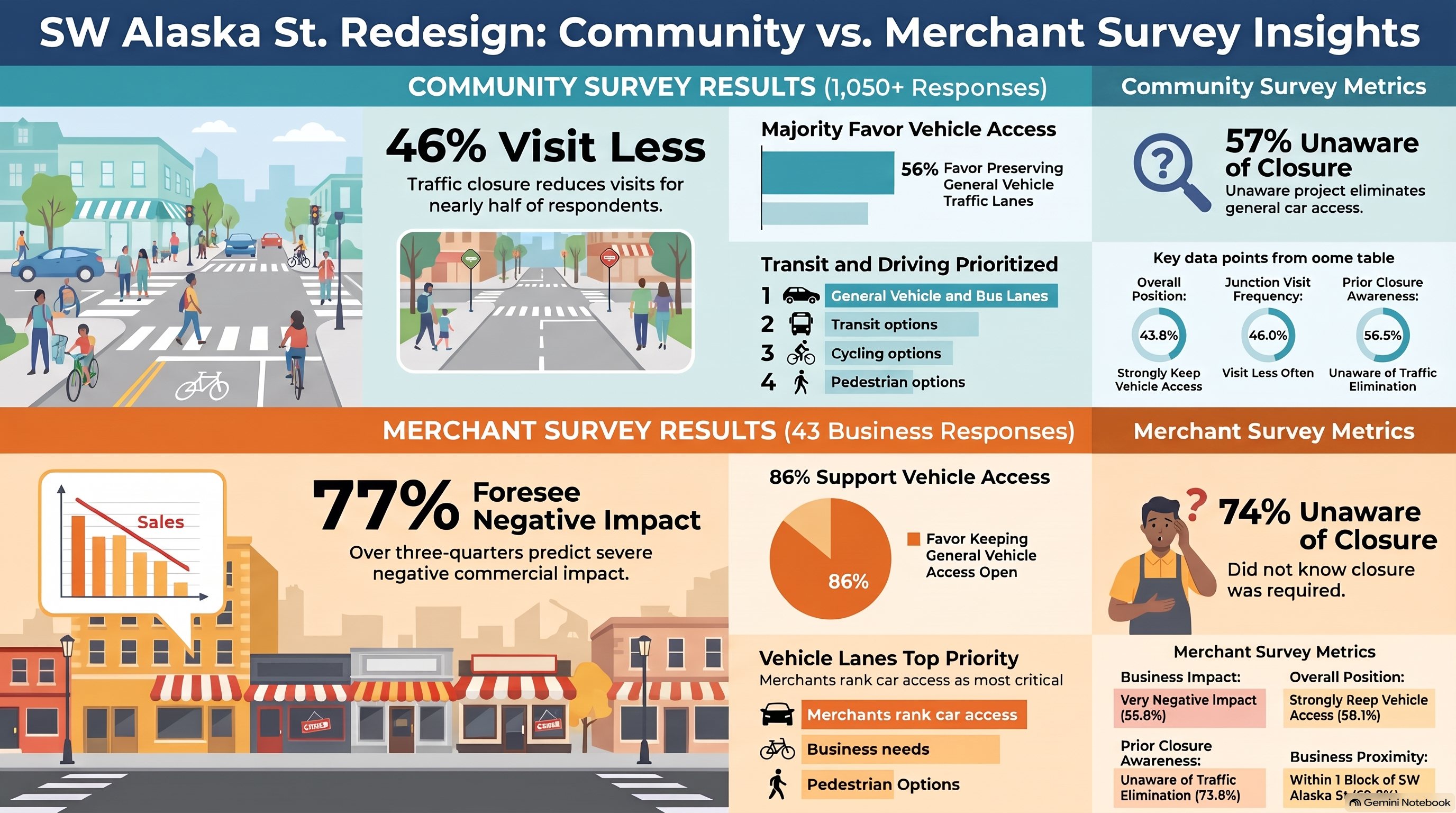
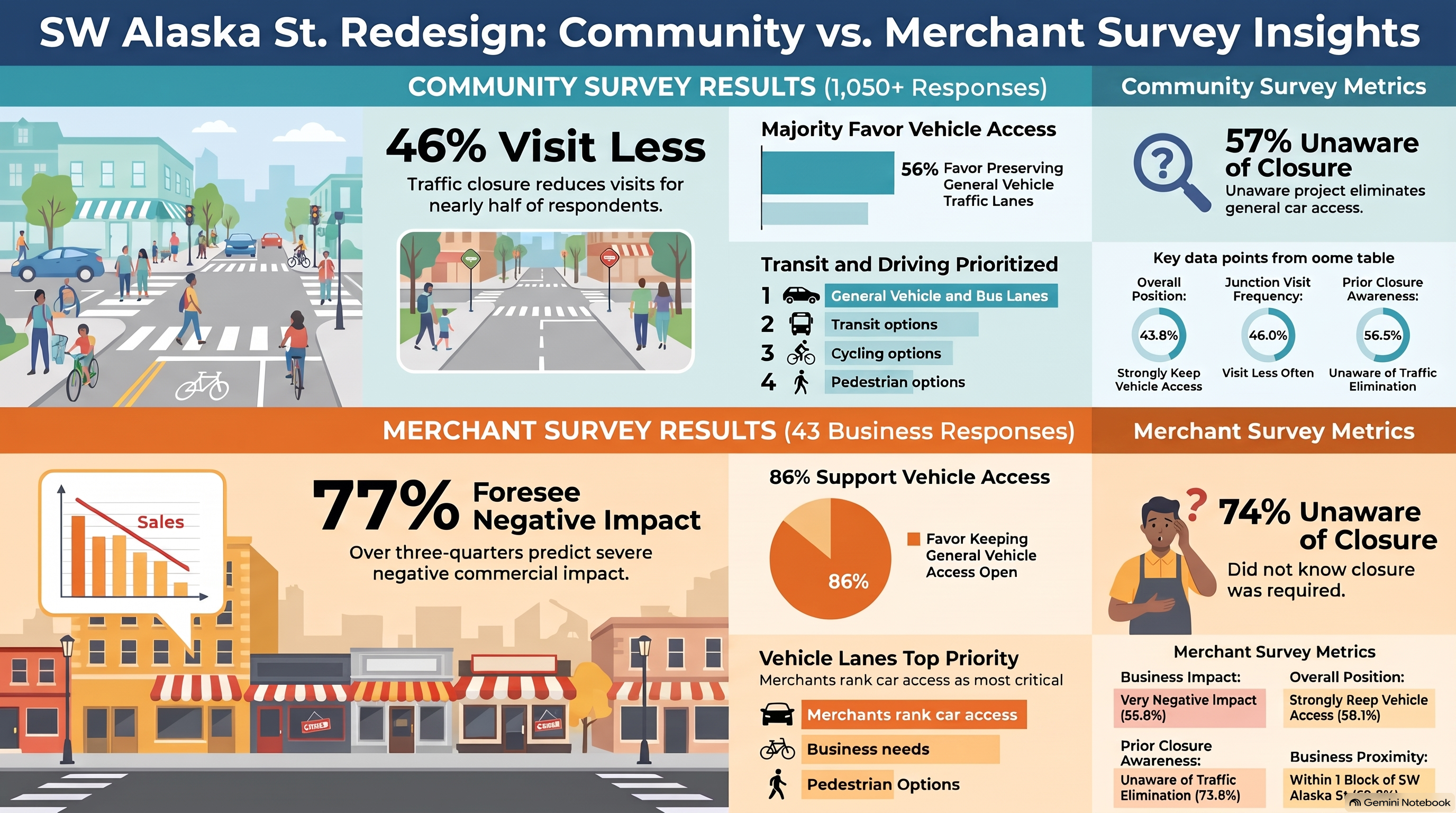
To measure public sentiment, the West Seattle Junction Association conducted a comprehensive survey of area residents and visitors, receiving 1,098 responses. The findings demonstrate significant concern about accessibility and neighborhood vitality.
According to the survey data, 56 percent of community respondents favor retaining general vehicle access on SW Alaska Street. Specifically, 43.7 percent strongly support keeping car access, while 12.1 percent support keeping access while remaining open to compromises. In contrast, 41.4 percent of respondents support eliminating general vehicle access (28.3 percent strongly support elimination and 13.1 percent support elimination).
The survey also highlighted potential changes in consumer behavior. When asked how the proposed street closure would affect their visitation habits, 46 percent of community respondents stated they would visit the West Seattle Junction less often. Only 30 percent indicated they would visit more frequently, while 20 percent reported their visitation frequency would remain about the same.
Additionally, 57 percent of community respondents indicated they were previously unaware that accommodating wider sidewalks, transit lanes, and bike lanes on SW Alaska Street would require the complete elimination of general vehicle traffic.
Merchants Warn of Severe Economic Consequences
Concerns are even more pronounced among business owners and managers in the Junction commercial core. A separate survey of 43 Junction merchants, representing retail, restaurant, professional service, and medical establishments, revealed near-unanimous alarm regarding the closure.
A striking 86 percent of merchant respondents favor retaining general vehicle access on SW Alaska Street. Furthermore, 77 percent of merchants anticipate that eliminating vehicle through-traffic will have a negative impact on their businesses, with 56 percent expecting a very negative effect. Only 11.6 percent anticipate a positive outcome.
Lack of prior outreach was another central finding. Nearly 74 percent of surveyed merchants reported that they were unaware the planned street improvements would come at the cost of general vehicle access. Nearly 80 percent of merchant respondents represent businesses located directly on SW Alaska Street or within one block of the corridor.
WSJA Calls on City Leadership and SDOT to Evaluate Alternatives
In formal correspondence addressed to Seattle City Councilmember Rob Saka, Councilmember Teresa Mosqueda, and SDOT Leadership, WSJA Executive Director Chris Mackay outlined the survey findings and urged city officials to pause the current plan.
Mackay emphasized that while the association supports safety, transit, and pedestrian enhancements, protecting the economic viability of neighborhood business districts must remain a central priority. The organization expressed specific concern regarding how neighboring streets, particularly SW Oregon Street and SW Edmunds Street, would handle diverted vehicle traffic, delivery trucks, and transit vehicles.
Because active construction for the street redesign is not expected to begin until Sound Transit completes its light rail station work, WSJA argues that ample time exists for the city to evaluate modified designs. The association is requesting that SDOT:
- Reopen consideration of the SW Alaska Street configuration to evaluate design alternatives that preserve general vehicle access alongside multimodal improvements.
- Conduct and publish detailed traffic diversion modeling for SW Oregon Street, SW Edmunds Street, Fauntleroy Way SW, and adjacent intersections.
- Perform a comprehensive economic impact assessment detailing the potential effects on local business revenues, parking, and freight deliveries.
- Engage directly with WSJA, local merchants, and neighborhood stakeholders in collaborative design workshops prior to finalizing street plans.
City officials have acknowledged receipt of the survey findings, and community leaders hope the data will prompt a meaningful dialogue before final engineering decisions are locked in.