
An international movement raising awareness of colon cancer has its roots in West Seattle
An international movement raising awareness of colon cancer has its roots in West Seattle
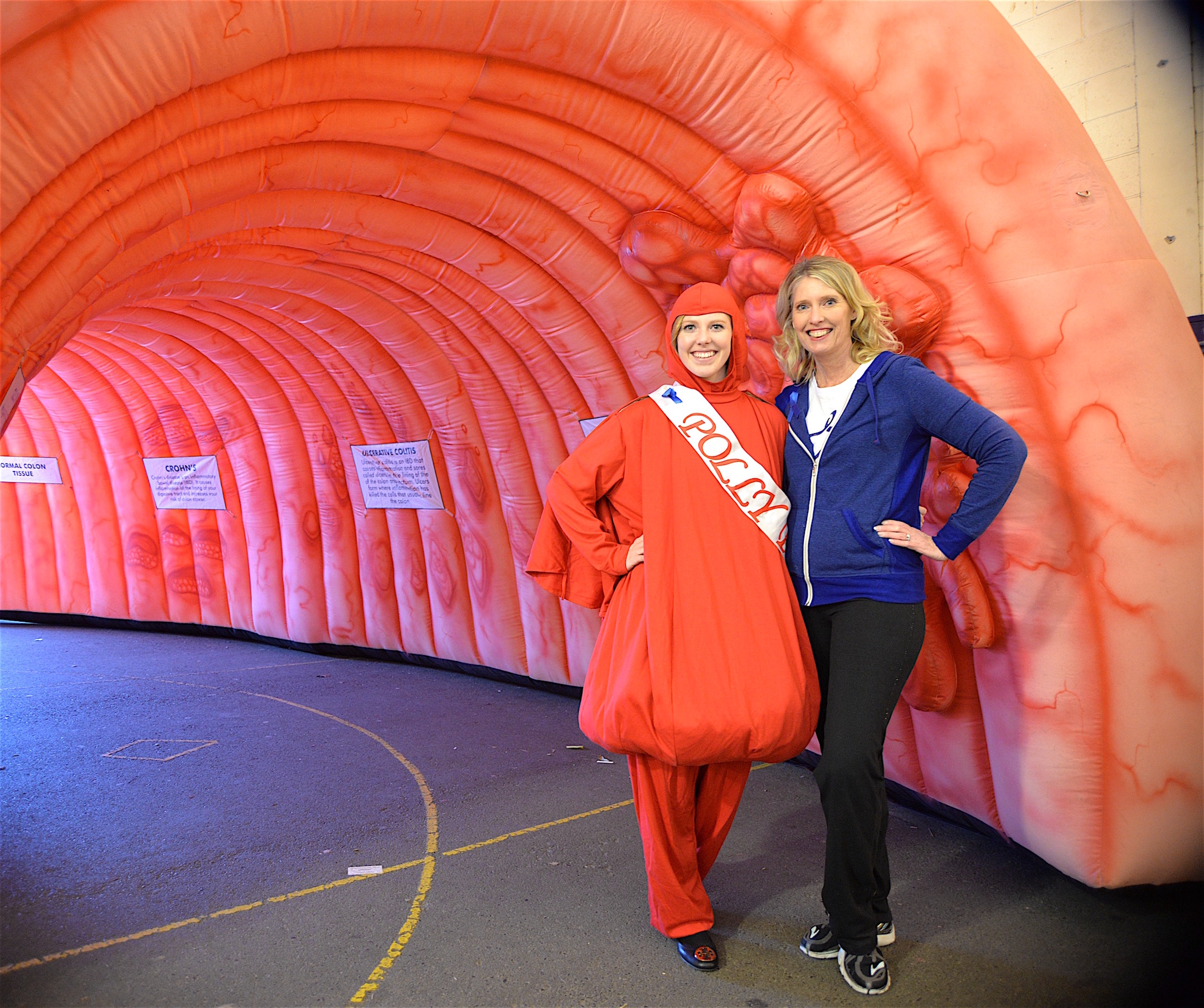
Anita Mitchell, right, an advocate for colon cancer prevention, still visits schools in West Seattle to spread the message. Last week, she visited Schmitz Park Elementary, where her daughter Emily Mitchell, left, now teaches second grade. The brought a giant inflatable colon for students and their parents to walk through as part of the educational experience.
Lindsay Peyton
Mon, 04/04/2016
By Lindsay Peyton
Anita Mitchell came out on top in her fight against the odds – and now she is sharing her story with anyone who will listen, with hopes that it will spring them into preventative action.
In 2005, Mitchell was living in the North Admiral area, a busy mother of three children – 9-year-old Alex, 12-year-old Emily and 13-year-old Madeline. She had little time to pay attention to her symptoms - gastrointestinal pain, diarrhea and an occasional bloody stool.
When conditions worsened, she finally made an appointment with her doctor.
“I was told I didn’t need a colonoscopy, because I was young,” Mitchell said.
But a closer look at her family history revealed that her father, who she thought had died of bone cancer, actually had colon cancer that spread throughout his body.
She demanded a colonoscopy this time – and received a diagnosis of stage IV colon cancer. She was 41 years old.
A surgeon removed more than a foot of Mitchell’s colon, 14 lymph nodes and one ovary. She began chemotherapy the next month, followed by another surgery to remove tumors and then more chemotherapy.
While Mitchell has been in remission for the past 10 years, she also has learned that she should have started screening much earlier.
“I should have been screened at 30,” she said. “In my case, it could have all been prevented with early screening.”
Mitchell felt called to spread the word about screening – encouraging those with a family history of colon cancer to sign up early and anyone 50 years and older to schedule colonoscopies as part of routine health checks.
Following the success of the color pink in raising awareness of breast cancer. She thought that drawing attention to the cause through the color blue would be a first step.
Mitchell went to her children’s school, Holy Rosary, and asked for permission to start a Dress in Blue Day for Colon Cancer Awareness on campus.
“I had to push a little,” she said. “I said this cancer is one of the few we can prevent with early screening. We’re just not educated about it. It’s really common, but people don’t talk about it.”
After a successful first event in 2006, Mitchell started Dress in Blue Day at other schools and businesses in West Seattle and in her hometown of Port Angeles.
“It started locally – just a soccer mom at a school,” Mitchell said. “It just kept growing. Now it’s a nationally recognized program.”
Now Dress in Blue Day for Colon Cancer Awareness Day is held on the first Friday in March around the world.
Mitchell became a member of the Washington Comprehensive Colon Cancer Task Force, Washington State Survivorship and the End of Life and Palliative Care Committee.
She has also been recognized for her work by several organizations, receiving the Laurel of Advocacy from the Prevent Cancer Foundation, a leadership award from Colon Cancer Alliance, Gilda’s Club Snapshot of Survival and Seattle Rotary’s Self Above Service award.
Michael Sapienza, CEO of the Colon Cancer Alliance, clearly recalls meeting Mitchell for the first time.
“I was struck by her tremendous passion, her drive and her caring nature,” he said. “She is such a cheerleader for others – and she is not only a ray, but an entire splash, of hope to patients all around the country.”
He said that her creativity has made Dress in Blue a success.
“This has turned into a phenomenon,” he said. “That all started with one person. It’s incredible. Anita has done such a huge thing – not just in Washington state and Seattle, but across the country.”
In 2008, Mitchell started the nonprofit Colon Cancer Stars, with a mission to save lives through education. The nonprofit distributes screening cards that list symptoms in English and Spanish, provides speakers to area events and connects individuals with a colon cancer diagnosis to a support group.
“People want to talk to someone who has gone through what they are going through,” Mitchell said. “It gives them hope.”
Her main goal remains making people aware of the importance of screening. “There’s a false sense of security,” she said. “The problem is you usually don’t have symptoms. You don’t know if you have polyps. You can’t feel them.”
If polyps are found early, they can be removed and the early stages of cancer can be fought.
“If you find it early, it’s 90 percent curable,” Mitchell said. “The problem is most people don’t find it early.”
She still visits schools in West Seattle to spread the message – even though she moved to Woodinville about a year ago. Last week, she visited Schmitz Park Elementary, where her daughter Emily Mitchell now teaches second grade.
Mitchell hopes that the children will encourage their parents to get screenings.
“They go home and spread the word,” she said. “I would like to see this grow around the country – and I think it will. I still have a long way to go.”
For more information, visit http://colonstars.org.
