
Sound Transit Executive briefs West Seattle Chamber on streamlined link extension plans
Sound Transit Executive briefs West Seattle Chamber on streamlined link extension plans

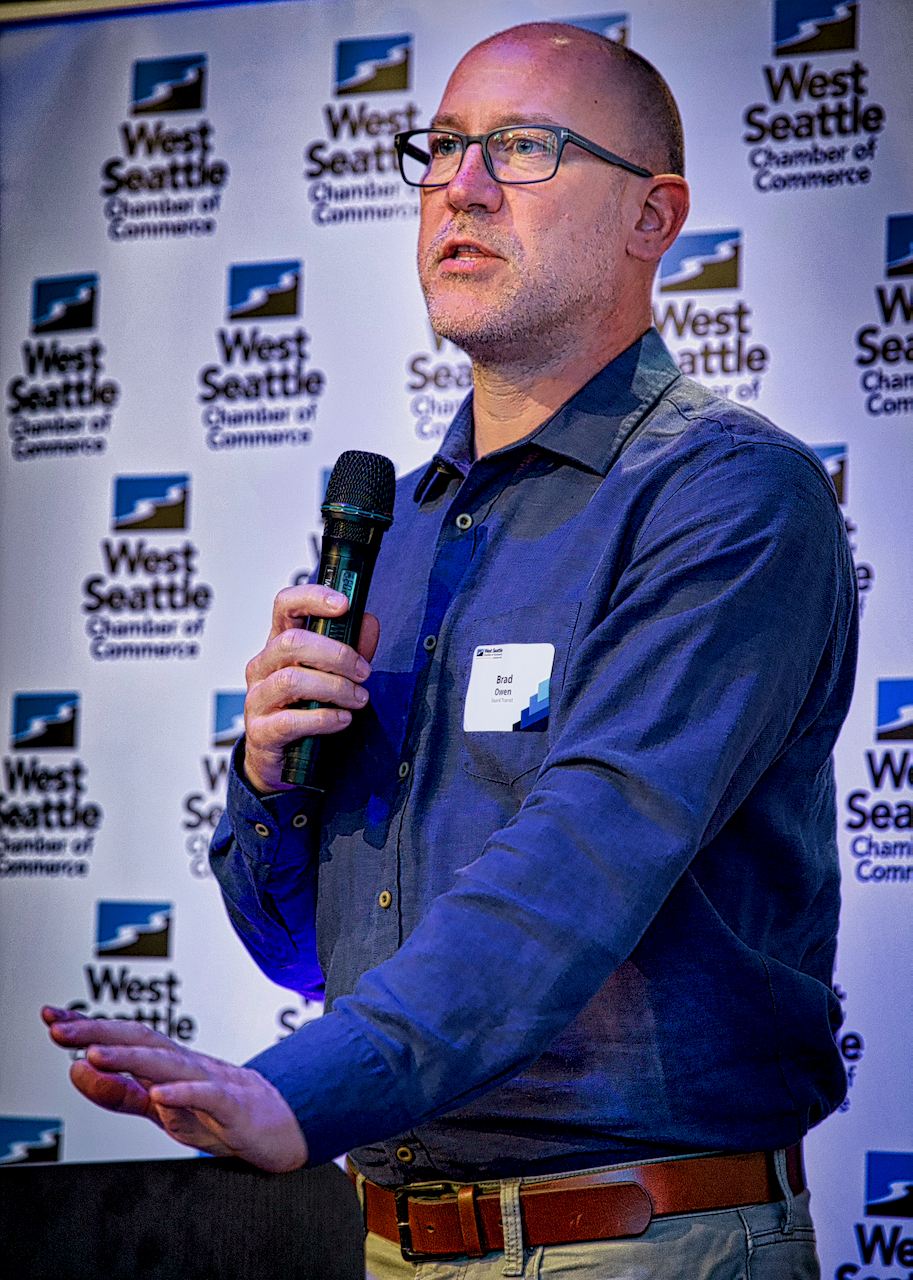
Brad Owen, Sound Transit’s Executive Director for Capital Delivery, addressed the West Seattle Chamber of Commerce on April 8 as part of their efforts to do community outreach prior to the start of construction which could begin, first as drilling bore holes, in the 90 days following board approval.
Photo by Patrick Robinson
Wed, 04/08/2026
Brad Owen, Sound Transit’s Executive Director for Capital Delivery, addressed the West Seattle Chamber of Commerce on April 8 to outline significant design refinements intended to close a massive funding gap and move the West Seattle Link Extension (WSLE) toward construction. Owen described the agency's recent efforts as a "cost work plan" exercise to "build a better mousetrap," successfully bringing the project’s estimated cost down from over $7 billion to a range of $4.9 to $5.3 billion. (See WestsideSeattle's previous coverage here)
Significant Design Refinements
The cost-saving measures involve several high-profile changes, most notably the elimination of the Avalon Station. Owen explained that removing this station "unlocks a lot of opportunity," including shifting the Delridge Station and guideway north to avoid displacing a local health club and reducing environmental impacts on Longfellow Creek.
In the Alaska Junction, the station has been redesigned to be roughly 20 feet shallower than originally planned. By removing underground "tail tracks" and moving the track crossover to the front of the station, Sound Transit has significantly reduced the need for property acquisitions, including preserving Jefferson Square. This shallower design also allows for "direct-to-platform" access via a single elevator or set of stairs.
Community Concerns: Parking, Displacement, and Vibration
During the Q&A session, local business leaders and residents raised concerns about the project's local impact:
- Parking: Owen clarified that Sound Transit does not build parking as part of the light rail system in Seattle, stating it is a city responsibility, though they are working with King County Metro on "hub and spoke" bus connections.
- Displacement: Attendees noted the potential loss of the Alki Beach Academy, a major childcare center. Owen acknowledged the "disruption and displacement is the hardest part," promising to work with property owners to minimize burdens during transitions.
- Tunnels: Addressing fears about noise and vibration for homes above the 35-foot-deep tunnel, Owen stated that modern Tunnel Boring Machines (TBMs) and absorbing materials mean residents likely "would not know it" was there once built.
Emergency Safety: A Deeper Look at Egress
When asked how passengers would escape the 4,400-foot tunnel or the high bridge over the Duwamish in an emergency, Owen provided a generalized overview, noting the presence of walkways and comparing the system to the SR 99 tunnel.
However, detailed safety protocols reveal a more comprehensive three-tier approach to evacuations:
- Rescue Trains: The preferred method for elevated guideways and bridges is to send a rescue train to couple with the disabled vehicle and pull it to the nearest station.
- Continuous Walkways: Tunnels and many elevated segments include lighted, signed evacuation walkways. If a train cannot be moved, the Operations Control Center (OCC) cuts power to the overhead wires, and passengers are escorted along these paths to the nearest emergency exit or cross-passage.
- Fire Department Intervention: In rare cases where walkways are unusable, the Seattle Fire Department (SFD) takes command, utilizing aerial ladder trucks, portable stair towers, or rope-assisted systems to reach passengers on high guideways.
Owen concluded by noting that the Sound Transit Board is expected to take action on these refinements in May or June, which would trigger the beginning of property acquisitions and construction contracts.
