
Seattle City Council unveils comprehensive six-piece legislative package to regulate RVs and support vehicle residents
Seattle City Council unveils comprehensive six-piece legislative package to regulate RVs and support vehicle residents
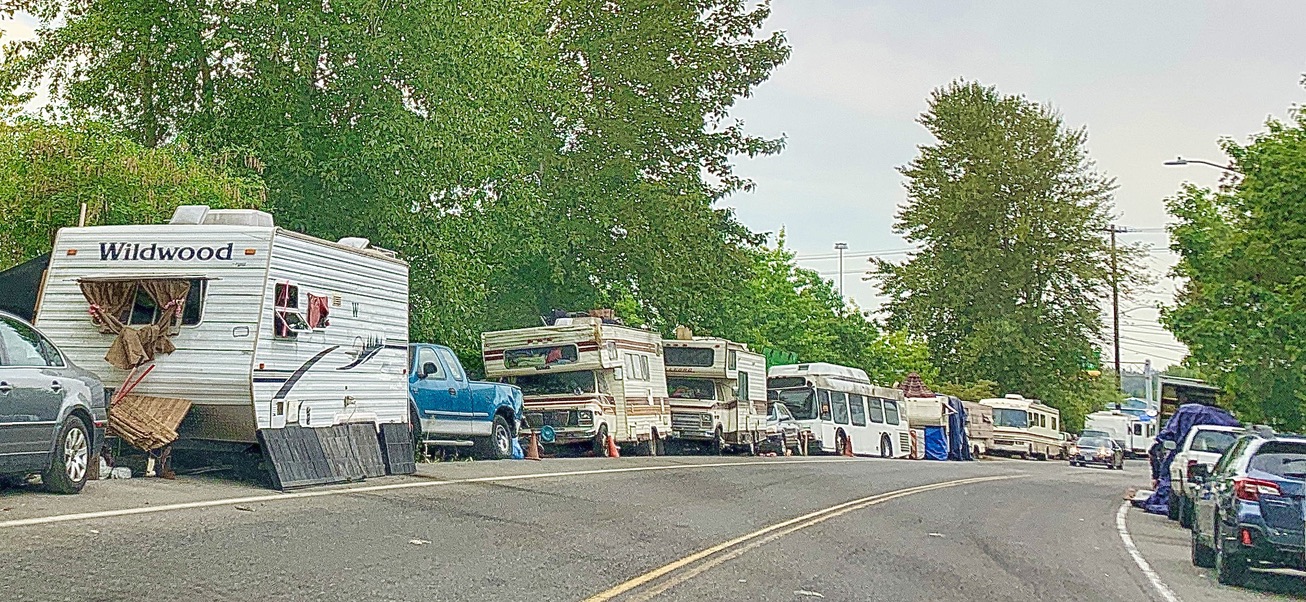
RV's and homelessness were the subject of potential legislation introduced in the Seattle City Council meeting on August 11.
File photo from 2021 by Patrick Robinson
Tue, 08/11/2026
In an informational session on August 11, the Seattle City Council previewed a sweeping new legislative package aimed at rewriting how the city manages vehicle residency and recreational vehicles (RVs). Developed by Council Member Dan Strauss in cooperation with council central staff, the six draft bills represent a coordinated attempt to establish dedicated pathways to housing while implementing strict new overnight parking regulations.
The package was presented as an informational item only and was not formally introduced or debated. It is scheduled to be officially placed on the council’s August 18 introduction and referral calendar, with a public hearing, discussion, and potential vote slated for the Public Safety Committee on September 22.
Addressing a "Failing" System
In his opening remarks, Council Member Strauss emphasized that Seattle’s current approach to vehicle residency is not working. "Today there are no dedicated city teams focused on helping people who live in their vehicles," Strauss said, noting that the city currently has "zero safe lots open" and "zero services available" to help vehicle residents transition into housing while storing their vehicles.
How Other U.S. Cities Are Regulating RV Residency: A Comparison to Seattle’s New Six‑Bill Proposal
As Seattle prepares to introduce a sweeping six‑bill package aimed at reshaping how the city manages RV residency, it joins a growing number of U.S. cities grappling with the same challenge: balancing compassion for vehicle residents with neighborhood livability, public safety, and infrastructure limits. While Seattle’s proposal is unusually comprehensive—combining strict parking limits, a new permit system, expanded leasing authority, and updated junk‑vehicle rules—many of its core elements mirror policies already in place elsewhere.
Overnight RV Parking Bans and Time Limits
Seattle’s plan to impose a citywide midnight–6 a.m. RV parking ban and a two‑hour daytime limit echoes measures adopted in several West Coast cities.
Los Angeles enforces widespread “No Oversize Vehicle Parking” zones, many of which prohibit overnight RV parking on residential streets.
San Diego bans overnight RV parking citywide unless a resident obtains a permit, with strict enforcement in coastal neighborhoods.
San Francisco uses targeted RV restrictions and 72‑hour movement requirements to prevent long‑term street camping.
Seattle’s proposed citywide approach is broader than most, though the enforcement model is similar.
Permit Programs and Safe Parking Systems
The centerpiece of Seattle’s package—the Vehicle Resident Assistance Permit—resembles permit‑based safe‑parking systems already operating in other cities.
Santa Barbara runs one of the nation’s oldest safe‑parking programs, offering designated lots and case management for vehicle residents.
San Diego requires permits for overnight stays in safe lots and ties participation to housing navigation services.
Los Angeles uses a similar model, linking safe‑parking access to outreach and caseworker engagement.
Seattle’s proposal is more restrictive than most—particularly its one‑time census, one‑permit‑per‑person rule, and automatic revocation after six shelter refusals.
Industrial‑Zone Concentration
Seattle’s plan to limit overnight RV parking to industrial zones mirrors a trend seen in cities attempting to reduce residential impacts.
Oakland has concentrated RV “managed areas” almost exclusively in industrial districts.
Los Angeles designates industrial corridors as preferred locations for RV parking under certain ordinances.
Denver places most safe‑parking sites in industrial zones due to zoning constraints.
Seattle’s council has already raised concerns about geographic equity—an issue that has surfaced in these other cities as well.
Expanded Authority to Lease Large Parcels
Seattle’s proposal to expand the Finance and Administrative Services director’s leasing authority for safe lots and storage sites aligns with actions taken in cities facing large vehicle‑resident populations.
San Jose expanded its authority to lease large parcels for RV safe parking and transitional sites.
Los Angeles granted emergency powers to lease land for safe‑parking lots and tiny‑home villages.
Phoenix increased its ability to lease large parcels for heat‑respite vehicle sites.
Seattle’s proposed 100,000‑square‑foot threshold is among the largest in the country.
Updated Junk‑Vehicle Definitions
Seattle’s plan to tighten junk‑vehicle definitions—while exempting permitted RVs—reflects a growing effort to distinguish between derelict vehicles and those used as shelter.
Portland updated its abandoned‑vehicle criteria and exempted vehicles enrolled in safe‑parking programs.
San Francisco revised its definitions to target derelict RVs while protecting those in homelessness programs.
Denver adopted similar reforms to reduce towing of inhabited vehicles.
Seattle’s exemption for permitted RVs is consistent with national best practices.
Funding and Outreach Staffing
Seattle’s plan to allocate $5 million, create eight new positions, and expand outreach capacity parallels investments made in cities with large vehicle‑resident populations.
Los Angeles funds specialized RV outreach teams and caseworker staffing.
San Diego dedicates funding to outreach tied to safe‑parking programs.
Houston uses multi‑agency funding to support outreach to vehicle residents.
Seattle’s emphasis on lowering caseworker‑to‑client ratios is in line with national trends.
Addressing “RV Ranching”
Seattle’s concern about predatory RV rentals—sometimes called “RV ranching”—is shared by other cities.
Los Angeles has cracked down on individuals placing multiple derelict RVs on streets for rental.
Oakland enforces against multi‑RV clusters used for illicit rentals.
San Francisco targets RV clusters associated with predatory rental practices.
Seattle’s one‑permit‑per‑owner rule is a common anti‑abuse mechanism.
Conclusion
Seattle’s six‑bill package is one of the most comprehensive RV‑residency reforms proposed by any major U.S. city. While many of its components—overnight bans, permit systems, industrial‑zone concentration, expanded leasing authority, junk‑vehicle updates, and outreach funding—mirror policies already in place elsewhere, Seattle’s combination of strict parking limits, a closed permit program, and a one‑time eligibility census sets it apart.
As the legislation moves toward formal introduction and public hearing, Seattle joins a national conversation about how cities can support vehicle residents while maintaining safe, accessible neighborhoods.
Strauss stated that the legislation aims to ensure people living in vehicles are cared for and have a clear road to housing, while also addressing a "small minority" of RV owners who do not move their vehicles every 72 hours or act as decent neighbors.
The Core: A New Permit Program and Parking Limits
At the heart of the package is the Vehicle Resident Assistance Permit Program, which focuses specifically on motor homes and travel trailers wider than 80 inches.
Starting April 30, 2027, the city would establish general parking restrictions on these vehicles, limiting them to a maximum of two hours of parking in all areas of the city and prohibiting parking entirely between midnight and 6:00 a.m..
To bypass these strict limits, eligible residents could apply for a Vehicle Residence Assistance Permit. This permit would allow vehicles to park for up to 72 hours and park overnight in designated industrial zones. Key details of the permit program include:
- One-Time Census: The Human Services Department (HSD) would conduct a one-time census to establish a list of eligible individuals and vehicles. The program would be closed to latecomers.
- Strict Limits: Only one permit would be allowed per person, and the applicant must be the registered owner of the vehicle.
- Revocation Policy: The permit would be automatically revoked if a holder turns down six consecutive offers of shelter.
- Enforcement: The Seattle Police Department's parking enforcement division would handle enforcement. After the rules take effect on April 30, 2027, the city would issue warnings for 90 days before full parking enforcement begins on July 31, 2027.
Updating Land Use, Leasing, and "Junk" Rules
The package includes five additional bills designed to support the permit program:
- Land Use Definitions: A land use bill would update Title 23 of the city code to clarify that RVs can be self-propelled or towed, and would adjust the definition of "flexible use parking" to exclude RV storage.
- Expanded Leasing Authority: The Director of Finance and Administrative Services (FAS) would see their leasing authority expanded. Currently capped at 65,000 square feet, the director would be authorized to lease sites up to 100,000 square feet without council approval for outdoor vehicle storage, transitional encampments (safe lots), or overnight driver respite areas.
- Junk Vehicle Clarifications: The traffic code's definition of a "junk vehicle" would be updated to clarify terms like "extensively damaged" or "apparently inoperable," and would add new criteria such as missing license plates or unreadable Vehicle Identification Numbers (VINs). Crucially, any vehicle holding an active assistance permit would be exempt from the standard impoundment rules applied to other junk vehicles.
Reallocating $5 Million in Funding
To fund the initiative, the package relies on an existing, uncommitted $5 million in 2026 funding earmarked for RV and vehicle-related work within HSD. The appropriations bill would:
- Create eight new city positions, including one permit technician in the Seattle Department of Transportation (SDOT) and seven outreach counselors in HSD.
- Transfer $216,000 from HSD to SDOT for IT and staffing costs.
- Restrict $2 million specifically for contracted service providers conducting outreach to vehicle residents, with funds allocated for capacity building, increasing staff, and lowering caseworker-to-client ratios.
Council Members Raise Early Concerns
Though the package was not debated at length, council members raised several immediate questions regarding implementation:
- Geographic Equity: The Council Vice Chair raised concerns about "concentration risk," pointing out that restricting permitted RVs to industrial zones could disproportionately concentrate them in specific neighborhoods like Ballard-Interbay and the Duwamish. Central staff admitted they have not yet conducted a geographic equity analysis and expressed uncertainty about whether sufficient data exists to track where these vehicles are currently parked.
- Jurisdictional Gaps: Questions were raised about whether the parking bans would apply to non-right-of-way city properties, such as parks, green belts, or utility substations. Staff clarified that while SDOT governs the right-of-way (including park boulevards), other properties like utility substations or parks would fall under the security and management of their respective departments.
- "RV Ranching": The Vice Chair questioned how the legislation would handle "predatory RV rentals" or "RV ranching"—where individuals repeatedly place multiple damaged RVs in the right-of-way to rent to vulnerable populations. Staff responded that while the bill does not directly address this, restricting permits to one per registered owner would help curb the practice, and unpermitted vehicles would remain subject to towing without notice.
- Exemptions: Staff confirmed that because the rules only apply to travel trailers and motor homes wider than 80 inches, smaller vehicles such as modified vans or truck-cap conversions would not be covered.
With the package set for formal introduction next week, the city will begin unpacking these issues leading up to the public hearing and committee vote in late September
